

Review
by Bamboo Dong,Fruits Basket
DVD 3: Puddles Of Memories
| Review: | ||||||||
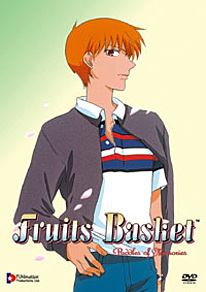
A tear-streaked desk, a crumpled pillow, a soggy stuffed kitten, and Puddles of Memories—the items in the list may seem like random components of a sad movie, but some viewers will understand that these objects, or derivatives of them, often go hand in hand. A show mixing in a dash of comedy, a bit of wisdom, a pinch of cuteness, and a whole lot of grief, Fruits Basket is easily one of the most enjoyable shows to be released this year. With seven episodes gracing the third disc in the four volume series, Funimation marks the second half of the series with more of the same packaging finesse that they carried for the first two DVDs. Not only are the seven episodes being retailed at a very approachable price, but the disc comes full of great extras that were seen in the original Japanese release. Amongst the more common ones is a page of character profile, giving brief descriptions about the main characters and also a few of the side characters that pop up. There's also the requisite textless opening song that appears on most DVDs, but with such a sweet theme, it certainly doesn't hurt to have the song appear in more places. What's especially a joy is a special feature entitled “Fruits Basket Room #2.” This turns out to be an interview of Tomokazu Seki (the voice of Kyo) conducted byYui Horie, the lady who gives voice to Honda Tohru. This rather lengthy extra gives some insight into Tomokazu's personality and his thoughts on Fruits Basket. It also does a magnificent job of entertaining viewers with funny anecdotes, character impressions, and just other miscellaneous oddities that the two actors spout off. If that wasn't enough, there's also an extra that shows a gallery of all of the “Ka-ching Eye Catches” that are used from episodes 13 to 26, narrated once again by Horie Yui. This actually proves to be very amusing and fascinating, especially since the eye catches swipe too fast during the series to really see clearly. With the colorful commentary by Horie (“Those are bandages! Not toilet paper!!!”), the gallery is able to provide viewers with an odd assortment of useless information and just plain amusement. With such a packed DVD, Funimation is showing how impressive they can be and frankly, they do a wonderful job of showing off.
Even if the disc had been devoid of any extras, though, just the episodes themselves would have been a powerful incentive to buy the DVD. Packing an emotionally charged story, laced with carefully plotted out character development, Fruits Basket embodies all that could be sweet and earnest and places it into a shoujo series strong enough to blow away all other competitors. As the series continues, more characters from the Zodiac are introduced, including Ayame the snake, and an absolutely adorable tiger, which ends up being a girl named Kisa. This addition of characters and the smooth way that it is handled is one of the magnificent points of Fruits Basket. While the list of characters in the series is quite long and still rapidly growing, series director Akitarō Daichi receives strong help from Natsuki Takaya's original manga in keeping all of the players separate and easily distinguishable. Each of the characters is given a distinct look and a unique personality, with their background exposition revealed to show their emotional history and quirks as well. Through Tohru's endearing stream-of-consciousness prattle and willingness to help each Sohma's personal problems, the inner secrets and depth of personality of each character is developed and strengthened in a time frame as quick as one episode. Viewers are able to not only keep track of the separate characters better, but also come away with the distinct feeling that they've known the characters for a good portion of their lives. Emotional weaknesses like insecurities and fears are naturally revealed—information which usually doesn't become known until knowing a person (especially one as distanced as any of the Sohmas) for several months or years. This measure of intimacy and trust allows viewers to feel much closer to the characters, feeling their pains and lavishing their happiness. Because viewers can feel close to all of the characters, or at least understand the way their minds function, the emotional scenes are given an added impact. It is without a doubt that Fruits Basket possesses a great sense of humor, varying from slapstick comedy, to perverted comments, to scenes that just seem to parody the entire shoujo genre (like pastel cherry blossoms and sparkly hair), but its real strength lies in the ability to portray feelings of sorrow and heartbreak. After viewers are imparted with the feeling that they truly know all of the characters, certain scenes will intercede to slap the audience with the reality that what they know doesn't even scratch the surface of all the misery that the characters have experienced. The heart-wrenching stories pour so nonchalantly from the stoic Sohma characters that it's this indifference and acclimation to pain that really turns the knife in the viewer's heart. Adding to that is the way that the other characters in the scene react. For instance, Tohru is notorious in the series for being happy and cheerful even in times of great taxation. When she does break down and cry, viewers are pulled into the same puddle of sorrow, caught with the thought that “Tohru's crying? She never cries; why is she crying? This must be really ridiculously sad.” Coupled with the expressive facial expressions and the lyrical music, the sad scenes are enhanced to the point that some viewers might feel their heart start to throb and their eyes start to leak. Although the characters' faces may help enhance the sad scenes with their expressive eyes and placid brows, the artwork doesn't have much impact by itself. In fact, much of the art in the series works perfectly in the show's context, but other than that is rather mediocre. The character design offers a broad range of bishounen that for the most part look either like movie stars or girls, complete with odd fanservice (if you could describe it as such) shots of some of the men dressed in women's clothing. The one downside is that the characters aren't entirely consistent throughout the disc, having some shots of them with longer faces, or bigger eyes, or what not. Both the foreground and background art lack details, but with the simplicity of the series, this perhaps works better than if the screen had been more busy. One amusing aspect of the series, though, is the variety of ways it presents the scenes. In addition to the “normal” animation, there are cartoonish sketches, pastel stills, and white caricature cutouts—much like the diversity in animation that is used in series like Kareshi Kanojo no Jijou. Although this is used to make the goofy scenes more funny (or save money in the animation budget), it works well with the scenes, often upholding a pattern of sorts by having certain animation types appear around certain characters. Other than these burst of creativity, however, the animation lacks in fluidity. The characters' movements appear a bit chunky, but with the powerful words coming out of their mouths, this otherwise glaring aspect of the show hardly matters. While the visuals may be mediocre, though, the acting certainly isn't. In fact, if there was one thing that was stellar about the show's non-story aspects, it was the Japanese voice acting. Tohru's innocent nature is portrayed perfectly by the gentle voice of Horie, and the different Sohmas' characters are dynamically presented by the equally talented actors. Whether playing characters that are coldly stoic, utterly flamboyant, or just plain silly, the characters burst with life and ooze with emotion. As for the English dub, it was well done, but there were parts of it that could have been massively improved. The voices were rather poorly cast, with Tohru uttering Valley Girl-isms that aren't anywhere in her original character whatsoever, or boys being voiced by middle aged women that sound like middle aged women. It just didn't have the same idyllic, good-hearted passion that was in the original Japanese version, which is a shame. Luckily, the translation was done rather well, although certain lines were replaced with distinctive Americanisms like regional slang and crude language where there originally was none. Fruits Basket is a show that can be enjoyed by everyone who is willing to let down their guard and feel the raw emotions pouring out of the screen. The dialogue is powerful and combined with the heart-wrenching atmosphere of certain scenes, can produce a dramatic effect. Coming from a person who has never shed a single tear during an anime series or movie, and was sniveling and aching midway through the disc, the guarantee can be made that the series certainly has the power to drag out latent emotions in almost everyone, allowing them to feel Tohru's pain seep through the screen and jab them in the chest. With just the right balance of comedy and sorrow, Fruits Basket is a captivating series that will grab hold of your heart and Never Let Go. Do yourself a favor and buy this DVD; it's hard to imagine that you would ever regret it. |
||||||||
|
The views and opinions expressed in this article are solely those of the author(s) and do not necessarily represent the views of Anime News Network, its employees, owners, or sponsors.
|
| Grade: | |||
|
Overall (dub) : C
Overall (sub) : A
Story : A
Animation : C-
Art : C
Music : B
+ Heart-wrenchingly sweet and emotional |
|||
|
bookmark/share with:

|
|||
| Production Info: | ||
|
Full encyclopedia details about Release information about |
||