

This Week in Games
Start Your Year on the Right Foot with... Rance?
by Jean-Karlo Lemus,
Welcome back, folks! And welcome to 2026! It's still 2025 while I'm writing this (the topic of temporal displacement relative to readers is not something I'm ready to discuss—this column will forever be in 2025, no matter when you read it). While the holidays may officially be over for most, we Puerto Ricans have one more to look forward to: Three King's Day, this upcoming January 6th! That's right, our moms let us have two Christmases! But I still have a column to write, so it's not like I get more free time or anything.
Xenogears and Xenosaga Co-Writer Retires
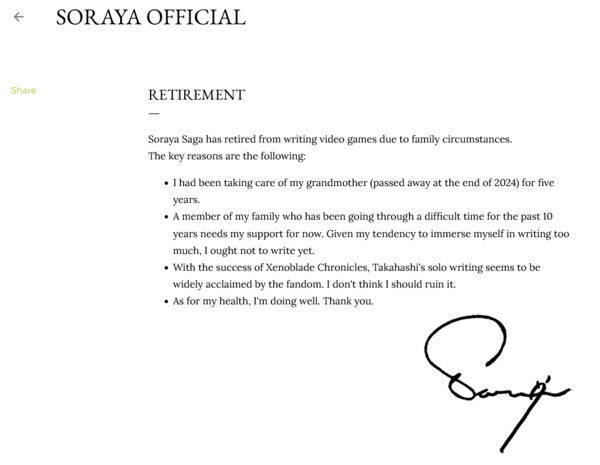
Fans of the Xenoblade Chronicles series, as well as Xenosaga, were crushed to learn that series co-writer Soraya Soga has announced her retirement from writing. The writer/artist has explained that their longtime absence was due to caring for ailing family members, and that they'll continue to take care of their family.
We like Xenoblade a lot around here. Nevermind my ongoing struggles with finishing the games, the Xenoblade series represents... a lot, really. They're Monolith Soft's ongoing science-fiction epic, the success story of the off-beat RPG Nintendo didn't want to release in the U.S. finally gaining a foothold and becoming a widespread success. They're a quartet of phenomenal open-world games with beautiful worlds and heart-touching stories about people challenging their fate (random thought: the Xenoblade series is a lighter and softer Fear and Hunger). And, most importantly, they're a major win for Tetsuya Takahashi, founder and CEO of Monolith Soft; ever since Xenogears, Takahashi had endeavored to write his magnum opus: a multi-chapter science-fantasy epic where people and giant robots do battle against higher-dimensional lifeforms akin to gods, all while deeply enmeshed in Kabbalistic imagery. Xenogears was an attempt at telling the story in media res, being at one point in its development a possible treatment for Final Fantasy VII. But for a variety of reasons, the game didn't work out; Takahashi left to found Monolith Soft and tried again with his kabbalistic science-fantasy epic with Bandai Namco, creating the Xenosaga games. That didn't quite work out, either; what was supposed to be a sextet of games was hastily (and unsatisfyingly) wrapped up into a trilogy. Xenoblade Chronicles represents the realization of Takahashi's efforts.
To illustrate how much of a bad fan of Xenoblade I am (I haven't even played Xenogears!), I've failed to mention Soraya Soga's contributions to the series. While married to Takashi, Soga's resume is an embarrassment of riches in its own right: she was responsible for a great deal of the script regarding Edgar and Sabin and their characterization, co-wrote Xenogears and Xenosaga alongside Takahashi up until Xenosaga Episode II (where she was removed from the project), and has even contributed some of her amazing art to Xenoblade Chronicles 2 courtesy of designing the Blade Gorg. She also factored heavily in the scripting for Soma Bringer, a phenomenal RPG on the Nintendo DS that never released outside of Japan. Soga had also tried reestablishing her career as recently as four years ago, amidst her caring for her elderly grandmother who passed away in 2024.
A note that stands out for many is her desire to not "ruin" Takashi's writing in the Xenoblade games, citing how long it had taken him to establish the series and gain the following he has. Soga clarified her statements on Twitter, insisting that her attitude isn't coming from "impostor syndrome." "Y'know, our games flopped many times in the past decades. Tet deserves to enjoy his solo success he has finally achieved. I shouldn't turn his fanbase off with my geeky, wordy, jargon-filled writing," she is quoted as saying.
I've been very detached from a lot of the foundational stuff surrounding Xeboblade, so I have no frame of reference for how Soga's writing in prior entries was received by fans. In response to Soga announcing her retirement, I've seen a few people talk highly of it and how much it means to them. There is also a lot of discussion of how Soga's absence can be felt in the current Xenoblade games, given the lack of some of her signature themes.
It is unfortunate that Soga feels so strongly about her writing the way she does. But I hope she can find peace during her retirement. If nothing else, the reactions to the news of her retirement have both surprised and flattered her. I think the industry is lesser for her absence, and it is a tragedy that talent like hers wasn't properly appreciated in its time (I'm including myself in this). If nothing else, now I'm especially frustrated that the Xenosaga trilogy hasn't been remastered...
Rance Series Now On Steam (I'm Just As Flummoxed As You Are)
I cannot take credit for formulating this joke, but I tried teaching a chimpanzee Steam's requirements for adult media on its storefront. I now have an ex-chimpanzee, and some Rance games on Steam.
The Rance series are a number of games featuring the titular Rance, a jackass with a heart of iron pyrite who drags his beleaguered slave Sill on a number of adventures. Across many lands and nations, Rance encounters and rescues countless women from danger... in exchange for sex. The Rance games come from Alicesoft, who've made other eroge like Beat Blades Haruka and Beat Angel Escalayer; you'll notice that those also had adult OVA adaptations that are likely listed in ANN's encyclopedia. MangaGamer has done a pretty great job of bringing those titles over, as well as the Rance games... but given that they all involve lots and lots of explicit sex, you're justified in feeling a bit of bewilderment at the news that these games are on Steam now. I say again: Rance owns a slave. He fucks. Steam almost refused Chaos;Head, and that game isn't even rated "M," but three Rance games are apparently A-okay.
Something that definitely helps Rance is that, going by the Steam pages for the currently-incoming games, the games have had their adult content excised, and they'll likely require some kind of patch to reinstate them. This isn't all that unusual for certain other adult games that have been hosted on Steam, like the Taimanin games or the Kuroinu games. This is the most practical workaround for an eroge that I can think of; you guarantee a game has as wide a net as Steam allows, plus the dedicated audience already knows where to get "the good stuff." Not that I'm particularly happy about this, as aren't many other people on the Internet; it's becoming increasingly obvious that there's no real concrete policy at Steam other than "hope that the one person judging your game is cool." It doesn't help that this comes in the wake of Horses getting banned off of Steam, for similarly vague and seemingly arbitrary reasons. Granted, I don't feel like the solution to this is Rance getting banned in the first place, either. As with many things, Steam could do a lot to improve its transparency with creators and consumers alike.
The thing that makes the Rance games stick out with people (besides Rance himself being such a loveable jerk) is that the games are all RPGs—fairly involved ones, too. The first two games are dungeon crawler RPGs, while later games like Sengoku Rance and Rance IX are strategy RPGs. Yeah, there's boning, but there is actual gameplay to get invested in.
Currently, none of the Rance games have proper release dates; currently, Rance 01 + 02 (a remake of the first two games), Rance 03 (a remake of the third game) and Rance IX are listed on Steam and are available for wishlisting. Rance X, Rance Quest Magnum, Rance IV, and Sengoku Rance are also planned for release on Steam at a later date.
Dragon Quest X Gets Update Patch (Yes, It's Still Getting Them!)
We know there are tons of Dragon Quest games that have never been released stateside: a number of high-profile Dragon Quest Monsters titles (including remakes of the first two games), a good number of the Zelda-esque Rocket Slime spin-offs, a number of other spin-offs featuring characters from the many games (did you know Drago Quest VIII's Yangus had his own Rogue-like?)... Given Dragon Quest's storied difficulties in making headway in the United States, you can almost forgive Square Enix for not even bothering. But you'll definitely wish they reconsidered after spending some time with Dragon Quest: Rocket Slime. This, unfortunately, still applies to one of the numbered entries: Dragon Quest X.
Now, Dragon Quest X: Rise of the Five Tribes does have a wrinkle in its formula; in spite of being an official numbered entry, it's an MMORPG. It did get an offline adaptation, fittingly named Dragon Quest X Offline, but Square Enix didn't release that one in the United States either. The original Dragon Quest X released in Japan on the Nintendo Wii, which might help explain things; the U.S. was fiercely and vocally dismissive of Japanese RPGs in 2012, which was part of why Nintendo themselves almost passed entirely on bringing the original Xenoblade Chronicles to the United States in 2010. Things are slightly better in 2026... but not by much: getting people to play a Japanese RPG is still an uphill battle, and most would seemingly rather gnaw their limbs off than play Dragon Quest. And even though Dragon Quest X has been ported to the Nintendo Switch, releasing a 14-year-old game in the U.S. would still be a risky move. Not that I'm happy about the reluctance—a Dragon Quest is a Dragon Quest.
Regardless of its absence in the United States, Dragon Quest X has still received a ton of support in Japan; over the past fourteen years, Dragon Quest X has received seven whole expansions—and announced an eighth slated for this June 2026. Titled Stray Children of Time and Space, precious little is known about the expansion; further news about it will be released this March during the Dragon Quest X Spring Festival 2026. Square Enix also announced an all-in-one release for Dragon Quest X, featuring the base game with all eight expansions.
Is it likely we'll see Dragon Quest X in the United States this year? Fat chance; Square Enix has, for the most part, stuck to releasing mainline Dragon Quest games in the United States, and their decision to do so is quite justified: American audiences are just too resistant towards Dragon Quest. There's just no way to effectively promote these games; people will insist Square Enix "doesn't market them enough" while potential fans in America blatantly skip past Dragon Quest announcements during even a Nintendo Direct. Dragon Quest I & II HD-2D Remake released just this past Halloween, to no discussion outside of Dragon Quest fans. Famously, the most successful attempt at marketing Dragon Quest to people in the US would be Nintendo's marketing campaign for Dragon Quest IX, but that likely had to do with them using Seth Green's star power over them marketing the actual game. (I counted, you see the game for all of five seconds in a 30-second commercial.) And sure, Dragon Quest X is a mainline title... but being an MMORPG that requires active servers, it's unlikely Square Enix would want to invest in what would be an obvious loss. Even if they wanted to release the offline version of the game, you're talking about releasing a 14-year-old game in the United States—that's way too tall an order.
Can this issue be overcome in 2026? Eh, fat chance; it would require a lot of people (a lot of them in positions of power) to change how games are talked about. And with Dragon Quest being so closely married to its traditional turn-based format, not to mention the late Akira Toriyama's character designs, it'd be hard to change anything about the games without completely abandoning the very things that make Dragon Quest so beloved in Japan, where the games are a national institution. It was rough enough when they tried making Final Fantasy XIII incorporate Call of Duty's cinematic linearity in an attempt at appealing to American players; that's not a risk Square Enix will take with Dragon Quest. (Remember, Dragon Quest IX: Sentinels of the Starry Sky was going to be an action-RPG—until outcry from Japanese players forced Square Enix to reconsider.) A lot of people are going to have to stop being so weird about saturated colors and big eyes before Dragon Quest becomes accepted in the United States, and uh... that one's a problem that goes well beyond anything Square Enix can do alone.
Let's wrap up with some quick tidbits:
That'll do it for this week, and that'll do it for our first column of the year. I look forward to being a part of your 2026, and to seeing you all (in a manner of speech) throughout the year. It's going to be a rough one: the prohibitive prices of RAM chips and GPUs is already dealing major blows to the gaming industry at large (thanks for nothing, Generative AI). More than ever, it's important to remind the creatives we love of just how much their works matter to us. There are going to be a lot of tough times ahead, but there are going to be a lot of great surprises too; new games we'll discover, new stories that'll inspire us, new characters we'll fall in love with. Remember the people who made them! It can mean a lot to them to know that they did something. Similarly: I thank you for accompanying me throughout 2025, and I look forward to your continued support in 2026. As our belated local sage Walter Mercado used to say, I hope that 2026 brings you all peace—lots of peace, but above all else, lots and lots of love. Be good to each other, I'll see you in seven.
This Week In Games! is written from idyllic Portland by Jean-Karlo Lemus. When not collaborating with Anime News Network, Jean-Karlo can be found playing Japanese RPGs, eating popcorn, watching VTuber content, and watching tokusatsu. You can keep up with him at @ventcard.bsky.social.
The views and opinions expressed in this article are solely those of the author(s) and do not necessarily represent the views of Anime News Network, its employees, owners, or sponsors.
discuss this in the forum (13 posts) |
