

The Winter 2026 Anime Preview Guide
Journal with Witch
How would you rate episode 1 of
Journal with Witch ?
Community score: 4.7
What is this?
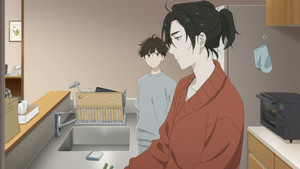
35-year-old novelist Makio Kōdai and her 15-year-old niece Asa live together under one roof. Makio took Asa in on an impulse after Asa's parents, which included Makio's older sister, passed away. The next day, Makio returns to her senses and remembers that she does not do well in the company of other people. So begins their daily life, as Makio attempts to acclimate to a roommate, while Asa attempts to get used to an adult who never acts like one.
Journal with Witch is based on Tomoko Yamashita's Ikoku Nikki (Journal with Witch) manga. The anime series is streaming on Crunchyroll on Sundays.
How was the first episode?
Rating:
Everyone else, go home. We have the anime of the season right here—possibly even anime of the year.
As a critic, it is my job to find ways to discuss any piece of media that crosses my path. It's not always easy; I've spent cumulative hours of my life rolling around, complaining to my husband and cat that I can't think of anything to say about something I just watched or read. Often, this is because a piece of media failed to inspire any strong feelings in me. Sometimes it's caused by a series so lacking in original ideas that I've already said everything there is to say about it in a review for another series.
Something is rarely so beautiful, so stunningly made in every dimension, that words fail me. Journal with Witch is one such case. Letters on the screen feel utterly inadequate for capturing the sheer beauty in every frame of animation, every line spoken, every note of music. And yet, I must try.
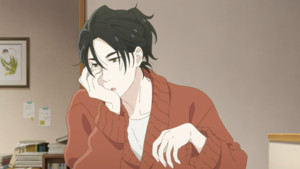
If nothing else, let's start from the beginning, or at least, what began things for me. Journal with Witch caught my eye when it was announced that Miyuki Sawashiro would play the starring role. Sawashiro has been my favorite voice actor since The Woman Called Fujiko Mine—and while she's never stopped working steadily, she's rarely played the kind of multilayered adult women that I feel like she particularly excels at. When Makio, a novelist who takes in her niece after her estranged older sister dies in a car crash, stared at me from the announcement image with her messy hair and gray sweatsuit, I knew she would be exactly what I wanted.
I was right, but Journal with Witch is so much more than a Miyuki Sawashiro vehicle for me now. The episode jumps around in time between Makio and Asa at the funeral, Makio setting Asa up in her cramped apartment, and scenes of the two of them living together. I don't know how the manga approached it, but the intercutting of the three moments in their lives together prevents the story from dragging. It moves effortlessly between Asa trying to cope abstractly with her grief and conversations between the two—keeping the episode feeling varied but paced so that it never feels restless, exactly. It's the rhythm of their lives together: intertwined, one informing the other, greater than they are individually.
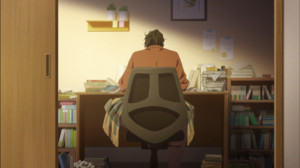
So much of this comes from the way the episode thinks about the details of their everyday life together. Too many anime these days use CG backgrounds that the characters barely interact with, but Makio and Asa occupy every inch of the space. Makio, like many writers, is a total slob (there may or may not be a resemblance between her apartment and mine); little details like Asa getting a piece of paper stuck to the bottom of her foot give me a sense of what it's like living with her aunt. Despite Makio saying she's not sure she can ever love the daughter of the sister she hated so much, the warmth between the two is palpable.
If I were to sit down and think about it all day, I might find adequate words to describe Journal with Witch. However, it's much more efficient for me to simply say, watch this anime. There's no magic or hero's party or other world or harem of any gender, but it just may be the most powerful thing you'll watch all year.

Rating:
There are a lot of people who see themselves as the main character in this world. They are the hero and always do the right thing—and if they don't, there is always a reason or justification that makes things okay. They simply don't have enough self-introspection to see their selfish nature for what it really is.
For those who do truly see themselves for who they are, there are only two choices: to either accept that they are sometimes not the best person and live with the guilt, or to step up and be what everyone else pretends to be—to not just talk the talk but walk the walk. This is the kind of person that Makio is.
She knows exactly what her shortcomings are: she is self-centered, slovenly, and holds a grudge even beyond death. However, when she sees her niece—the daughter of a sister whom she hated—set to be passed around as an unwanted burden by the wider family (who will all no doubt pat themselves on the back for being so kind while also doing nothing but the bare minimum), she lays down the hard truths and offers the kid a home. It may not be the best one or even the one that Asa deserves, but it will be a stable one.
Meanwhile, Asa is truly alone for the first time in her life. Her parents are dead, and her family is looking at her like a problem to be solved, not a child to be loved. They're concerned not with Asa but with how her becoming an orphan affects them. No one asks Asa what she wants to do. No one offers her any choices—no one except the family outcast and misanthrope Makio.
Makio may not love Asa and may have gotten in way over her head in a moment of righteous indignation, but she is determined to follow through. Makio has her own set of rules and morals she lives by. And strangely, taking in Asa is almost a way of getting revenge on her sister—to show she is the better person. Makio wants to treat her niece like she wishes her sister had treated her—to respect her feelings and opinions even if she doesn't understand them. And this is the key to the connection between them.
All this is shown to us through 22 minutes of visual metaphors and tightly-written conversation. I'm not sure how things will go for this series with its inciting incident out of the way, but I'll tell you one thing: I'll absolutely be back next week to find out.
Rating:
I haven't met a Tomoko Yamashita manga I haven't liked. There's something about the way she can quietly get to the heart of an issue without overstating anything, and Journal with Witch is one of the best examples of that skill. (Her is another.) Carefully handling grief, anger, and discomfort, this first episode is an exploration of emotions and feeling at sea in the world, albeit using the metaphor of an endless desert rather than the ocean. Neither Asa nor her aunt Makio is entirely comfortable with people, for reasons that haven't been fully explored yet, but in this episode, it already feels like the reason is less important than the fact itself.
The episode proper begins with the deaths of Asa's parents. As the news reports the story, Makio is visited by the ghost of her older sister, though given their relationship, it's unclear whether this is an actual ghost or merely a version that lives in Makio's mind. Makio doesn't have much of a reaction to her sister's death, which isn't so much cold as a sign that she's made her peace with the relationship. She's at first similarly ambivalent about being presented with her orphaned niece, but it would be a mistake to read this as coldness or a lack of caring. Makio doesn't resent or dislike Asa; she's just never thought about caring for a child (teenage or otherwise), much less taking one in. It's not about Makio having no feelings – it's about how Makio's emotions are private to her and don't necessarily follow social norms.
It would be easy to read Makio as neurodivergent, and I think that's a valid view of the character. She could also be read as anxious and introverted. Either way, she's made herself a place where she can function comfortably, and that's what she begins teaching Asa to do as well. Makio tells her niece that she doesn't have to feel sad, that she doesn't have to cry or display any emotions. Her feelings are her business. The eponymous journal comes in as a way Makio suggests Asa can process her emotions. When Makio says that Asa can write what other people say, she's giving her permission to listen and work things through, a way to engage with the world safely in the confines of text and paper.
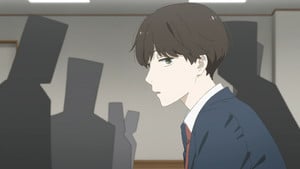
It's clearly something no one has suggested to Asa before. At the funeral, she mentions that she can tune out the people around her, turning their words into gibberish. She pictures herself as the lone person among grey paper cutouts, suggesting that, like her aunt, she feels safer distancing herself from the world. Makio seems to be the first person to validate that: she tells Asa that her journal doesn't even have to be true. The implication is that Makio is a writer and through her work, she's able to connect with the world as much as she's comfortable doing, while also using words to help herself process life.
We know from the flash-forward that opens the show that Asa and Makio will find comfort in each other. How they get there feels like the more important journey, and likely one that will continue even after they find equilibrium. This is emotionally resonant and quietly comforting, and I think we could all use a little of that these days.
Rating:
I've never checked out the Journal with Witch manga, but the series quickly sprang to the top of my list of most anticipated new shows based on its premise alone (the tasteful and melancholy trailer also didn't hurt). I've been watching anime for most of my life, and I've been writing about it professionally for a decade now. For as much as I love crazy explosions, melodramatic twists, teen angst, alien invasions, body horror, and trashy sexcapades, sometimes it is nice to sit down and watch a show about real people dealing with real problems as they simply try to make their way through life. Bonus points go to any show that puts the focus on a character that I can relate to just a little bit easier than a high-school student.
In that sense, Journal with Witch contains everything that I've been craving, as of late. Sure, one of our protagonists is still a teenage girl. Still, Asa is too busy mourning the loss of her parents and her completely upended life to worry about magical transformations or dark pacts with witchy mascot characters. More importantly, though, is that Asa shares her new life with her introverted aunt Makio, an honest-to-goodness adult woman (in her mid-30s, even!) who is trying her best to figure out this new normal alongside the niece she's just taken in. Despite the obvious undertones of grief, maturation, and uncertainty that are simmering below every conversation that these two ladies share, this isn't a melodrama that has to wallow in unending rivers of teary monologues. Neither Asa nor Makio suffers from any overly exaggerated personality defects or showy displays of Big Trauma.™ They may be very different, and neither of them asked for this new life that they share, but they are clearly doing their best to take this whole “life” thing one step at a time.
I've never been a big fan of iyashikei-style slice-of-life stories, as the lack of meaningful conflict and big personalities tends to put me to sleep, if I'm being honest. The honest, pure reality of Journal and Witch's whole presentation is a perfect example of the kind of hook I need to get invested in a show that isn't trying to steal my attention with flashy spectacle and narrative showboating. Asa and Makio's understated yet palpable grief, combined with Studio Shuka's equally restrained production, gives the show a feel almost like a documentary or the humanist portraits of everyday life we got from master filmmakers like Yasujiro Ozu. To be clear, I'm not necessarily putting Journal with Witch in the same conversation with something like Tokyo Story; I'm merely saying that this is one of those deceptively simple human dramas that treats its cast with the same level of respect and thoughtfulness.
The views and opinions expressed in this article are solely those of the author(s) and do not necessarily represent the views of Anime News Network, its employees, owners, or sponsors.
discuss this in the forum (98 posts) |

this article has been modified since it was originally posted; see change history
back to The Winter 2026 Anime Preview Guide
Season Preview Guide homepage / archives