

The Winter 2026 Anime Preview Guide
The Case Book of Arne
How would you rate episode 1 of
The Case Book of Arne ?
Community score: 3.6
What is this?
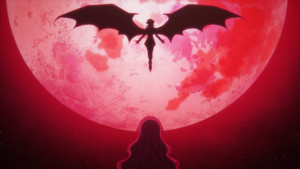
Vampire detective Arne Neuntöte and Lynn Reinweiss, the daughter of a noble family who loves vampires, solve bloody murder cases.
The Case Book of Arne is based on Game Magazine's The Case Book of Arne mystery game. The anime series is streaming on Crunchyroll on Tuesdays.
How was the first episode?
Rating:
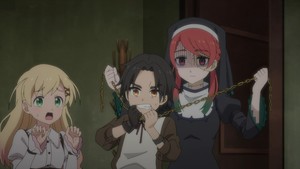
The Casebook of Arne is about an immortal little dead-boy who solves spooky supernatural mysteries with the aid of a curious and spunky lass who is also serves as his tether to the world of mere mortals. Naturally, my first reaction to its premiere was, “Oh man, this show wants to be Toilet-Bound Hanako-kun so bad.” Not that this is bad company to keep by any stretch of the imagination; Hanako-kun is one of modern manga's best dark romances, after all. The Casebook of Arne uses its focus on mythological monsters and an old-school Gothic aesthetic to set itself apart. Plus, Lynn Reinweiß spells her name with an eszett. That's…pretty neat, I suppose.
To get straight to the point, I was honestly pretty disappointed with The Casebook of Arne, and not because I'm trying to damn it with faint praise as “We've Got Toilet-Bound Hanako-kun at Home.” Putting aside any incidental or intentional similarities to one of the best spooky-cutesy manga on the market, The Casebook of Arne's premiere is brought down by a much simpler and more common malady: It's kind of boring. The European countryside that Lynn and Arne travel has the potential for all sorts of lush vistas and moody backdrops, and while the show is clearly attempting to impress, its meek storyboarding cuts that ambition off right at the knees. The opening scene does an okay job at setting a dark atmosphere, but any personality that might have been established is slowly sucked away by languid exposition and drab pacing. The scenes that try to emphasize Arne's vampiric nature or introduce the rotting zombie nun fall curiously flat.
Honestly, I think my instinct to compare this show to Toilet-Bound Hanako-kun has less to do with shallow plot comparisons and more to do with presentation. In TBHK, even when the animation ends up being fairly limited, there are episodes where practically every single shot still feels like an event to behold—which is due in part to the fact that the original manga's artwork makes for a stupendously gorgeous foundation to build upon. In The Casebook of Arne, you feel like whoever was in charge of photography only knew how to place the camera at varying degrees of medium distance in whatever location was the most immediately convenient for a quick take—and this is a cartoon, where the camera can go literally wherever you could imagine because it doesn't actually exist. Don't get me wrong, I'm not suddenly converting to the GoHands School of Assaulting the Viewer's Retinas With a Rusty Pipe in the Middle of a Crowded Street in Broad Daylight, but can't we find some sort of compromise that still results in an anime that is interesting to look at?
Maybe I would be more forgiving if the mystery that Louis, Arne, and Lynn solve was more compelling in its own right, but alas, the fangs on this one have been filed down to dull nubs. Given that we're only one episode in, and mystery shows do sometimes require a few episodes to truly find their groove, it is possible that I would end up singing a different tune entirely if I gave The Casebook of Arne the old 3-episode test run. These days, however, we're all drowning in an endless ocean of Too Much Anime, so betting it all on “It might get better, eventually?” is an awfully risky proposition. Instead, I think I'll use the free time I'll get from skipping Arne to catch up on Hanako-kun's latest season. I hear it's a hell of a good time.
Rating:
I have a feeling The Case Book of Arne wanted me to participate in solving the mystery. It's based on a game, which by definition invites players to join in. The original game, made in RPG Maker and published independently, is primarily a visual novel, and most of the gaminess stems from the player trying to solve the mystery alongside the characters. Moreover, much of the episode was devoted to characters sitting around and talking about their evidence and observations, so I assume I was expected to keep up.
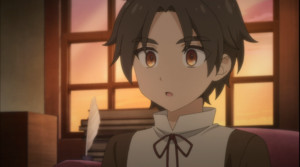
However, I didn't solve it. Part of this is because I'm not much of an active viewer or reader when it comes to mysteries. I like them in games and logic puzzles, but when they're part of a story, I'd rather let the plot wash over me. More than that, however, is that The Case Book of Arne isn't very good, and I was having a hard time staying engaged. Louis, the ostensible protagonist of the episode, is hunting for his father's murderer, but the script never properly sold his grief. Nor was there a sense of his connection to the adults around him who were caring for him in his father's absence. The final twist should have been emotional, but left me cold instead, because I didn't feel like I knew anything about these characters. The mystery is competently-written, but without the emotional thrust, it falls completely flat.
In a stunning display of parallelism, the visuals are also competent but overall uninteresting. By the end of the episode, I longed for the return of Undead Murder Farce, with its snappy dialogue and sparkling direction. It may be unfair to compare The Case Book of Arne to one of the best anime of 2023, but they're both supernatural mystery procedurals with jazzy opening theme songs. It's just that one had one of the best creative teams in the anime industry, and one has the guy who directed Ao-chan Can't Study!. It's not a surprise that one is a series I still think about to this day, and one is a series that I'll forget about immediately after sending this review in.
The Case Book of Arne is the definition of mid, so much so that I'm probably not going to play the game, even though I was considering it at the start of the episode. On the other hand, it did have a kid telling someone with fangs and pointed ears that he doesn't believe in vampires, and that's pretty funny.
Rating:
I'm going to be frank. When it comes to the mystery, characters, and world, this is about as bog-standard a supernatural detective anime as you can get—and I'm not exactly keen on watching further episodes. However, this episode in particular does one thing that elevates it; it's not the story being told but how that story is being told.
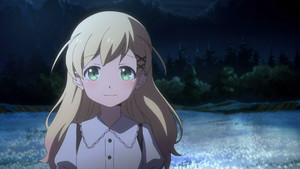
Everything here is seemingly set up for Louis to be the main character of the anime. He's the viewpoint character. He loves the supernatural. He has personal stakes in the mystery—and in ensuring that what happened to him doesn't happen to others. He's the perfect audience proxy—the person set up to ask all the “stupid questions” and impart to us the information that the other characters see as common knowledge in a natural way.
And then, he dies.
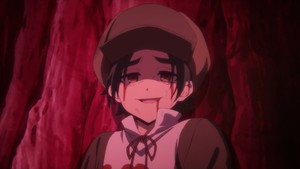
In the moment, I wasn't shocked by this—it didn't really even phase me that Louis had a gaping hole in his chest. I mean, how many works of vampire fiction end with the newbie character being killed and resurrected as a vampire at the start? Even as his narration ends and he dies—and goes on to stab his father's killer to death as a reanimated zombie corpse—I assumed that, in the next scene, he'd basically be his old self (if not a little more on the undead side). Yet that's not what happens. Louis is just dead—end of sentence.
This changes how we view the entire episode. Rather than his introduction to the wider, supernatural world of mystery, this becomes a story about the dangers of pride. Time and again, Lynn reaches out to Louis, tells him he's not alone—that he doesn't need to seek revenge all by himself. Yet, every time he rebuffs her. Even after she meets him halfway, with an information-sharing meeting, he reneges on his part of the deal—simply leaving them behind and confronting his father's killer alone once he figures out who she is.
This is what gets him killed. If he had been able to see beyond his own pride—his need to take revenge without anyone else's help—he would have survived. His father always told him to pay attention to the world in front of him. But what Louis failed to see was himself. Even if there had been no supernatural element to the case, he was a child confronting an experienced murderer while isolated and alone. He never would have been able to physically take her down.
And in the end, both his life and death meant nothing. Arne would have solved the case on his own eventually, and even Lynn gives Louis little more than a second thought before moving on. He could have been a great detective—honored his father's name. Instead, his pride caused him to fall into the grave beside him.
Rating:
In any mystery narrative, laying out clues for the viewer or reader to pick up on is tantamount. Or at least, it is in the fair play mysteries of the Golden Age; in earlier mystery fiction, it was more important for the detective to look smarter than everyone else, readers included. (Think Sherlock Holmes vs Ellery Queen.) In that respect, the first episode of The Case Book of Arne succeeds: the clues are right there in plain sight so that we can solve the case alongside the detectives. As a fan of fair play mysteries, I really appreciate that. When the answer came clear, it felt triumphant, not because I had solved the mystery (I had, just not from the clues, but from genre familiarity), but because it was possible to.
The rest of the episode? I can't say I was as impressed. It certainly makes some interesting choices, regardless – the most striking being the sheer amount of horror in a show with such innocuously cute character designs. I was not expecting to see quite so much blood or be serenaded with the sound of a boy stabbing someone's head for quite so long. (Great squishy sound design, by the way.) It's discordant in a way that feels both deliberate and perhaps overdone, as if the narrative couldn't decide whether it wanted to be a mystery or a horror story. The two can coexist, of course, but there are some decidedly jagged edges between the two genres here.
The plot's also playing fast and loose with some of its monster mythology, although that's not going to be an issue for everyone. Vampire myths are pretty fluid anyway, with bloodsuckers existing around the world in various forms. Golems are another story; they're creatures from Jewish lore that exist specifically to save people from those who would harm them. I can be hypersensitive on the subject, but it's not a great look to have a “golem-summoning witch” even if it isn't done with any awareness of where they originate. Just golems on their own are fine; it's the conjunction of the two that I take issue with.
I haven't played the game, so I can't speak to how well the anime adapts it. I do feel like things might even out with another episode or two, since this really did feel like an introduction to the setting and characters. If horror/mystery hybrids are your thing, particularly when paired with sweet-faced anime children, it's worth checking out.
The views and opinions expressed in this article are solely those of the author(s) and do not necessarily represent the views of Anime News Network, its employees, owners, or sponsors.
discuss this in the forum (111 posts) |

this article has been modified since it was originally posted; see change history
back to The Winter 2026 Anime Preview Guide
Season Preview Guide homepage / archives