

The Winter 2026 Anime Preview Guide
You and I Are Polar Opposites
How would you rate episode 1 of
You and I Are Polar Opposites ?
Community score: 4.3
What is this?
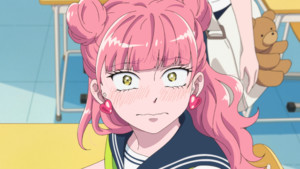
Suzuki has a desperate crush on Tani, a boy in her class, but she has no idea how to approach him. The two are on opposite ends of the class social hierarchy: she's loud and bubbly with lots of friends, and he keeps to himself, barely responding when she talks to him. But when she finally gets over her fears and admits her crush, it turns out that things aren't so hopeless after all.
You and I Are Polar Opposites is based on the manga series by Agasawa Tea. The anime series is streaming on Crunchyroll on Saturdays.
How was the first episode?
Rating:
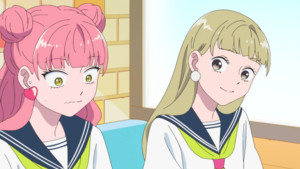
Most stories end when the main couple admits their feelings for each other and gets together. You and I Are Polar Opposites is not one of them – by the end of this episode, we're where most romances end. That's part of the appeal of this series, though: it doesn't stop at the pivotal moment, it starts there. And frankly, it's a good thing it does, because while I love Suzuki to pieces, the poor girl would self-destruct if she had to spend twelve episodes thinking her crush was unrequited.
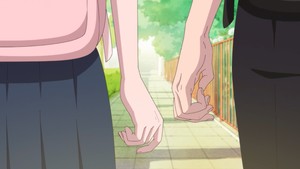
That's not to imply that this isn't full of delightful romantic comedy moments. Or even to say that they officially start dating, for that matter. But the episode feels like a distillation of a shounen rom-com: Suzuki is bright and bubbly, while Tani is quiet and withdrawn. They both like each other but aren't sure how to say it. There's an absolutely wonderful scene where they're walking together, sounding it out, and he takes her hand. The next day, the inevitable miscommunication happens. All the hits are there, just without the filler that usually surrounds them. And while I enjoy a good romance as much as (if not more than) the average reader/viewer, it's also really nice to get those out of the way. Now the story can focus on Tani and Suzuki without having to also focus on the will-they/won't-they bit.
There's a very nice balance between loud and quiet in this episode as well. Everything about Suzuki is the former, from her character design to her voice, while Tani embodies the latter. But their walk home is a peaceful, silent moment, with both of them lost in their own thoughts, while Tani's solo trek after the big misunderstanding is loud in his head. It's a nice way to show that, while both fall into one camp or the other, they're generally just people with a variety of thoughts, feelings, and voices, and it makes them both feel very human in the space of twenty-two minutes. Their classmates are somewhat less nuanced, but they're still shaping up to be good characters, particularly Yamada, who not only realizes his mistake but also takes steps to fix it.
With art that's as bright as a set of brand-new markers and deceptively simple in its character designs, You and I Are Polar Opposites is as fun to look at as it is to engage with, even if I'm not sold on the electric snot color of the girls' uniform ribbons. This should be a delightful combination of sweet and silly, and I'm looking forward to seeing more.
Rating:
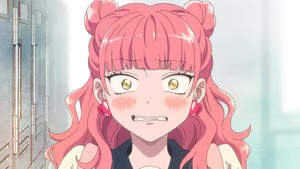
I'm one of those people with a low tolerance for will-they-won't-they stories. I feel that romantic relationships truly begin when two people admit they like each other—so stories that end with a confession of love and expect us to be content with a nebulous happily ever after often don't sit well with me. Hence, spending only a single episode watching Miyu pine after Yusuke is pretty much perfect for me.
At its most basic level, this is the story of a girl with social anxiety. Miyu is someone who excels at reading the room—to the point of self-detriment. Because she knows what people want to hear, she's afraid of saying anything else. Everything she says and does is to appeal to those around her. Her own honest thoughts and feelings are pushed deep down (even if they sometimes bubble back up).
Meanwhile, Yusuke is the exact opposite. He's a straight shooter. He's not rude or mean but rather just exceedingly straightforward in how he thinks and feels. To Miyu, who never acts on her true feelings, he is someone she dreams of being like but feels she never could—which develops into a major crush over time.
In this episode, she lucks out and gets into a situation just the two of them where she can take off her “reading-the-room” mask, and things go well—only for the mask to get in the way the next day. However, the emotional turmoil from this causes her to put her own feelings above others' expectations for the first time.
When she throws the mask away and tells her friends the truth about her crush on Yusuke, the big reveal is that they all support her. They aren't going to turn on her for liking a guy that they wouldn't have imagined her with. Thus, Miyu discovers that she has been living in a fear-induced world of her own making—one that exists only in her head. And now, she is entering a new world, one where she is not only dating her crush, but can be more honest with those she cares about.
I don't know if I'll watch the whole series, but I may just pop back in a few times to check out the early days of their relationship.
Rating:
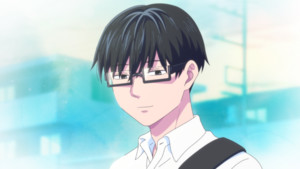
I was talking about You and I Are Polar Opposites with my little sister, who is still in her 20s. She wasn't enthralled by it, citing its adherence to all the expected rom-com beats. Suzuki's crush on Tani, his slipping his hand into hers on her walk home, her getting embarrassed and denying that anything was going on, and him overhearing it – we've seen this exact story dozens of times. She's past the blushing first love stage of life, so she can't really relate to the teenagers in the show. My response was that when you reach my age (waves cane), you learn to appreciate series like this more, because they let you vicariously experience feelings you'll never have again, so long as the creative team behind it sells it to you.
And wouldn't you know, the folks behind You and I Are Polar Opposites sell it wonderfully. On a purely literary level, I appreciated Suzuki spelling out what she likes about Tani, rather than leaving us to wonder what she sees in a blunt nerd with a flat affect. Turns out, she likes the qualities in him that she wishes she had herself: as a chronic people-pleaser, she admires his straightforwardness and disinterest in currying favor with others. Her crush is totally adorable - when she discovers Tani behind her after she denies anything happening between them, I was crying, “NOOOOOOOO! NO NO NO!” and hiding my face even though I'd only known these characters for all of fifteen minutes. I was invested in them, dang it.
I also explained to my sister that, as a critic, a production that does the basics well is just as valuable to me as something totally original and unexpected. Not everything can be SANDA after all, and it takes just as much technical mastery to grab my attention. Lapin Track continues its excellent track record here, using its visual creativity to amplify Suzuki's charms and communicate the growing attraction between her and Tani. Backed by a funky soundtrack, the production balances naturalistic teenage dialogue with the bright, almost cartoony, simple visual style. It's just so charming from top to bottom that it seems impossible not to fall in love with these kids, to fall in love with watching them fall in love.
But as my sister has proven, it's entirely possible not to be charmed by it. If you're old enough to be a bit cynical but too young for nostalgia, it may not hit in quite the same way. Still, if you like stories about good kids falling in love, You and I Are Polar Opposites is a perfect match.
Rating:
I had a good feeling about You and I Are Polar Opposites within the first minute or two of its premiere. As the rest of the show's many supporting characters make their usual morning trips to school, our protagonist Miyu Suzuki dutifully styles her hair, applies her makeup, and awkwardly practices greeting her crush and smiling “naturally” in the mirror. While all of this is going on, a poppy soundtrack of lively synthesizer beats and chiptunes fills the air with not a single goddamned recorder to be heard in the mix. After so many years of watching anime, this is music to my ears in the most literal sense. God bless you, DJ tofubeats.
More importantly, it is how well this introduction conveyed the show's irrepressible charm in just a few precious minutes. In a romantic comedy, charm is everything. While a critic like me always appreciates novelty and experimentation, at least when it is executed well, rom-coms are by and large not meant to be shocking, or subversive, or challenging. There is a reason shows like this get a pass: they just turn the premise's cliché into a catch-all title. Miyu likes Yusuke, and Yusuke likes Miyu, but - get this - they are polar opposites! Will this bubbly ball of pink-hued energy and this stoic wallflower be able to overcome their differences and be together? Of course they will. That's the whole freaking point of the show.
In the end, it all comes down to execution. Appealing art, stylish animation, clever writing, palpable romantic chemistry between the romantic leads — these are the ingredients that are necessary for a romantic-comedy anime to succeed, because they are the elements that allow it to stand out from all of the has-beens and also-rans of the genre. In other words, these are the sparkly accessories and perfectly practiced flourishes that give a series its charm, and let me tell you, You and I Are Polar Opposites has charm to spare. Miyu is a heroine who is perky and outgoing without being obnoxious, and the script makes sure that her self-conscious affections never come across as shallow or fake. She's just a girl who wants to look cute and stand out to her friends and her crush, and when you're a kid, that also means stumbling into plenty of opportunities to end up acting like a big dork. I defy anyone with even half a heart to finish this episode without muttering “You've got this, girl!” to themselves and pumping their fists in camaraderie with Miyu at least once.
As our co-lead, Yusuke acquits himself very well, precisely because he is, indeed, the polar opposite of Miyu in personality. The big mistake that a lot of anime make with these introverted types is that they fail to understand that a guy being “shy, quiet, reserved, and/or bad at communicating” is not the same thing as “not required to have a discernible, likeable personality.” You can tell us over and over how cute and attractive our heroine finds the main guy in a rom-com, but if the audience doesn't also think he's a cutie, then it's game over, man. I didn't quite know where Y&IAPO would fall when Yusuke was first introduced, but all of my worries were soundly obliterated the minute we got to that expertly animated shot of him taking Miyu's hand as they walked home. As Miyu's brain utterly failed to process this momentous development and began to shut down completely, I got up from my chair and ran to my wife to yell, “We have cuteness! I repeat: They are holding hands, and it is adorable as hell!” My wife, who had already read the manga, just smiled knowingly and waited patiently for me to stop dancing in the hallway.
The real secret ingredient that gives a rom-com all the charm it could ever need and then some is a deceptively simple one: You have to convince your audience that your characters are real people, and that it would be satisfying as all get-out to see them smooch and stuff. More anime have failed at this than have ever succeeded, but You and I Are Polar Opposites is one of the keepers. I'll be checking in on these crazy kids every week to make sure that they get the happy ending they deserve.
The views and opinions expressed in this article are solely those of the author(s) and do not necessarily represent the views of Anime News Network, its employees, owners, or sponsors.
discuss this in the forum (253 posts) |

back to The Winter 2026 Anime Preview Guide
Season Preview Guide homepage / archives