

The Winter 2026 Anime Preview Guide
SHIBOYUGI: Playing Death Games to Put Food on the Table
How would you rate episode 1 of
SHIBOYUGI: Playing Death Games to Put Food on the Table ?
Community score: 4.5
What is this?

In a world where death games are a robust, underground entertainment industry unto themselves, Yuki is a seasoned player who seeks to survive 99 games.
SHIBOYUGI: Playing Death Games to Put Food on the Table is based on writer Yūshi Ukai and artist Nekometal's Playing Death Games to Put Food on the Table (Shibō Yūgi de Meshi o Kuu) light novel series. The anime series is streaming on Crunchyroll on Wednesdays.
How was the first episode?
Rating:
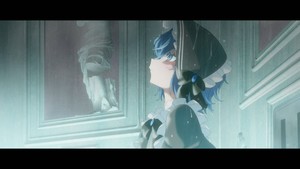
The slow drip of water falling from the ceiling to the floor. The discordant ring of chimes from somewhere in the distance. The low thrum of electricity running through the walls powers the cameras and traps scattered throughout the empty mansion halls. Over forty-two minutes, the premiere of SHIBOYUGI builds tension in the same way an orchestra's sound buzzes to life as they tune their instruments to concert pitch, then suddenly snaps back to eerie silence. It's funny because, even though quite a few people die before this episode runs its course, SHIBOYUGI may be the first death game I've ever seen where not a single drop of blood is spilled. This is, of course, because all of the girls who are trapped in this mansion have had their blood replaced with doll stuffing. For the sake of the audience watching at home, you see.
I knew I was all in from the first scene of the premiere, with its lingering yet confident shots of a vague nighttime landscape paired with a moody, melancholic ambient score. As we meet our heroine, Yuki, and watch as she calmly — far too calmly — walks her fellow contestants through what to expect with one of these death games that their society puts on for fun and profit. Aoi, Kinko, Kokuto, and Beniya are all essentially newbies to the experience, but Yuki has survived dozens of these things, and she claims to genuinely mean it when she says she wants every single one of the girls to walk out of here alive. The camera almost always keeps at a distance from everyone in the game, though, Yuki included. Their faces become lost in the middle-distance of the shot, and the girls' linework becomes almost invisible, like we're looking at the already fading memories of a dream upon waking. We can't completely trust that every one of these girls is being honest when they promise to work together. We don't trust Yuki, either, even though she's the closest thing we've got to a main character. SHIBOYUGI is playing a slow and cruel game that offers neither the player nor the viewer an opportunity to let their guard down.
When the first girl dies, it is done with merciless indifference. She was simply standing in the wrong place for a couple of seconds too long, and a single needle is enough to pierce her through and do her in. The second death is slow and painful, with poor Aoi getting shredded to ribbons after the others spend too long fighting for the key to the shackles that have locked them in the shackles of a murderous trap room. It's a test right out of a Saw movie, really, and it puts the blood on the other girls' hands — or, in this case, the tufts of shredded stuffing that spilled forth from Aoi's tattered body. On and on we go, with Yuki acting as our determined heroine, though we know that determination cuts both ways. After all, you can't survive twenty-seven killing games without learning how to make the hard choices when the time comes, which the premiere is happy to demonstrate in its horrible but inevitable denouement. Then, after a nap, Yuki is off to get a head start on conquering the next game. It's a long road to 99 wins in a row, after all.
SHIBOYUGI is one of those premieres made with such bold, blistering confidence that I cannot help but adore it, even as a perfectly atmospheric, haunting little short film. It's a dark satire, a grim thriller, and a disturbing work of fairy-tale body-horror, all in one. I cannot wait to see what comes next. If the show can keep up this level of rock-solid presentation and provide equally compelling games in the weeks to come, then we'll have an easy contender for this season's best new show.
Rating:
Do not take my middling rating to mean that SHIBOYUGI is a mediocre anime. Instead, I'm using it to indicate true ambivalence: I can't decide whether the show is an astounding achievement or if I want to dunk it straight into the trash can.
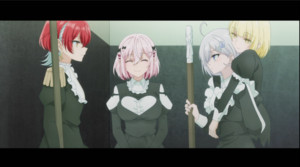
When Madoka Magica came out fifteen years ago, a contentious debate raged through the anime community: whether it was a serious commentary on the link between girlhood and suffering, or an excuse to watch little girls being tortured. SHIBOYUGII brings back this debate, as we spend an hour watching the cast work their way painfully through a death game, presumably being broadcast to an audience for a monetary award. It is self-consciously artsy, front-loaded with lineless, long shots of the entirely female cast in maid uniforms, sitting around a table, talking about their situation and snacking on macarons. We're then treated to a long sequence of them poking around rooms with symbolically dismembered statues, and I started to feel antsy about the ponderous pacing and Yuki's monotone line delivery. And what was with the countdown to 23 that kept appearing?
The first death was swift and sudden, but the second one was drawn out enough to be haunting. I was annoyed because Yuki could have easily prevented it with a bit more leadership, but the details of the world started to build up and work their way into my skull. The show was trying to build up discomfort and anxiety, and, well, it worked. Even the deaths that should have been gory were rendered bloodless in a way that was even more horrific. Every detail was designed to evoke dread, and I've watched enough death game series to know that nobody was safe until they walked out that door. Something supremely messed up was happening here.
My question is, what is the role of the real-life viewing audience in this? The entire cast is made up of young women, and the maid costumes appear to be the expected uniform for the game. They're being subjected to this for the entertainment of an audience in their own world, but it's unclear how much we ourselves are meant to sit back and enjoy watching them dismember one another and themselves. By the simple act of viewing, we ourselves become participants. Is SHIBOYUGI trying to make us think about this, or does it just want us to feel sad as it tears girls to shreds in a story we've chosen to engage with?
The best death game stories always have something to say about the audience and their relationship with the brutal violence being committed in their name. However, I'm still not sure if that's enough. Squid Game may have been a harsh commentary about capitalism, but that didn't stop a billionaire from recreating it for a major streaming service. They keep making new Hunger Games stories. They may not involve actual deaths, but they're proof that we are addicted to the Torment Nexus.

Rating:
Visual tone. I feel that so few anime these days truly understand the importance of visual tone in a story. Most are content to follow what came before to the letter—be that a light novel, manga, or both. All too often, this results in a show having a standardized quality. Think about how many isekai shows look and feel the same—so much so that if you saw an image of the setting or background characters, you'd have no idea which one it came from.
Visual tone can make you feel a certain way. As we see in this episode, the simple addition of a timer constantly reminds us of how close we are to the climax. Meanwhile, the creative cuts, camera angles, and voice-overs give us a look into the characters' thoughts and emotions that would likely not be there in a more standard presentation.
From there, this tone is used to tell us two separate stories: one through the plot and the other through the setting. With this first game, we can see a cross-section of the people who play these death games. For most, it is because they (or their families) are in some sort of financial trouble. For others, like Yuki, playing the games has become a way of life.
This first episode is a look into the mind of a veteran player. Yuki isn't evil. She genuinely wants to escape with everyone if possible. However, if you look closely, you'll see that she always puts herself first. She keeps the keys, ensuring her survival from the buzz saw trap. When she gives up her limbs for the elevator, she makes sure she can physically overpower at least one other person if needed. She's utterly pragmatic when it comes to her immediate survival, but she also understands the long game. Who knows if a person's particular talents might be needed in the next trial—or even in a subsequent death game if said person becomes a veteran?
The other story being told is through the setting. It is the story of how and why these death games exist. Here we have a system set up by the rich for their own entertainment. They find the poor, troubled, or crazy and bribe them to participate (or force a family member to). This gives the watchers of the death game a clear conscience. After all, everyone is playing “by choice.”
The participants are all pretty young women. They are put in fetish costumes (and are even given a safe room to fix their clothes and makeup halfway through). They are given sweets to eat along with a safe room to start in. Viewers want to see cute girls doing cute things—before they end up getting killed by traps or by one another. Likewise, the participants have all had their bodies altered to replace the gore with cotton-like stuffing. That way, the watchers can partake in the ultra-violence and not see themselves as monsters.
Lastly, the trials are designed with two solutions—one in which the girls turn on one another and one in which they work together to survive. The watchers want to see whether the players are calm and smart enough to figure out the trick, or if they go straight into violence. Also, the vast majority of games and their instructions are modular—allowing the game to be made easier or harder on the fly and ensuring an entertaining experience for the viewers. And just in case the players get along too well and pass every trial together against all odds, the final room has only one solution—the violent one—to assure those who came for the bloodsport leave feeling satisfied.
This is the twisted world Yuki is trying to survive in, and I'll be back next week to see her on the road to her eventual goal of completing 99 death games.
Rating:
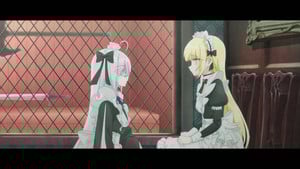
I appreciate what this episode is trying to do, even as I didn't enjoy it at all. There's a self-conscious artiness to the entire production, from the use of color (primarily black and white) to the ornate maid dresses the girls all wear. Someone was even kind enough to show us the cage crinolines (hoop skirts) underneath the longer dresses, even if the animation isn't up to showing how they would move properly. The details of the oddly static 19th-century manor have the look of a hidden object game, and the puzzles mostly make sense, with the notable exception of the one that takes out the first girl. I get that it's supposed to be our jump scare and the sign that this really is a death game, but given how much thought appears to have gone into making the others feel plausible, it's a bit out of nowhere.
The plot itself? That's where this loses me. Richard has said that for every double-length premiere, he asks himself if it needed to be that long, and while I don't know what he'll say about this one, for me, the answer is “no.” I do understand the idea: we're shown the entirety of a death game so we get a feel for what it is that Yuki plays to put food on the table, as per the title. But the game's exhaustive detail feels excessive. Did we really need to see them poking around? To see how Momono was dragging everyone else down? Have Yuki be the smartest gamer in the room? Clearly, someone thought so, but I respectfully disagree. I'd have been more interested in whether we had been told this was a game and just had two episodes to figure it out. This way felt like a lot of narrative hand-holding, and I was struggling to pay attention by the ten-minute mark.
At least the English dub is good. Kayli Mills' Momono is a bit nails-on-a-chalkboard, but the performance suits the character, and everyone is strong enough that I feel safe saying that you won't lose much by listening to it in the language of your choice. The letterboxed format feels a touch pretentious, but you do get used to it after a while. I suspect I'll be an outlier in not caring for this, because as I said, a lot of thought and care clearly went into making this episode happen. It just…isn't for me.
Disclosure: Kadokawa World Entertainment (KWE), a wholly owned subsidiary of Kadokawa Corporation, is the majority owner of Anime News Network, LLC. One or more of the companies mentioned in this article are part of the Kadokawa Group of Companies.
The views and opinions expressed in this article are solely those of the author(s) and do not necessarily represent the views of Anime News Network, its employees, owners, or sponsors.
discuss this in the forum (138 posts) |

this article has been modified since it was originally posted; see change history
back to The Winter 2026 Anime Preview Guide
Season Preview Guide homepage / archives