

Exploring an Alien World with All You Need is Kill Director Kenichiro Akimoto
by Andrew Osmond,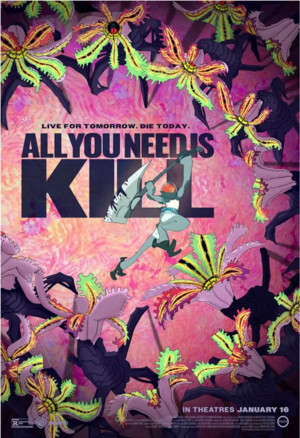
Animated by Studio 4*C, All You Need Is Kill is the story of a sudden alien attack on Earth. A woman called Rita is killed, only to be caught in a timeloop where the day resets and she finds herself dying again and again – but can the loop be broken? The film is based on a 2004 novel by Hiroshi Sakurazaka, which Takeshi Obata adapted into a manga, followed by an American graphic novel by Nick Mamatas and Lee Ferguson. The book was also the basis for the 2014 live-action American film Edge of Tomorrow, which was set in France and starred Tom Cruise and Emily Blunt.
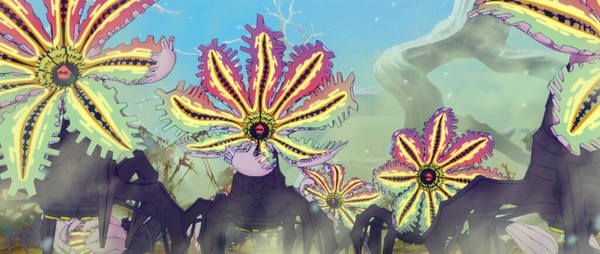
In the previous versions, the viewpoint character was male. In the book, Keiji was a soldier, and so were Rita and most of the other characters. Akimoto's film, though, focuses on Rita, and she, Keiji, and the other characters are now non-military personnel. In this version, an alien entity landed on Earth, taking the form of a massive tree-like organism surrounded by brilliantly colorful flora. The characters are trying to clear all this away when the attack starts...
This version of All You Need Is Kill foregrounds Rita, giving her a dramatic backstory and a very solitary personality. Can you talk about how this characterization of Rita was decided on by staff?
Kenichiro Akimoto: Yes, as you have pointed out, it is different from the original book in the sense that the protagonist is Rita, instead of an army officer called Keiji. The reason is that we were trying to tell the story differently for this animation. We didn't want to tell the story from the viewpoint of an army personnel who is far removed from the general public, in any sense of the word. We wanted to capture the viewpoint of somebody who's just living day to day, (a member of the) general public. A lot of them are experiencing daily emotional difficulties. We wanted to tap into that, to tell the story from that viewpoint. And that's why Rita is someone who cannot connect with herself or with others who struggle. We wanted to tell the story and reach a conclusion from the perspective of someone who experiences those challenges, while giving viewers hope.
I was very struck by how Rita is very sullen and self-contained in the early scenes, even while she's still made sympathetic to the audience. Can you talk about how you wanted to show her?
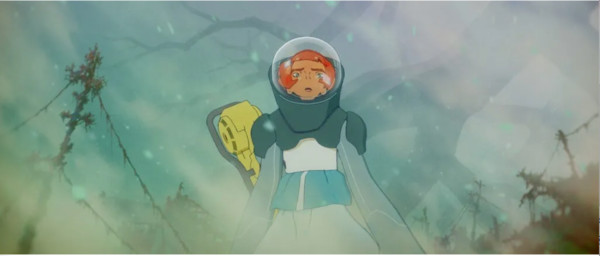
Akimoto: So this is not obvious in the film, but Rita is mixed-race, with a white father and a Black mother. But this backstory isn't apparent from the film. To explain: her father abandoned her mother, so Rita was raised by a single mother, and Rita herself inherited red hair from her father. So there is a little bit of a conflict with that, because red hair is a representation that Rita cannot fully love herself, because of what happened before she was born, but also with Rita's mother as well—even though she loves her daughter dearly, just seeing Rita's red hair reminds her of that difficult incident.
This is a question: Would you say red hair could be seen as a potential source of bullying in this country [England] as well?
Yes.
Akimoto: Why do you think that is?
Simply because red hair is unusual, and people often bully people who are in any way unusual.
Akimoto: Okay, so that was part of the answer. That red hair has long been a source of conflict for Rita, but Keiji actually saw beauty in it. It's something original, beautiful, and uniquely hers, so it became a symbol of Rita and Keiji moving forward together.
Keiji is also different from how he was in other versions of the story. In the film, he seems almost pathetic at first, and there's the lovely detail of the self-defensive way that he laughs.
Akimoto: There might be a sense of me, actually, within how you describe Keiji; there is a slight overlap. Perhaps I am really projecting how I saw myself and how I was when I was small. Perhaps I have used laughing as a self-defense mechanism. So when we think about where things come from and how they're projected onto reality, maybe that's where they stem from. To be evasive, just by laughing, to avoid the subject. I don't remember being “bullied-bullied,” but there have been occasions where I needed to escape scenarios where I would be seen as pathetic. I don't know if you can relate to that...
There have been many stories about time loops, in Japan and elsewhere. For you, what are the most interesting opportunities offered by a time loop story?
Akimoto: As you said, this time loop concept has been explored in Japan as well as many other countries. It's a well-established genre. To make it original and fresh, I've thought about highlighting what we experience day to day. It's a privilege in itself to have a workplace to go to every single day. The commuting route might be the same, so we do see the same scenery every single day. However, the scenery we see might be different depending on how we feel that day. Our emotions, psychology, largely affect what we take in, so that when we are elated, we might see colors more vividly.
That is definitely something that we wanted to highlight in this film. The world changes as soon as our mentality shifts. The colors are slightly different in each loop as well. And when Rita is carrying this heavy weight in her chest, the color is slightly muted. But as she got together with Keiji, and there is a hope that they could break this loop, the colors are slightly more vivid.
Some people in the audience may have seen many time loop films, while other viewers might be new to this genre. Was it difficult to find the right level so the film is clear to follow yet still unpredictable?
Akimoto: One of the obvious challenges is that there is a risk of audiences getting bored with what they see. And if the audience is well-versed in this genre, they may be used to that sensation, so that it wouldn't affect them as much. But if they're not, they might feel, 'We've seen this already, why do I need to go back again?' That's why, as I've described in the previous question, there are the differentiations in colors and slight variations; we were hoping that would make it more visually interesting.
I loved the whole fantastic alien plant-based environment in the film. It reminded me a little of Miyazaki's films Nausicaä and Laputa. What were your main inspirations, whether from fantasy media or real life?
Akimoto: I grew up loving Studio Ghibli films, so I am sure they have influenced me in some ways. But the specific images you might be referring to of these regions affected by the extraterrestrials are inspired by the Danakil region in Ethiopia. It's the lowland that is exceptionally close to the volcanic center, magmatic. The clay appears yellow and red; the color scheme is extremely vivid. The way I would describe it is it looks like hell, but extremely colorful, a vivid hell. We wanted to capture the essence of that.

The author of the original book, Mr. Sakurazaka, said he was partly inspired by video games, where players die over and over again. Are you a gamer yourself, and did games influence the non-linear action?
Akimoto: Now I work in animation, but before that, I was at Konami, so I was in the gaming industry. However, I'm not an avid gamer myself, so I don't play games that often. Stylistically, I am probably more influenced by the limited animation of Japan. Maybe, in some ways, games have influenced me, but my major influence is limited animation.
The idea to make this film first came from Warner Bros. Japan. Were you already acquainted with any of the earlier versions of All You Need Is Kill?
Akimoto: No, I have not, but since this project came about, I did go and watch the other version. I have read the book as well.
The robot characters that Keiji makes remind me of the “Haro” robot in Gundam. Was that an inspiration?
Akimoto: (Laughs) Not a direct inspiration. However, there was a sense that we wanted to come up with a cute companion robot to take them on the adventure. And as well as that, Rita was alone for a very long time until that point. So we came up with the drone and four-legged robots to accompany them. For those scenes, we did think about creating the atmosphere as almost like a pseudo-family that they [Rita and Keiji] could belong to.
In terms of the animation, were any paper drawings involved, or was everything created straight onto tablets and computers?
Akimoto: I don't believe we had any paper for this film. It's mostly 3DCG animation, and about 10-20% was done as digital drawings.
Some of the designs of the supporting characters are very idiosyncratic and unusual. Was there a particular feeling or vibe that you were aiming for with the designs of these characters?
Akimoto: We had a designer called Izumi Murakami, and she's extremely skilled in creating a beautiful silhouette. Perhaps the characters that you have described aren't typically Japanese-looking. [Note: In the film, the human characters are clearly from different ethnicities.] It's because we really wanted to capture the unique personalities of each character; what they look like represented how they are inside.
A great deal of dramatic weight in the film is put on Rita's voice actor, Ai Mikami, who does not seem to have voiced in many other anime. Can you talk about casting her, and if you worked with her to find the character?
Akimoto: It was actually her animation voice debut. I had suggested she take on the role, and we offered it to her. While she has never voiced animated characters before, she loved animation; as an actor, she wasn't unfamiliar with the characterization process. So I didn't really work with her from the get-go; we sent her all the reels and the character profile, and then she developed her own characterization process. She was ready when we started recording.
It was great from the get-go, especially when she recorded with the voice actor for Keiji, Natsuki Hanae. Both of them working together really elevated it to a different level, because Hanae has many experiences - he voiced Tanjiro [in Demon Slayer] as well. There was a symbiosis between them as they worked together.
There's a crucial scene midway through the film where Rita suddenly starts crying. Were you involved in directing Mikami in this scene?
Akimoto: No, I did not direct her in any specific manner. She really understood the situation instinctively. Mikami is a well-known actor in Japan, so she's skilled at reading the script and delving into the character.
The last question has a slight spoiler for later developments in the film.
There's an interesting twist with the early relationship between Rita and Keiji, when it seems Keiji wants to be like a video game player, treating Rita like his avatar.
Akimoto: Oh yes, I know which scene you're talking about specifically. Regarding that, yes, we intentionally tried to make it look a little more “game-like,” including the music score as well. We did think about game music for that as well. However, [in the story], that wasn't strong enough to resolve the entire situation. That's why Rita and Keiji opt to collaborate and work together.
All You Need Is Kill is currently playing in theaters in North America.
discuss this in the forum |
