

Roll Over and Die
Episodes 1-2
by Sylvia Jones,
How would you rate episode 1 of
Roll Over and Die ?
Community score: 4.1
How would you rate episode 2 of
Roll Over and Die ?
Community score: 3.9
Before I talk about the specifics of Roll Over and Die, it's prudent for me to speak a bit on the “kicked out of the hero's party” phenomenon. As far as I can tell, part of the microgenre's origin lies in The Rising of The Shield Hero. This isekai web serial became popular enough on Narou (see here for more info) to trickle its premise/influence down into series like Arifureta, Banished from the Hero's Party, I Decided to Live a Quiet Life in the Countryside, and many others. This is relevant to note because Shield Hero's inciting incident is rooted in misogyny. A misfit from the start, Naofumi becomes fully ostracized when his sole female companion, Myne, falsely accuses him of rape. Myne, revealed to be a conniving temptress and the kingdom's princess, functions as a main antagonist throughout the first season of the anime. Ultimately, Naofumi is exonerated, Myne is stripped of her power, and Naofumi officially renames her to (and I'm not joking) “Bitch/Whore.”
Thus, we need to understand this genre as fundamentally cynical and vindictive. It's a step removed from an archetypal isekai, in which an outcast becomes a respected hero after reincarnating into a fantasy world. A normal isekai, in other words, presupposes that our present world/society is the problem. A change of setting—more accurately, a second-chance narrative constructed to aid the protagonist's growth—is all anyone needs. A “kicked out of the hero's party” story, on the other hand, believes people themselves are the problem. The setting doesn't change this fact, so it becomes solely up to the protagonist to self-actualize. It's a libertarian view of the world, and not coincidentally, the microgenre frequently invokes slavery. The hero may harbor moral qualms about the practice, but they nevertheless do not deny their right to dominion over others. That is, after all, the thematic essence of these narratives. Even the laid-back Banished from the Hero's Party casts these shadows.
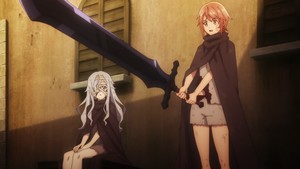
Roll Over and Die's premiere adheres to many of these aforementioned tropes. It takes place in a generic fantasy world suffused with RPG elements. Despite her selection as a hero, Flum's apparent weakness turns her into an outcast within her own party. Her closest female companion betrays her. Authority figures are shown to be manipulative and evil, while regular people look weak and self-absorbed. At her lowest point, Flum realizes that, despite the constant belittling, she possesses incredible power and saves herself. And after her self-redemption, she's awarded with a slave companion. That's just how these arcs go.
A reasonable question, then, is what makes Roll Over and Die more tolerable to me than its companions in this genre space. Thanks to “This Week in Anime,” I've sampled enough of these “kicked out of the hero's party” series to know that they are not my cup of tea. However, I watched one episode of Roll Over and Die and asked to review it. Why? My answer right now is twofold. First, look at director Nobuharu Kamanaka's pedigree, which includes the anime adaptation of Big Order. That remains one of my all-time favorite so-bad-it's-good indulgences, and I thought Kamanaka's direction fit the schlocky source material well. Here, he displays a similar aversion to subtlety, with the prison scene in particular exhibiting a comical degree of onscreen misanthropy. We have to watch and hear the piggish, wine-swilling slave owner laugh and jeer for an interminable amount of time, as we cut back and forth between Flum's invariably tragic flashbacks and the awkward zombie gore. We immediately know how this scene is going to end, yet we still have to watch it for ten entire minutes.
However, I did not choose Roll Over and Die solely as an ironic watch to laugh at. It possesses a more fundamental quality that intrigues me: it stars a queer woman heroine. Not simply a victim of circumstance, Flum Apricot is a member of an actual marginalized class, which adds heft to the core trope of rejection and redemption. Flum's presence also opposes the genre's misogynistic roots that snake all the way back to Shield Hero. I do not know whether the story is truly interested in developing womanhood or queerness as a theme, but I find it interesting that Flum is branded as a slave. The scar on her face makes her a visible member of an underclass to the people around her. While blunt and misguided, that might be the story's way of approaching the topic of discrimination. “Blessed are the weak,” and all that jazz.
Frankly, I am also just more interested in these kinds of stories when they are about women. I am not, nor have I ever pretended to be an unbiased critic. Moreover, I like Flum as a character. She lacks the embittered detachment and sense of entitlement we can observe in many equivalent male protagonists. Vengeance isn't her salvation and raison d'être. She saves herself when she decides to go down swinging rather than Roll Over and Die (get it?). The trauma of her abandonment informs her, but it doesn't consume her. While these are broad strokes, they're a fine foundation for further development.
Additionally, Flum's pluck draws contours against the dark fantasy setting. The adaptation can't do the monsters or gore much visual justice, so the anime relies on these shades of contrast to create any semblance of shock value. It's better than nothing, but a more confident, less bland, and bloodier production would have been ideal for this material. Abandon all taste and lean into the schlock. For instance, the corkscrew-cursed werewolf chimera in the second episode is a legitimately cool idea, especially when it infects Flum's arms and forces her to self-amputate before she twists herself to death. That's the kind of moment that gives Roll Over and Die a unique identity. How many anime explore yuri eroguro in earnest? It could be a killer in a show that didn't look like butt. Alas.
Milkit, unsurprisingly, is my biggest concern right now, next to the dull visuals. She is the requisite slave girl who only understands the relationship dynamics of slavery, so the hero has no choice but to enslave her to save her. Yuck. Nevertheless, this trope is a bit more complicated in Roll Over and Die. Like it or not, the sexual politics of Flum taking in Milkit are far different than those of Naofumi buying Raphtalia. No money is exchanged for Milkit either, and people perceive both her and Flum as slaves, so the power dynamic feels not quite as gross here. Still, if that's the case, one has to wonder why the slavery angle is even necessary. Does the narrative intend to explore it more thoughtfully, or is it checking another box?
This ties into the yuri component, which, by itself, is an uncommon selling point in this space. I'm glad the second episode explores Flum and Milkit's dynamic with slightly more depth. Don't get me wrong, nothing approaches the hand-holding close-up in the premiere (did you see how their fingers entwine???), but it's encouraging to see Flum's thoughts drift unconsciously to Milkit in the midst of her swordplay. Their scene in the river afterwards is functional but nice, with Milkit's fear of rejection assuaged by Flum's virtue of being a normal person. I just hope we witness Flum's conviction and Milkit's ambitions grow in tandem, because right now they're fairly one-dimensional characters.
I've already exceeded my word limit, so I'll save my thoughts on the worldbuilding for later. Suffice it to say, I've punched my ticket for the adventures of Flum Apricot and Milkit (and no, I will never get over how funny their names are). While these opening episodes don't deviate too much from the formula, they've deviated enough to draw me in. But can Roll Over and Die accomplish more? Can the director of Big Order and the power of yuri combine to elevate the “kicked out of the hero's party” subgenre? I'm cautiously optimistic.
Episode 1 Rating:
Episode 2 Rating:
Roll Over and Die is currently streaming on Crunchyroll.
Sylvia is on Bluesky for all of your posting needs. You are not allowed to ask her to roll over. You can also catch her chatting about trash and treasure alike on This Week in Anime.
The views and opinions expressed in this article are solely those of the author(s) and do not necessarily represent the views of Anime News Network, its employees, owners, or sponsors.
discuss this in the forum (8 posts) |

back to Roll Over and Die
Episode Review homepage / archives