

Answerman
Hiding Behind Pen Names
by Jerome Mazandarani,
A Reader asks:
"How does someone convicted of a serious crime simply reappear in manga under a pen name, and nobody raises a flag? Do publishers run any checks on the actual person behind the pseudonym, and why are pen names becoming more and more popular for manga creators, writers, and artists? Should proper background checks become a regulated part of the industry? Or is the manga industry one that simply operates on handshake relationships and mutual omertà?"
Content Warning: This installment of ANSWERMAN discusses sexual abuse and may be triggering to some readers. This includes material linked within the column.
It is incredibly depressing to be writing about yet another shocking sexual abuse scandal emanating from the Japanese entertainment and publishing industry. In February, news began leaking about a scandal at Shogakukan that has since sent shockwaves across the broader entertainment industry and the global manga fandom. At the centre is Kazuaki Kurita (better known by his pen name Shōichi Yamamoto), the creator of Daten Sakusen. In 2020, Kurita was convicted under Japan's Child Prostitution and Pornography Prohibition Act for offences against a 15-year-old student. According to a report in Unseen Japan, Kurita received a ¥300,000 fine for photographing the student in contravention of Japan's child pornography laws, and the abuse reportedly continued even after she had graduated. He paid a minor fine and disappeared from public view. Or so it seemed.
But he didn't disappear. He was rebranded. Under the new pseudonym Hajime Ichiro, he was quietly rehired by Shogakukan's digital platform, Manga ONE, to write Jōjin Kamen. He wasn't the only one; Tatsuya Matsuki, the writer of act-age, who was convicted of indecent assault in 2020, was also found to be working on the app under a different name. A truly shocking revelation, and one that throws the treatment of act-age artist Shiro Usazaki into sharp relief. When Matsuki was convicted, act-age was cancelled, ending Usazaki's run on the series through absolutely no fault of her own. To her enormous credit, she has rebuilt her career and is currently working on Ichi the Witch. The perpetrator, meanwhile, was reportedly allowed back in via a side door.
In case you aren't familiar with the term “Omertà,” it comes from Southern Italy and is a strict “code of silence” or conspiracy of silence employed by members of organized crime gangs. “Do nothing. Say nothing.” You may have heard lines to the effect in any number of crime thrillers like The Departed or The Godfather. It has become a popular term to describe a conspiracy of silence and inaction.
It is worth pointing out that there is no suggestion whatsoever of any connection between Japanese manga creators or publishers and the Italian Mafia. In this instance, as reported, the "omertà" wasn't just a lack of oversight. It seems to have been an editorial strategy.
To understand the gravity of this story, we have to look at the timeline. In May 2021, an editor at Manga ONE, the digital manga publisher owned and operated by Shogakukan (one of the "Big Four" Japanese publishing houses), reportedly joined a LINE group chat with the survivor and the perpetrator - Kurita himself. The editor didn't call the police. Instead, it is alleged that they offered the young woman ¥1.5 million (USD $13,700) in 'hush money' to sign a non-disclosure agreement, so that the manga series in question could continue.
She refused the “generous” offer. She chose the long, painful road of a civil lawsuit. In February 2026, the Sapporo District Court ordered Kurita to pay ¥11 million in damages. It sounds like a lot, but it really isn't. The USD equivalent of $72,500, which is best described as a derisory sum, but within the upper limits of compensation for comparable cases. The verdict, the handling of the case, the punishment, and compensation are a sad reflection of a system that is out of touch with contemporary attitudes, which protects predators and seemingly shames and punishes the people they harm. Nonetheless, it was this civil victory, not the publisher's actions, that finally tore the mask off "Hajime Ichiro." Japanese publishers generally do not run background checks on authors and artists before commissioning them. It is important to note that while background checks are common practice for corporations hiring office staff, mangaka are independent contractors. The vetting process tends to focus on their talent and pedigree, the commercial potential of their work, and positive references from other creators and peers in the industry.
To understand how this scandal was possible, we first need to understand why anonymity is so common in manga. Japan is a dense, interconnected society, and many mangaka live double lives by necessity. They hold down day jobs and are busy raising families in ordinary neighbourhoods, where the sudden exposure to "famous artist" status can invite stalkers, paparazzi, or the uniquely intense scrutiny of parasocial fandom. When a plot twist displeases an audience, the vitriol can be staggering. A pseudonym is a psychological firewall. "Hajime Ichiro" absorbs the hatred online, while "Kazuaki Kurita" can still go to the grocery store in peace. Publishers, for their part, actively encourage persona-building. After all, a clean avatar is simply easier to market than a real human being with a complicated life. The result is an industry where anonymity has become so normalized and structurally embedded that it is no longer questioned. I believe that is precisely what makes pen names so exploitable. The same tools built to protect creators from harassment can be quietly repurposed to protect criminals from accountability. It creates a "digital witness protection program" where no conspiracy is committed; it just requires everyone to keep on not asking questions.
Most Japanese editorial departments operate with a great deal of autonomy. A lead editor at a digital app like Manga ONE has immense power to scout and hire talent. In this case, it would seem that the editors knew exactly who they were hiring. The fact that the mangaka in question adopted an alias for their new project suggests they were aware of their prior actions and did not want to draw attention to themselves.
The most unprecedented part of this 2026 scandal is the reaction from other mangaka. In a move that would have been unthinkable a decade ago, some of the industry's biggest stars have begun what is starting to look a lot like a mass exodus from the Manga ONE app. It is difficult to confirm with 100% certainty that all of these moves away from the platform are an explicit boycott in action, but the timing suggests that it is more than a mere coincidence. For example, Rumiko Takahashi's legendary catalogue, which includes Inuyasha, is no longer available on the platform as of March 2026; however, the reasons for this have not been formally stated as of this writing.
Sports Nippon (also known as Sponichi) ran a news report on Friday, March 13, naming several manga series that have been removed from the platform, including the aforementioned titles. They have also listed several new titles as being removed “at the author's request.” In the case of Haro Aso's (Zom 100: Bucket List of the Dead), it is claimed their series was pulled “in protest.” In other news, Kanehito Yamada (Frieren: Beyond Journey's End) had announced in October that their popular series was on indefinite hiatus, citing health reasons; however, it wasn't until March this year that it was removed from Manga ONE. ONE, the creator of One-Punch Man, was more explicit, publicly condemning the editorial department and vowing never to work with them ONE, the creator of One-Punch Man, was more explicit, publicly condemning the editorial department and vowing never to work with them again.
I have summarised below a full list of all of the series reported removed from the Manga ONE App as of Friday, March 13, 2026, according to the Sponichi Annex website.
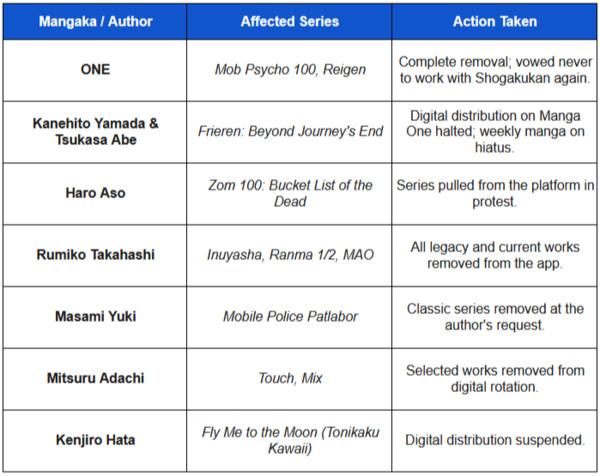
These creators aren't necessarily leaving Shogakukan, the publisher is too large a monopoly for many to quit entirely without facing serious financial implications, but they are refusing to lend their prestige to an app that shelters predators.
For decades, the Japanese manga industry could be accused of turning a blind eye to sexual abuse scandals. At the time, they could afford to. Domestic sales were king, but today, that is no longer true. Manga's future is global, and while large-scale international partners like Netflix and Disney have strict "Morals Clauses" in their contracts, when it comes to the hiring of talent, their Japanese counterparts do not. By hiding convicted offenders under pseudonyms, Shogakukan is failing both ethically and commercially, creating massive reputational liability for its international business. Manga's future is global, and while large-scale international partners like Netflix and Disney have strict "Morals Clauses" in their contracts, when it comes to the hiring of talent, their Japanese counterparts do not. By hiding convicted offenders under pseudonyms, Shogakukan is failing both ethically and commercially, creating massive reputational liability for its international business.
In case you were wondering, Morals Clauses are provisions that grant studios the right to terminate agreements immediately if a partner's conduct causes reputational damage. The language is intentionally broad: terms like "public disrepute" and "scandal" are designed to give Western conglomerates maximum discretion. In a licensing deal, these clauses are relatively manageable. But in the context of a joint venture or acquisition, and make no mistake, as domestic manga revenues shrink, those conversations are coming; they become something else entirely. Any serious buyer would require Shogakukan to legally warrant that no undisclosed scandals are lurking in their creator roster. After the Manga ONE revelations, making that guarantee would be impossible without carve-outs so large they would effectively kill the deal. A buyer would then face the unenviable task of auditing every creator on the platform to confirm that no other convicted offenders are working under aliases. A process so expensive and time-consuming, it could make the acquisition economically unviable before it even reaches the negotiation table.
Morals Clauses need not only be a weapon pointed at Japanese companies from the outside. Proactively implemented, they are a shield. A publisher that builds robust creator vetting, transparent disclosure protocols, and genuine accountability mechanisms into its contracts not only protects itself ethically, but it also makes itself a more attractive partner for the global entertainment ecosystem that now drives anime's commercial ceiling. The companies that move first on this will find international doors open to them. The companies that wait for a scandal to force their hand will find those same doors closed, precisely when the stakes are highest.
In a world where domestic readership and revenues are shrinking, while international audiences are still peaking, shouldn't publishers be accelerating their attempts to move with the times? It is not out of the question that one day, the Shogakukans and Manga Ones of this world will become an acquisition or JV target from an overseas partner. “Handshake deals” violate the Morals Clauses of many major global players, including Netflix and Disney. That could cost these companies in the long-term; however, in the immediate present, the implementation of the Qualified Invoice System is making it harder for publishers to hide a creator's real identity behind a pseudonym.
Known in Japanese as tekikaku seikyuusho, the Qualified Invoice System (or more simply the "invoice system”) came into effect in October 2023. Under the system, invoices can only be considered "verified" if individuals file them using their real names, and those names are accessible to the public via a national database. Although it is voluntary to file verified invoices, freelancers are strongly incentivized to participate to retain work, as publishers need their contractors to be registered to claim tax credits. The commercial pressure to register is, in practice, near-irresistible. For publishers who knowingly rehired convicted offenders under aliases, the invoice system introduces a new variable: a fully transparent paper trail.
Anonymity in manga is a sacred tradition. It allows creators to live private lives while telling public stories. But when a publisher uses that mask to smuggle a predator back into the marketplace, they break the social contract with the reader, and make no mistake, readers are furious. The backlash this time feels different. Perhaps thanks to ONE issuing a public statement on the matter. It is a scandal that has crossed over and repulsed a wide section of the global manga readership.
The "handshake culture" only works in the dark. Thanks to a brave woman who refused to be silenced and a group of superstar creators who refused to look away, the lights are finally turning on. The industry has been operating on omertà for only as long as it has been profitable to do so. I think that this sickening scandal and the reaction it has caused have blown that system to bits. Anonymity should protect the artist's peace, and not the predator's past. I sincerely hope this is a reckoning for the manga industry and that masks become a thing you only read about in the latest manga, while real accountability is something every participant in the industry is held to.
Do YOU have a question for the Answerman?
We'd love to answer your questions and especially encourage questions inspired by recent news and headlines.
However, READ THIS FIRST:
● CHECK THE ARCHIVES. Over the years, we've answered THOUSANDS of questions and might have already answered yours!
● We cannot tell you if or when a show will get another season, nor can we help you get in touch with any producers, artists, creators, actors, or licensors.
● Only submit your question once.
● We take questions by email only. (Tweeted questions get ignored!)
● Please keep your questions within a paragraph length.
●The email address is [email protected].
Thank you!
discuss this in the forum (1 post) |
