

Journal with Witch
Episode 11
by Sylvia Jones,
How would you rate episode 11 of
Journal with Witch ?
Community score: 4.6
At the end of the novel Detransition, Baby, Torrey Peters dedicates her book “to divorced cis women, who, like me, had to face starting their life over without either reinvesting in the illusions from the past, or growing bitter about the future.” As a newly out trans woman in the process of hitting that giant reset button, both the novel and the dedication made me stop and think. It is easy to feel alone and hopeless in my situation—that I am a freak anomaly, even among other trans people. However, Peters correctly recognizes commonalities among women who do not conform to the “normal” narrative pushed by society, especially in their lack of external support systems. Intersectionality is therefore not only sound, but advantageous. I do not walk an untrodden path. I follow in the footsteps of the myriad other women who have forged their own way. That thought comforts me.
To my pleasant surprise, Journal with Witch touches on this same theme. While the anime does not directly invoke transness as Peters does, it is nevertheless significant that a divorced woman, Makio's friend Motsu, talks to Asa about labels, identity, and actualization. Labels have their uses, but labels can also be traps. Motsu surely felt some obligation to the label of “wife” at the start of her marriage, because that role imparts privileges and security. By conforming to what a woman is “supposed” to be, Motsu was able to survive. This isn't necessarily sinister—it's just the reality of living in a patriarchy—but if the marriage is not working, then those benefits become shackles. A woman in Motsu's situation has to weigh the societal advantages of staying in a crummy (if not unhealthy and abusive) situation against the personal misery she accumulates as a consequence. There isn't a universally correct answer to that dilemma.
At some point, Motsu found her own answer, and it involved leaving her husband. We don't know anything specific about her marriage, other than that it ended recently enough for us to see the faint indentation of a ring on her finger. But she tells Asa about falling into the mold of the demure wife: being understanding, avoiding confrontation, putting others first, and never crying. It made her feel like she wasn't a person. And even though she took herself out of that situation, she still regrets the time wasted within it. That hits the core of me. If I had the chance, I'd grab the shoulders of my younger self and implore her to look beyond the labels that suffocate her. I'm sure Motsu wants to do the same. Absent time travel, however, she understands that the next best thing to do is to let the next generation learn from her mistakes. Despite the many legitimate fears and struggles, it is worth it to start over if that means living true to oneself.
Frankly, that's why I've been so loud about my transition on Bluesky (and, I suppose, on this site). I got the inkling I might be trans almost 10 years ago, and I ran myself ragged on my mind's hamster wheel for the next decade in a futile attempt to avoid the one thing I needed to do. Nothing was tying me to maleness besides inertia and society, but those were forces powerful enough to mire me in my miserable state. By the same token, there was not one single moment that pulled me out of the muck. It was a decade's worth of stories, art, anecdotes, thought experiments, friends, mentors, experiences, and professional help. I've gotten better about not beating myself up for taking so long. In fact, on good days, I feel lucky to be where I am, living authentically for the first time in my life. I had never considered that I could be this happy. Therefore, part of me wants people to look at me and my writing, and if they are similarly stuck, I want to be one of the hands that pulls them out.
I know a lot of what I've written so far seems more tangential than usual to the content of the episode I am supposed to be reviewing. You caught me. However, this is germane to an overarching compliment I want to pay Journal with Witch. That one little conversation between Asa and Motsu took me down this road. This might be only the second or third time we've heard Motsu speak, yet the writing finds enough space to provide her with depth and authenticity. I see myself in this woman. I empathize with her. I understand what she's saying to Asa and why she is saying it. It's the same advice I would want to give to a young girl struggling with her identity. I think that's an incredible testament to the incisive humanity at the heart of this series. Journal with Witch paints an entire tableau with a few lines of dialogue. It casts light onto indeterminate shapes lurking within my soul.
Of course, I also understand Asa's situation. To stand out or not to stand out. That is the question. Up until very recently, I lived my life under a protective shroud. I was the “default,” so it was easy to make people not notice me. That's a very real privilege I am throwing away, because I am going to be visibly trans in the short term, and it's possible (perhaps probable) I will be for the rest of my life. I can't lie; that terrifies me. I feel Minori's anxiety about suddenly becoming the nail that sticks out. I did not live my life preparing for this. I did not choose this. I want to fade into the background like Asa's dad. And like Asa, I have specters haunting my thoughts and tempting me with their invisibility. The other night, I dreamt that I was back in high school, introducing myself with my new name and pronouns in front of the entire class. I felt my face flush red under their stares. I heard my heartbeat pound in my ears. Why do I have to be singled out and noticed? Why do other people have to care? Why does Minori have to call Makio conceited when she knows that it will hurt her sister? Why does a prestigious medical school have to disenfranchise female applicants? Why them? Why us? Why me?
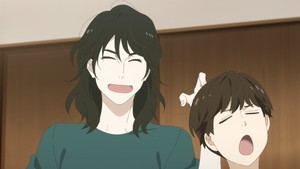
In spite of these headwinds, Asa makes the same conclusion I made. She takes a chance and sings because the alternative is just too overwhelmingly sad. If she stands out, she will find the people who truly support her. If she has second thoughts and disappears like Chiyo, she will have friends who look out for her. And if she grows more comfortable with her own quirks, she will better understand her aunt, her best friend, and everybody else who doesn't fit society's ideal mold. These benefits are worth the risks.
Finally, all of this ties back to the most important bit of wisdom Makio imparts this week: “There isn't a single thing in this world completely irrelevant to you.” We cannot know for sure who our allies will be or where they will be found. Trans women and divorced women know pain and freedom alike. Chiyo and that baseball player refuse to silently acquiesce to the rigged and abusive systems of patriarchal control. Makio and Asa continue to find common ground and compromises between their different walks of life. In the process of transitioning, I've connected with old friends and new acquaintances in ways I had never even considered before. It takes strength to be oneself. It takes humility to listen to others. While these forces appear oppositional, we can balance them, and in doing so, we grow as individuals and collectives. I believe that is our only way forward.
I recognize the irony of pontificating about the pros and cons of visibility in an essay on a platform that will project my words into an entire internet's worth of potential readers. I know that being a trans woman in the public eye opens me up to heightened scrutiny and dire consequences for stepping out of line. If I were a more disciplined critic, I could rewrite this review to make the same points without leaning so overtly on my lived experience, especially when I consider how raw and in flux that experience is, emotionally and existentially. That would be the smart thing to do. But Journal with Witch emboldens me. This adaptation and its quiet wisdom arrived at the exact point in my life when I needed them the most. Watching it heals me. Writing about it nourishes me. I am thankful to be in my position, and in allowing myself this moment of heightened vulnerability, I hope I have communicated what this anime means to me—and what it might mean to you.
Rating:
Journal with Witch is currently streaming on Crunchyroll.
Sylvia is on Bluesky for all of your posting needs. She is a witch-in-training. You can also catch her chatting about trash and treasure alike on This Week in Anime.
The views and opinions expressed in this article are solely those of the author(s) and do not necessarily represent the views of Anime News Network, its employees, owners, or sponsors.
discuss this in the forum (69 posts) |

back to Journal with Witch
Episode Review homepage / archives