

Making 'Bad' Animation Beautiful: An Interview with ChaO Director Yasuhiro Aoki
by Andrew Osmond & Richard Eisenbeis ,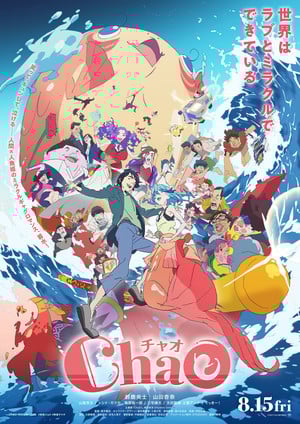
ChaO's boy-meets-mergirl premise might not sound too different from Ponyo or Lu over the wall. A surprised young man, Stefan, finds himself suddenly betrothed to ChaO, a mermaid princess. However, ChaO brings some important changes.
The setting isn't Japan, but a radiantly depicted Shanghai. Then there's the fact that the title character is mostly shown as a human-sized walking fish, although at certain points in the film she's shown in a far more "human" form. Moreover, she hardly looks unusual in the film, which has some of the oddest, most whimsically uncontained character designs you'll see this side of Yellow Submarine.
How did the concept for this film come about?
Yasuhiro Aoki: Over 15 years ago, I created the music video for Kumi Kōda's Amazing Nuts!: Tatoe Kimi ga Sekaijū no Teki ni Natte mo. Back then, we were talking about maybe someday making a movie out of it. [...] When I got the offer for this project, ChaO, I thought this would really match the theme of the music video we did 15 plus years ago. It was a different theme, but I would say the project started then.
As this story is clearly based on The Little Mermaid fairy tale, did you ever think about the Disney classic when making Chao? And, once your film was released, did you ever worry about being compared to the Disney film?
Yasuhiro Aoki: The Little Mermaid is also centered around mermaids, so it did actually come to my mind from time to time. I would say that Disney is really good at making entertaining films—especially for children. And I wanted ChaO to be that kind of movie. But if we just followed in Disney's footsteps, we couldn't go beyond that. So I was trying for a different angle.
When watching the film, some viewers might think that Stefan is being really nasty and cruel to ChaO, and other viewers might think Stefan's been put in an impossible, ridiculous situation. Did you intend to divide viewers, and are you on the size of one character more than the other?
Aoki: I'm on Stefan's side. As a guy, it's easier to put myself in his shoes, and actually, it's not so much that I'm on Stefan's side, but I feel like I am Stefan. I was drawing myself.
Why was the framing device, the story of the journalist, in the film? What did it add to the story that would be absent without it?
Aoki: I would say that it's not very fun to just focus on the main characters. Those supporting characters also have their lives and their stories. In that way, the journalist is like another main character. And, in the end, he confesses to the Editor-in-Chief—and you find out that the Editor-in-Chief is also a mermaid. Stefan also had to become brave enough to confess to a mermaid as well. So, in a way, it's a dual story. And there is also another story about Stefan's friend, Roberta, and how he wants to confess his feelings [to the woman he likes] but can't. So one fun part of this movie is that it's got three stories going on at the same time.
Your film looks unlike any other anime film. Do you remember a time when you started feeling that you wanted to make animation that looks and feels different from anyone else's?
Yasuhiro Aoki: I think everyone wants to make something that's individual. But the thing is that we all tend to watch the same things, and there's a lot of great stuff out there, but subconsciously, it means we all end up going in the same direction. But with ChaO, I just did what I wanted to do, and I've always liked looking at things from a different angle, and finding something different, and I think that's what I've done.
Can you expand on that a bit?
Yasuhiro Aoki: In Japan there is this art style called "heta-uma." "Heta" means "not very good," so the drawings may not look good—they look almost like a kid's drawing. But, of course, in this project, the animation was drawn by professionals, so the quality is actually very good.
Each studio has a different style. Some studios require me to draw in a very realistic style. And some people keep doing things in the same style, but I would rather do something new, challenge myself with a new style. In that way, I can keep my motivation. That's why I chose ChaO to be my next project. This is a film with a comedy touch—a little nonsense. It was very fun.
The flashback scene with Stefan and the bullies felt reminiscent of how young children draw pictures where people have strange shapes and proportions, and can look wildly different from each other, much like the characters in ChaO. Were you partially trying to catch the feeling of children's drawings?
Aoki: The character designer, Hirokazu Kojima, created that variety of characters. From the start, I was thinking about how far I could push different elements, and with the characters, I initially thought of them as a big round character, a long thin character, a very, very small character, a very, very tall character… And I decided that if those characters worked, then I could also push the story.
Early on in the film, there is a scene where Stefan meets the boss in the office, and the boss is this amazing Humpty Dumpty shape, and they're just talking together, like ordinary people. Were you confident that audiences would accept this kind of world? Have you sat in the cinema with the audience to see how they're reacting?
Aoki: I have watched it with audiences. Having watched numerous animations since I was little, I've encountered a wide range of animation styles. The animation style of ChaO wasn't meant to feel uncomfortable, but I feel like what's happened recently is that animation just seems to be going in one single direction. And so these kinds of characters feel unusual and are harder to incorporate. But I think it's animation; there's room to be much freer with what we draw, even if nowadays it feels harder to do something different. That's the impression I get.
Many of the shots of the Shanghai scenery are densely detailed, as in the early sequence when Stefan is walking to work. Some of these shots are only visible for about a second. The artists spent so much effort on something that's on screen for such a short time. Is that psychologically hard on them?
Aoki: I think you're exactly right, but drawing lots of things that only appear for a very short time is the fate of the animator. I went to Shanghai with the art director [Hiroshi Takiguchi], and he was overwhelmed by the amount of detail that there was just in that location, but you can't think that this is only going to be on screen for a second. You have to get it all in, or with ChaO, at least, it wouldn't have worked. So I think that was a bit tough for him.
Had you visited Shanghai before you made ChaO?
Aoki: I hadn't been there before. Shanghai is in Asia, as is Japan, but it felt like a place, a country, a city, a people who take up a different space than Japan. And so I felt that ChaO would take place not in Japan but in Shanghai, which has similarities to Japan, but at the same time, it felt like there was more room for the fantastical.
There are some classic films about transformation, like the films of Beauty and the Beast, where many people say they prefer the appearance of the Beast in his less human form. In the case of ChaO, have you heard from any people who said they prefer her in her fish form rather than her more human form?
Aoki: Yes, most people say they find (the fish) version of ChaO cuter. I like both, but it seems like she's had quite an impact; she's captured people's hearts in this form.
There is one particular moment when we see ChaO transform from her mermaid form into her fish form. It was an amazing moment; can I ask who animated it?
Aoki: The animator was Kanchi Suzuki. The thing with that transformation is that usually you see the fish becoming the mermaid, but here you see the mermaid going back to being a fish. And for the first time, you see that happening head-on. And the reason for that is that the process of transformation, part of it at least, is quite grotesque. And ChaO herself probably doesn't want anyone to see that happening. It's a sad moment for her, but at the same time, people can see this transformation happening to her, and so it's quite cruel and memorable for that reason.
Can you talk a bit about ChaO's mouth when she is in her fish form, which looks very strange in many shots; for example, in the wedding scene where she's wearing big lipstick
Aoki: The character designer, Kojima, lives alone, with four cats. It's quite unusual for a guy to have not just a cat, but four cats, and feed them every day. He really loves cute things. I think the character of ChaO is liberally sprinkled with the love of Kojima. But for more than that, we have to ask him.
Why did you choose those realistic, detailed backgrounds to go with the surreal character animation in the film?
Aoki: In this movie, we were trying to find a balance in the gap—the contrast—between the two. Because this is an animated film, we wanted to try something that only animation can do. There are many movies where the characters, as well as the backgrounds, are realistic. But we wanted to try something new.
So there are many characters—big ones, small ones, round ones—and we wanted to see how nonsensical we could get. We also wanted to experiment to see if it looked okay with these stylized anime characters on a realistic background.
Also, as you may have noticed, the first half of the movie is a straight-up comedy, but then, coming to the end, it becomes more serious, Of course, as human beings, we all have many faces—like a public face when you're out and about or a private face when you go back home and you feel really relaxed. It's different. But that's the fun part of it. We tried to show that [difference between public and private faces] in the movie.
Then, as the story goes on, Stefan becomes more reliable and tries to do everything for ChaO. And there is this scene—dancing with ChaO [around a Tao-shaped fountain]. There was this concept of Yin and Yang in China—the balance of light and shadow. That's what we were trying to show in this movie—the gap and the balance.
In another interview, you've said that Studio 4°C has changed the animation scene in Japan. Can you say any more about the importance of Studio 4°C?
Aoki: I think the design of ChaO and the drawing style and the directorial choices... There are lots of animation studios in Japan, but not many of them would have greenlit ChaO. That's not everything that Studio 4°C does, but the fact that they try to do something different makes them unusual, and I'm grateful that I got to work with them.
You worked as an animator on Studio 4°C's film Mind Game, directed by Masaaki Yuasa. Do you remember which parts of it you animated?
Aoki: I came on board with Mind Game quite late. It was nearly finished, and I had a meeting with Yuasa, and the bits he wanted me to do were the first shot and the last shot. I said, "We were quite far into the project. Why has the first shot not been done yet?" And it was because the first shot and the last shot were the same, although they're slightly different. After all, the character has grown and developed. That's why they hadn't done it yet.
discuss this in the forum |
