

The Best Anime of Winter 2026
by The ANN Editorial Team,
This winter season offered a bounty of viewing choices. For the first time in a while, I found myself stretched between girls murdering one another in death games, a heartfelt family drama about grief and identity, cackling historical heroes, and at least two anime about maladjusted idols vying for attention. Jujutsu Kaisen's Culling Game Arc also came out swinging with an attack pointed directly at Japan's criminal justice system (plus a battle that included surfboards). For once, there truly seemed to be something for everyone (except mecha fans, I know it was a dry season for you).
Below are the top 10 anime of the Winter 2026 anime season. Let us know which ones you watched, made your top 10, and what anime you bounced off of in the comments.
10. The Invisible Man and His Soon-to-Be Wife
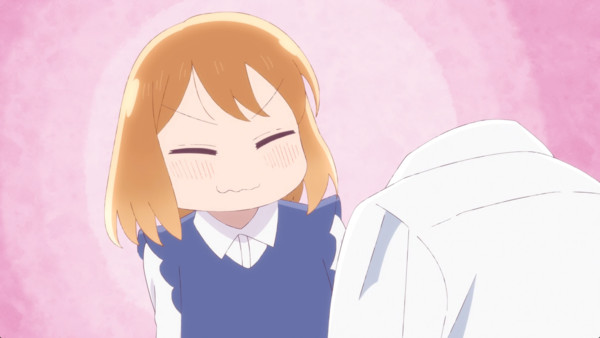
Remember that Twitter hot take about how Guillermo del Toro isn't a “monster f***er” but a “monster lover?" The Invisible Man and His Soon-to-Be Wife is an anime for the monster lovers out there, a fantasy of slowly romancing an invisible gentleman where each new step in the relationship — every date, every kiss, every touch — fills you with excitement as your kokoro goes doki-doki. It's incredibly cute, almost sickeningly so, but when you're in the mood for something sweet, this is easily one of this season's most enjoyable anime options.
The Invisible Man and His Soon-to-Be Wife has a lot to love, even beyond the sheer adorableness of its central romance. The show is wonderfully inclusive. Yakuo's blindness might have been conceived as a narrative convenience for why she's not creeped out by her invisible coworker, Tounome, but the writing goes the extra step to offer a thoughtful and realistic representation of how she navigates the world with her disability. The series is also queer-friendly, with the gay couple of Kikira and Madaraito offering Yakuo and Tounome a model for a successful relationship between people with very different personalities.
The fantasy setting, filled with demihumans of all sorts, is a fun playground for both the comical mysteries of the week and more sensitive personal drama. The badass bobcat woman Jarashi gets the best subplots — dealing with body image issues undercover at a maid cafe in one episode, beating the crap of kidnappers in a well-animated fight scene in the next — and is my personal pick for “Best Girl” of the season (if my “I'm not a furry, but…” list gets too long, do I have to make a fursona?). Tounome's struggles with prejudice and implied abuse lend darker levels to a mostly lighthearted series. As of this writing, we've yet to meet his family, but I'm expecting the upcoming trip to the invisible people village to be intense.
The Japanese voice actors are all very good. I have to give special praise to Yohei Azamaki's performance as Tounome for making us love a character we only experience as a voice and floating clothes. I do, however, have to take the time to complain about Crunchyroll not producing an English dub. Shouldn't a show with a blind protagonist be made available in more accessible formats for blind anime fans in the States? Hopefully someone dubs it later; anime this warm and wholesome deserves to be made accessible to as many people as possible.
—Reuben Baron
9. The Holy Grail of Eris
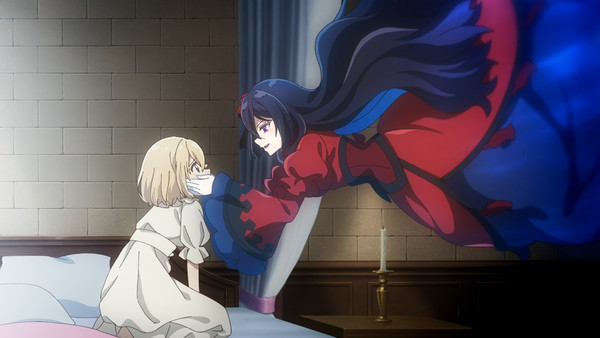
While the villainess stories haven't been run into the ground to the same degree as their male isekai counterparts, they have started to suffer from a similar degree of predictability in their setups. You can almost always count on them starting with our heroine losing their usually terrible fiancé to some other girl in a show of public humiliation, only to enact some sweet vengeance on the people who wronged her, while usually trading up for a better partner along the way. It's a perfectly functional formula for what it is, but sometimes you want something a little different, and it's hard to get more different than: “what if a villainess show was Yu-Gi-Oh! with court intrigue?”
Our primary heroine, Constance, is a poor, gentle-hearted noble whose attempt to marry her family out of debt nearly gets her falsely accused of a theft by a jealous rival, until she's rescued by the spirit of a haughty noblewoman named Scarlett, who agrees to help her out, but only on the condition that she helps solve the mystery of her execution.
Now, the Yu-Gi-Oh! comparison here might sound insane to anyone who only associates that series with card games or internet memes, but a big part of what made the original manga work was in the relationship between two Yugis, and a lot of that gets replicated here with Constance and Scarlett. Much like Yami Yugi, Scarlett tends to act as Constance's bolder half who has the wit and natural confidence to help give all dangerous nobles they face off against the comeuppance they deserve, while similar to regular Yugi, Constance's kind demeanor makes her better at empathizing with others, which helps to keep Scarlett's vengeful attitude from spiraling too far out of control. This dynamic makes it pretty easy to get invested in both leads. While Scarlett is the bigger standout of the two, it's still fun to watch them bounce off each other and see them start to gradually influence each other as the story progresses.
Now, if that were all it had going for it, The Holy Grail of Eris would still make for a unique villainess series, but what really makes the show work is how well it mixes those elements, with the greater mystery surrounding Scarlett's murder. As someone who often has trouble keeping up with these kinds of court intrigue dramas, it's hard to gauge exactly how well it manages to tie all of its various threads together. However, aside from occasional pacing issues, I still found myself generally impressed by how well it consistently builds on seemingly inconsequential events, and even as the cast expands with each passing episode, the show keeps enough focus on the leads to prevent the scope of its story from becoming too overwhelming. While it doesn't quite have the same level of worldbuilding or character writing as series like YATAGARASU: The Raven Does Not Choose Its Master or The Apothecary Diaries, there's plenty here to satisfy fans looking for a similar style of mystery drama. It delivers just enough clues from episode to episode to stay consistently engaging. It's proof that there are still plenty of ways to put a unique spin on the familiar beats, and even in a season as stuffed with quality as this one, it's a more than worthy contender for one of its strongest entries.
—Jairus Taylor
8. Frieren: Beyond Journey's End Season 2
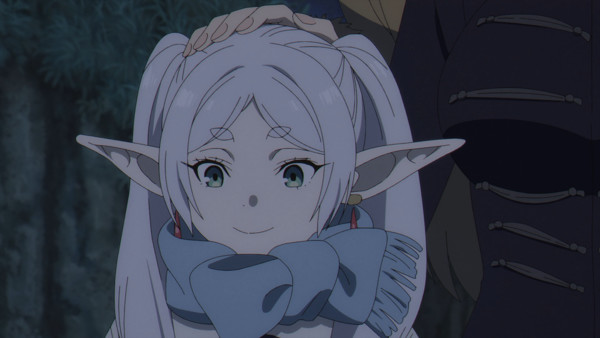
Is there any question in anyone's mind that Frieren: Beyond Journey's End is a modern classic in the making? Studio Madhouse's incredible 28-episode first season was practically pitch-perfect in every regard, from its gorgeous aesthetics and wonderful music to its thoughtful and often inspired adaptation and expansion of the source manga chapters, and a masterfully balanced mix of wry humor, spectacular action, and deeply evocative emotional moments. With a two-year wait between seasons, it wouldn't be hard to cynically expect that any subsequent season would struggle to reach the heights of the first. Yet, Madhouse and new director Tomoya Kitagawa have somehow achieved the impossible: season 2 is easily the equal of its predecessor in every single aspect. Frieren is now the new gateway drug to recommend to potential new anime fans, with the only downside that almost no other anime can hope to measure up.
The second half of last season comprised the show's unique take on a shonen battle story structure, which some viewers enjoyed slightly less than the first half's more stand-alone, contemplative stories. With season 2, we're mostly back to that structure, with our central trio of immortal elf Frieren and her two much younger companions, newly-qualified First Class Mage Fern and axe-wielding aspiring hero Stark wandering the countryside of the continent's Northern Plateau. It's a dangerous place, and they frequently find themselves in danger from various slavering beasts and itinerant demons. Yet, they find plenty of time for sweet diversions and amusing mini-adventures.
All three characters are a joy to spend time with, and their easy interactions are almost effortlessly entertaining (except, as a writer, making characters interact like this is anything but effortless). Frieren herself is an odd mix of wisdom and innocence, at once a chilled grandmother-like figure, while also retaining many childlike attributes. Her motivations are simple: offer her a grimoire with a seemingly pointless spell, and she'll do anything, as hilariously demonstrated when she allows cute thing-obsessed mage Methode to pet her head, much to possessive foster daughter/carer/apprentice Fern's chagrin.
Most episodes feature charming yet melancholy flashbacks to the time Frieren spent travelling with the now-deceased hero Himmel, whom we know loved her and whom she didn't notice. These flashbacks are cleverly structured to act as counterpoints and commentaries on Frieren's present-day adventures. The show conjures in its viewers the most delicious mixture of nostalgia, longing, excitement, and comfort. There really isn't anything else quite like it.
At only ten episodes, Frieren Season 2 is disappointingly short, but it takes a long time to make animated shows of this exceptional caliber. We should appreciate that Madhouse continues to invest time and effort in preserving the quality of this wonderful show. With the latter episodes of this season once more upping the drama and adopting a more serialized arc, there really is something for every fan of the show. Alas, it's all over too soon, and the painfully long wait for the surely inevitable third season will afflict us all.
—Kevin Cormack
7. Golden Kamuy Season 5
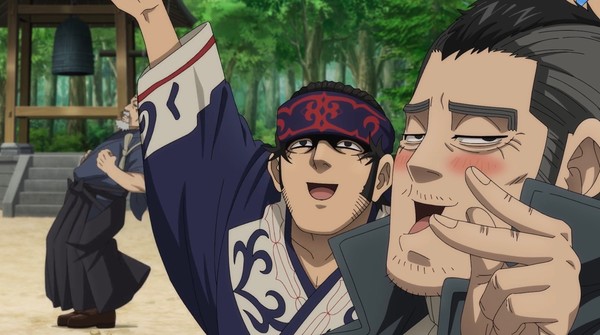
What was the wow factor that made Golden Kamuy the show I was most amped up to watch week after week? It wasn't the animation, which has been troubled for various reasons since its first season (we all remember that CGI bear). It was certainly not the gory content (you should not watch this show while eating). Instead, it was its captivating story, which has lost none of its verve throughout five seasons and has been consistently told through an irresistible blend of action and comedy that walks a tightrope between sincerity and irreverence, endearing its audience to the heroes and villains alike. It impressively navigates an enormous cast and a historical topic that I, for one, was unfamiliar with to tell a human story that can be universally understood. In its fifth and final season, Golden Kamuy has accomplished the rare feat of flawlessly sticking the landing, delivering on all of its promises in a literally explosive finale that demonstrates how carefully everything was planned from the start.
Break down Golden Kamuy to the sum of its parts, and it feels like too much for one series to handle. It's a gritty historical war drama. It's a celebration of Japan's indigenous Ainu population. It's an absurdist comedy. It's a character-driven mystery with everything at stake. It's unapologetically queer. It's a challenge to pin down because it doesn't feel like all of that should work together so well. But the special sauce of Golden Kamuy is its unpredictability; you never know what it's going to throw at you next. Take a critical turning point in season five that features the death of a beloved character. We've barely mourned him before a slow-motion car crash has his corpse rocketing into a building with a slide-whistle sound effect. You feel bad cracking a smile, but how can you not? Light and dark and pain and humor all blend in a rhythm that would be out of place in any other show. But here it feels bizarrely relatable, like it's imparting wisdom on the audience about the nonsensicality of life.
No part of Golden Kamuy has been a slog, but season five still feels like a reward for getting all the way to the endgame. More than any other season, each episode has had an enormous pay-off, whether it was a tantalizing bit of Lt. Tsurumi's backstory that fits in the final pieces of the puzzle that made him into the twisted man he is today, or the real story of Wilk's daring escapades that were only alluded to until now, or the long-awaited discovery of the gold at last. Even in its most dramatic moments, the show retains its bizarre comedic timing; Tsurumi's aforementioned backstory reveal is punctuated by his all-too-in-character choice to don a human skin mask. There was at least one moment every week that shocked and surprised me, and had me telling friends, “You need to watch this week's Golden Kamuy ASAP so we can talk about it.”
It's impossible to discuss this show without remarking on its sparse animation, defined by many cuts that just pan or show talking mouths. The show's behind-the-scenes issues have officially permeated all five of its seasons. Even so, it managed to deliver so much expressiveness with so little. I'll never forget the way Lt. Tsurumi's eyes darted back and forth like a Kit Cat Klock when he was this close to breaking the code of the tattooed skins. Plus, the decision to end the sequence with Sugimoto performing a solo interpretive dance that incorporates his history and the show's story was deeply evocative. It's this economy of animation, combined with very strong source material, that allows Golden Kamuy to triumph over its production woes. Just like its story about a motley bunch of heroes overcoming all the odds, this marvelous show made it to one impressive finish line without missing a beat.
—Lauren Orsini
6. Oshi no Ko Season 3
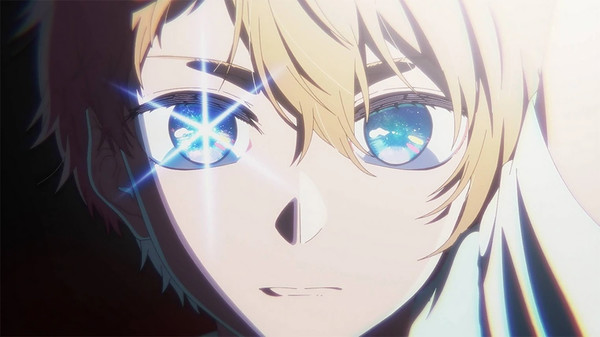
I know there's been a lot of discourse around Oshi no Ko, especially considering the very loud reactions that the internet had to the last couple of chapters of the original manga run. I can understand why many people view this adaptation as tainted by the expectation of what is to come. However, while a divisive ending can certainly leave a bad taste in your mouth, I don't think that should negate the quality and pathos the staff has clearly poured into this anime adaptation, which has only elevated the mostly strong writing of the original material. It's a shame the series isn't talked about as much as it was when that first season took off, because season three has been just as good as that first season, if not better in many ways.
After the hard shift Ruby's character underwent at the end of the second season, season three has balanced out the characters through distinct points in their arcs. Not only does it follow through on Ruby's downward spiral and how it parallels Aqua's journey, but many of the side characters also have strong moments of personal growth. Kana comes into her own as a character, wrestling with her feelings for Aqua without being dominated by them, and, once again, the insight into the entertainment industry is bone-chilling in its accuracy. If anything, seeing how Ruby utilizes the rather dark, underhanded nature of the entertainment industry for her own benefit was incredibly fascinating, especially since things like notoriety and exposure are tied to different elements of online culture. This season was the most relatable to modern-day problems.
Of course, the actual presentation and direction elevate these poignant writing moments to be far more memorable than I think the manga ever could. The voice actors continue to deliver extremely vulnerable performances, even when their characters enter morally gray areas. Everything is framed to hit maximum emotional impact from the first episode. While the upcoming series climax could leave a sour taste in viewers' mouths, we have to credit the story's compelling journey.
—Bolts
5. You and I Are Polar Opposites
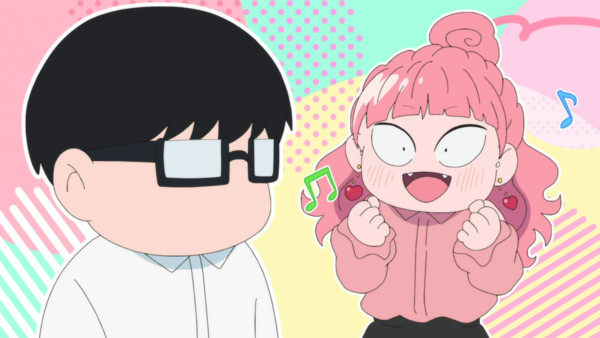
When you get down to brass tacks, a romantic comedy only needs to accomplish two things to be successful: It has to be romantic, and it has to be funny. This is a deceptively simple checklist to clear, especially in the realm of the two-dimensional, as any seasoned anime veteran will tell you. You can stick as many couples together on screen as you want and force them into all manner of absurd shenanigans, but few things are harder in the world of entertainment than earning an audience's genuine chuckles or the pitter-patter of their racing hearts.
What makes You and I Are Polar Opposites such a treat is how it all looks so easy when Miyu Suzuki and Yusuke Tani are lighting up the screen together. Thanks to their simple yet striking personalities, the pair have a genuinely sweet and easygoing chemistry that makes it impossible not to root for them. Miyu is a messy, weird, and delightfully awkward little gremlin who has enough personality to fill the molds of ten vacuous self-inserts from lesser love stories, and the animators at Lapin Track clearly delight in bringing all of her cartoonish mannerisms to life. Yusuke, for his part, walks the very fine line that separates introverted but meaningfully developed Shy Guys from the legitimately boring voids of personhood that have ruined many a rom-com in the past. His more reserved and straightforward nature is often the source of the show's funniest joke, but we're never laughing at Yusuke's expense. This is simply a story crafted by people who remember what it was like to be a kid and have enough good grace to laugh at the silly quirks and differences that make relationships so exciting and invigorating.
It's one thing for an anime to be a good comedy. Difficult, yes, but with the proper understanding of timing and human nature, a cartoon doesn't have to work too hard to get a laugh out of its viewers. To wrap that comedy up in a romance that feels so vibrant and infectious, though, is a real feat that deserves recognition. I can't tell you how many genuinely funny anime I have seen hit the proverbial brick wall once we're supposed to actually get invested in whether or not its protagonists will get their love confession out of the way after a dozen-or-so episodes of fruitless pining. With Miyu and Yusuke, though, the confession is the foundation of all the fun times and heartwarming memories to come, and that makes all the difference. You and I Are Polar Opposites is one of the season's best anime because it reminds us that, at the end of the day, falling in love is supposed to be fun, darn it. Now, if you'll excuse me, I have the sudden urge to drop everything I am doing and take my wife out for a night on the town.
—James Beckett
4. Tamon’s B-Side
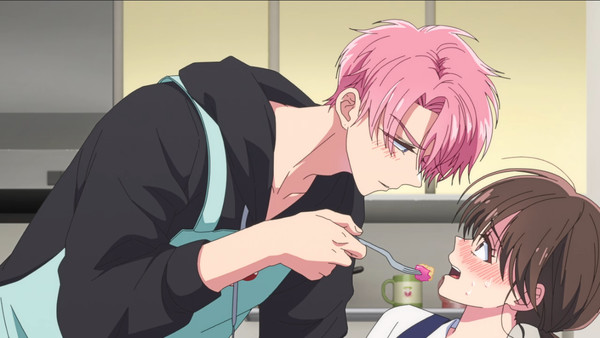
Tamon’s B-Side is kind of, sort of, more or less what I wanted Oshi no Ko to be. While both promise to be a more robust examination of what it's like to be a public-facing person in the Japanese entertainment industry, I found that the latter often took itself and its central murder-mystery plot far too seriously. Tamon’s B-Side, though, manages to be an equal parts comical, cute, and genuine in its exploration of what it's like to be, or be around, people living under intense public scrutiny and who might be more comfortable in character than as themselves.
While I initially found Utage Kinoshita's adoration for the idol Tamon Fukuhara a bit alien as someone who's never fallen too deep into fandom culture, once the two have a more established relationship, I quickly grew to appreciate their blushing, exclamatory interactions. As ridiculous as their relationship is, it's also rooted in both of them becoming more complete people in a way that feels true to life. Utage helps Tamon navigate his more depressive tendencies and offers him the reassurance and confidence that he doesn't hold internally. Meanwhile, Tamon provides Utage with a fantastic lesson about how a person she idolizes can have faults simply because they are multifaceted. I'm a big believer in real-life and fictional romance needing to be grounded in the betterment of the individuals that make up said romance, and Tamon’s B-Side understands that out of the gate!
Beyond Tamon's timid and anxious personality, Tamon’s B-Side also gives some great perspectives on the kinds of baggage people bring to an entertainment career, or the kinds of baggage that industry can create via his bandmates in F/ACE. For instance, Keito is just doing this kind of work for the money, while Rintaro's enthusiasm for this industry is more genuine; he's also a big ol' nerd who maybe believes too strongly in the media's ability to affect people. Tamon’s B-Side isn't exactly a deep dive into the trials and tribulations of being a celebrity, but it does have just enough commentary built into its story and characters to feel like more than just a love story.
What it is for sure, though, is gorgeous! Whoever at J.C. Staff made the call to take all the resources that could have gone into last season's One-Punch Man season three and instead pour them into Tamon’s B-Side absolutely made the correct decision! While I've never been the biggest shojo appreciator, I've long thought that the aesthetics of shojo manga haven't transferred well to anime since much of the industry switched to digital animation. It's a delight to see everyone and everything in this show look so good! I know that no single work can undo the largely sexist trend of media geared towards women getting limited resources and little to no promotion, but Tamon’s B-Side is bucking that trend and has already proved that shojo anime are worth investing in by being one of the best releases of the Winter 2026 season.
—Lucas DeRuyter
3. SHIBOYUGI: Playing Death Games to Put Food on the Table
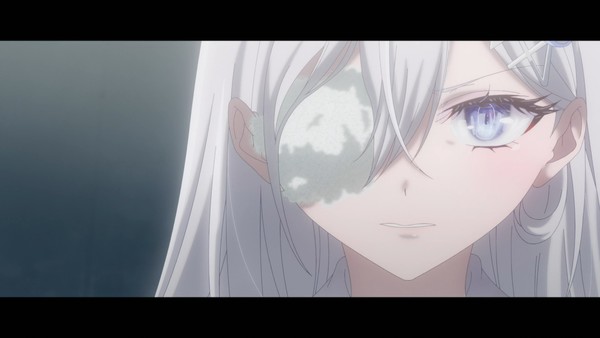
I am writing this entry on the morning after the SHIBOYUGI finale aired. This was not my plan; I had intended to do so last night. I budgeted enough time after work to catch up with the second half of the season, watch the finale, and have about an hour remaining in my evening to draft my overall impressions. Instead, I found myself catching my breath in the wake of the heaving sobs that the last episode ripped out of me. I steadied my body enough to throw a few posts onto Bluesky, but that used up all the energy I had left. I crawled into bed and slept through the night without interruption for the first time in weeks. I almost cried again when I looked at my phone and saw my usual wakeup time. I was so happy. SHIBOYUGI drained me, and it renewed me.
I know that the introduction doesn't tell you anything concrete about the anime. I'd usually utilize this space to talk about character, narrative, themes, adaptational choices, or any of the other facets that make up any given series. With SHIBOYUGI, however, I believe its quintessence lies within the depths of my visceral emotional reaction. A plot summary does the show an injustice. Describing it as a character study gets closer to the truth, but even that falls short. Certainly, director Sōta Ueno's patient, cinematic approach infuses SHIBOYUGI with the heightened introspection that defined his adaptation of Days With My Stepsister. The lurid subject matter—a capricious anthology of death games that literally turns young girls into disposable dolls—also gives SHIBOYUGI a richer palette and a wider audience to work with. This has a simuldub. They wanted it to be a hit.
Ueno, however, understands that SHIBOYUGI's story has two main prongs supporting it. The first is cruelty. The whole setup is cruel, as it relies on its participants' collective desperation to drive the gearworks of its gaping meat grinder. Yuki steels herself, numbs herself, dissociates herself, soothes herself, and keeps refining her coping method after dozens of successful games. Outside, the intersection of the universe and society is so intolerable that the girls come to prefer the structure and predictability inside these deadly contests. We all have to put food on the table at the end of the day. We make do. Like extremophile bacteria, we learn to thrive in situations that should destroy us.
While the metaphor for modern capitalism is blatant, SHIBOYUGI's focus is much grander in scale. I think about Azuma, one of the few and fleeting friends Yuki connects with during her playtime. I think about Azuma, who in the span of about a minute, describes the unbearable pain of gender dysphoria in loud, clear, and unambiguous language, concluding on the note that “slitting someone's throat and killing them is easier.” I think about Azuma, who is not seen again.
The other prong is love. Despite Ueno's propensity for lingering, he does not gawk at the worst of SHIBOYUGI's atrocities. In fact, the camera deliberately avoids most of them. Instead, he pulls the audience in close enough to hear a girl's breath brush against the ear of her partner. SHIBOYUGI freely admits that its world is twisted, yet nothing stops these girls from loving each other, over and over, mistake after mistake, and heartbreak after heartbreak. Love is powerful enough to overcome that cruelty. In fact, love is powerful enough to subsume that cruelty. Love keeps that grotesque form intact while adorning it with the appearance of softness, like cotton spilling out of a festering wound. It's a rabid love that scrapes her claws until her partner's insides are completely hollow, as both girls collapse, wailing as one when they have nothing left to give each other. That's SHIBOYUGI. It's as exhausting as it is nourishing.
—Sylvia Jones
2. Fate/strange Fake
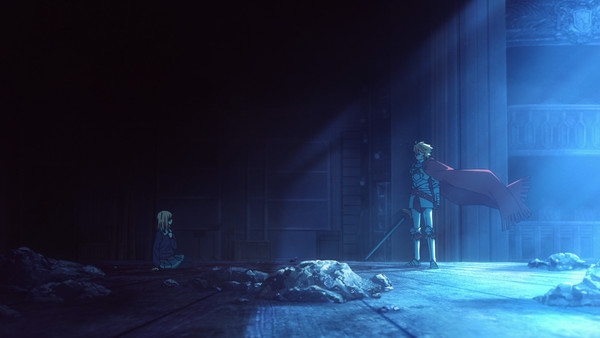
When it comes to Fate, I normally prefer to stick with the core titles—which is to say, the visual novel (the source material) and its ufotable anime adaptations (What 2006 Studio DEEN anime? There's no such thing, I have no idea what you're talking about). Fate/Zero exists in a weird gray zone: Not technically a core title, and created by Puella Magi Madoka Magica and Thunderbolt Fantasy's Gen Urobuchi rather than Type-Moon (or Kinoko Nasu, more specifically). Still, Fate/Zero is so widely beloved (rightfully so) that it's generally treated like a must-watch, core Fate title anyway. But while I don't see it becoming quite as popular as Fate/Zero has proven to be, I think that Fate/strange Fake—the brain baby of Baccano! and Durarara!!'s Ryohgo Narita—is destined for a similar, well, fate.
Fate/strange Fake takes from a little bit of every Type-Moon title it sees on its spice rack: Plenty of foundational Fate/stay night obviously, a bit of Fate/hollow ataraxia to flesh it out, two shots of Fate/Zero, a generous handful of Lord El-Melloi II's Case Files, and—oh, is that Tsukihime? Sure, let's put a pinch of that in there, too. Still, don't let that fool you. While you'll get more out of your Fate/strange Fake experience if you're already familiar with Fate and the goings-on of the Holy Grail War (and especially if you're already familiar with certain characters who have already appeared in other Fate titles—Gilgamesh, Waver, Flat, etc), you could jump into Fate here if you really wanted to, although the descriptions of what the Holy Grail War is and how it (usually) works might end up sounding a bit confusing and nonsensical as consequence. Nonetheless, you'll still probably get a kick out of the main story—and certainly out of the beautifully animated fight scenes.
We've become pretty used to seeing Fate get some stunning animation, but we've yet to see anyone do it quite like A-1 Pictures is doing it to Fate/strange Fake. The stylization and overall production value are through the roof, letting the fights feel every bit as massive, magical, and explosive as they're meant to. And setting a great deal of this in a city that's already so over-the-top on its own—a legally distinct vision of Las Vegas—helps bring out its most exciting aspects all the more.
But cool fights aren't all this anime has going for it. Like other iterations of Fate and Narita's other works, between all the fights, there's an overflowing well of interpersonal drama. And with so many characters and unique dynamics amongst them, there's a lot for Narita to play with. And play, he most certainly does. While some characters are obviously favored over others, everyone still has a pretty distinct storyline that never makes them feel boring, left out, or otherwise glossed over. Not only is it pretty impressive that Narita can juggle so many storylines without letting any of them fall by the wayside, but it also gives this anime that much more to enjoy.
With excellent animation, high-octane fights, incredible character writing, and a thrilling story, Fate/strange Fake really is the whole package—well, minus one thing, I guess. I like this anime so much that rest assured, I'm very actively fighting the urge to be a total pedant and yell about the historical accuracy—or rather, the total lack thereof—in this anime, since I've come to expect what could generously be called a minimal level of it throughout Fate. But aside from that—and again, I can't emphasize enough that this is Fate, I don't know what else you'd expect—this anime checks every box.
—Kennedy
1. Journal with Witch
“Write with the intent to kill.”
That's what Makio tells Asa when she asks for advice on how to write better song lyrics.
“Stake your life on the kill.”
Those are the words circulating through my head as I stare at the blank document, wondering where I can even begin to describe Journal with Witch and what makes it the best anime of the season, possibly even the year, maybe even the decade.
“Write with the intent to kill.” But who am I killing? And when Tomoko Yamashita began work on the manga this anime is based on, who was she intending to kill?
Perhaps it was those of us who relate to Makio, the 35-year-old novelist who takes in her niece after her sister and partner were killed in an accident. Makio, voiced by the supremely talented Miyuki Sawashiro, walks along the razor's edge of being relatable while also having a strong, distinctive personality that makes it difficult for audience members to fully map themselves onto her. The narrative is stronger for it; if she were an easy audience self-insert, her story as an individual navigating the world would lack the power it has. And yet, I could hardly go an episode without running into something that felt astonishingly specific to my own life experience: her broken relationship with her sister held a mirror to mine with my own twin, as did her struggle to perform seemingly simple administrative tasks and her processing difficult emotions through fiction. I never made it through an episode without feeling thoroughly bodied by some quality she possessed or choice she made.
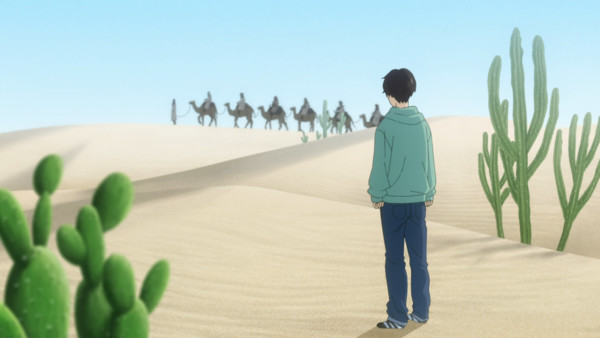
Or maybe Yamashita was aiming her blade at those who see their own messy grieving processes in Asa, who loses her parents just before she graduates middle school. Asa's loss comes at a time when her life would have been in upheaval anyway, as high school brings new friends, relationships, and interests. Instead of leaning on her aunt, who isn't any more prepared for this than she is, Asa sinks into the loneliness of her situation, often symbolized by her trudging through an empty desert expanse. Her grief takes the form of anger and acting out, of treating her best friend Emiri insensitively because even when the two of them are hanging out and joking around, she is too wrapped up in her own emotional processes to notice what Emiri is going through. All the while, she's going through the developmentally typical process of figuring out who she wants to be, torn between her mother's insistent normalcy and Makio's disinterest in societal norms.
Even if you don't feel the point of Yamashita's sword aimed squarely at your heart, Journal with Witch is a profoundly sensitive human drama that explores what it means to grieve and to find happiness as an individual. While I've focused on the writing, don't take this to mean that the production isn't top quality as well. Fledgling director Miyuki Oshiro has put together an incredible piece of art, with detailed character animation, hand-drawn backgrounds, and a gorgeous score by kensuke ushio. It will slash your heart to ribbons, and you will thank everyone involved.
—Caitlin Moore
Disclosure: Kadokawa World Entertainment (KWE), a wholly owned subsidiary of Kadokawa Corporation, is the majority owner of Anime News Network, LLC. One or more of the companies mentioned in this article are part of the Kadokawa Group of Companies.
The views and opinions expressed in this article are solely those of the author(s) and do not necessarily represent the views of Anime News Network, its employees, owners, or sponsors.
discuss this in the forum (14 posts) |
