

All the News and Reviews from Anime Expo 2026
With Sparks of Tomorrow, KyoAni Time Travels to Kyoto to Find A Vision for the Future
by Bamboo Dong,
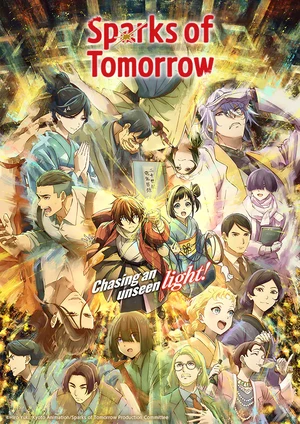
Fans at Anime Expo were able to watch the first two episodes ahead of the series' July 5 Netflix premiere, along with a Q&A with director Minoru Ōta, producer Satori Senami, and MCed by musician and producer Ginger Root (Cameron Lew), who provides the ending theme for the first season. The series follows a clumsy girl named Inako Momokawa, whose special talent is “believing in everything!” but who's been betrothed to the branch manager of the local steam monopoly, and an engineer and inventor named Kihachi Sakamoto, whose dreams for the future withered when his older brother never returned from war. Even so, he holds fast to his brother's belief that the 20th century will usher in the Age of Electricity, which will allow society to thrive in a technicolor dreamworld unshackled by steam.
For director Ota, that glistening hope that new technology embodies pervades both the series' main theme and his vision for the project and the production team at Kyoto Animation. “The hopelessness and despair that you see in society,” he says, referring to the show's steampunk-infused Kyoto, “is because of the lack of technology. And it's everywhere until the events of the story.” At the same time, he had a strong vision for the series that also asked the team to embrace new technologies, aesthetic styles, as well as leaps of faith in his direction. “I had to convince staff members to get behind some of these ideas when they were in pre-production,” he said, adding that he and his team had to be cautious of accidentally falling into more tried-and-true stereotypes.
This is evident just in the series' aesthetic alone—while the visuals embrace an almost- nostalgic, slightly-grimy memory of a Kyoto that never existed (“80% digital but 20% analog,” Ota says proudly, saying that the mix of techniques lent to the series' unique look)—even the original steampunk aesthetic couldn't constrain the ideas that flowed as the story progressed. Ota said that they initially wanted a steampunk aesthetic befitting the series' setting, but as the project progressed and they started integrating the evolving journey that developed between the two main characters, they thought the genre was too confining.
“We ended up focusing more on the character interactions rather than just strictly trying to do [steampunk Kyoto].” Rather, the world building became more focused on smaller decisions like how much of the daily life of the inhabitants should be shown, or how steampunk technology impacts smaller facets of their everyday lives. “It makes audiences decide how the world works without spending too much time on it.” “You can still tell it's Kyoto" Senami added, “even if there are pipes everywhere and people are just living their lives.”
Visually, everything is gritty and matte, with Ota being specifically inspired by impressionistic paintings, but bringing the vision to reality had its own challenges. Senami mentioned that many of the artists at Kyoto Animation come from traditional art backgrounds, but while the shift to digital has been challenging, the experience that younger artists have brought to the table has been appreciated, with everyone improving together as a team.
“Just the constant back and forth between the director and the art team—Ota really had a specific vision, and after the number of times they've had to meet about it—the art team really showed up and incorporated his ideas and came up with something unique.”
It's not just the backgrounds—one of the most breathtaking scenes happens when Inako sees a lightbulb-powered slideshow for the first time. In that moment, she thinks she's seeing her mother and a vision of Paradise, but the audience experiences something just as profound—a sudden and unexpected glimpse into Kihachi's mind, where the slideshow abruptly morphs into a semi-realistic fantasy of the future where theatergoers are dazzled by cinema and are delivered popcorn on motorized buckets.
This quasi-familiar yet fantastical reverie is such a departure from the anime that viewers were just watching that it's breathtaking and wondrous, alluding almost more to cyberpunk than steampunk, futuristic rather than fantasy. One would be hard-pressed to find similar sequences in some of Kyoto Animation's previous, cozier works, and that's a compliment.
“You know, this is Ota's first work ever as a debut director,” Senami laughed. “Before he started, I wondered how he was as a person. And as the project progressed, I thought, 'This guy is strange.' But more power to him. You can really see his personality and individuality shine through the finished project. [The production team] got to know each other more and more, and they made a great show because of it.”
Lew had his own experience to share with Ota's strong directorial vision. He told the story of receiving an email asking if he'd be interested in producing and performing the ending theme, and while he eagerly agreed, he was nervous because he'd heard that the opening theme (a bold track by Luna Goami called “Eureka Evrika” that blends traditional and new with a mash of time signatures and themes) went through over a dozen revisions. “I did the song in one go and got it approved after one take!” Lew said.
He credits that to the phone meetings he had with Ota, where the director talked through what he was envisioning (“the opening theme is very complicated because it needed to be organic; for the ending, [Ota] wanted something futuristic and electronic”) and provided both samples of the writing as well as a digital painting.
This interplay between traditional and futuristic, organic and electronic also embraces Ota's thesis of balance, which he also sees in the main characters (“Kihachi and Inako are very yin and yang—one is full of belief and one doubts himself”) as well as the show's juggling of comedy and drama. “What I want audiences to take away from the show is the back and forth of the comedy and drama, the colorful characters and their array of memories.” He added somewhat cryptically, “My personal directing style is very prevalent.” Senami responded with a laugh, “Ota is a strange person. He's very interesting.”
But perhaps the one thing that sums up the show—and Kyoto Animation's “new frontier”—is Ota's description of Kihachi's older brother, the one who championed innovation and technology: “He's a call of hope for what you can achieve tomorrow. He's literally the spark of tomorrow.”
discuss this in the forum |

this article has been modified since it was originally posted; see change history
back to All the News and Reviews from Anime Expo 2026
Convention homepage / archives