

The Winter 2026 Manga Guide
Wonder Boy
What's It About?
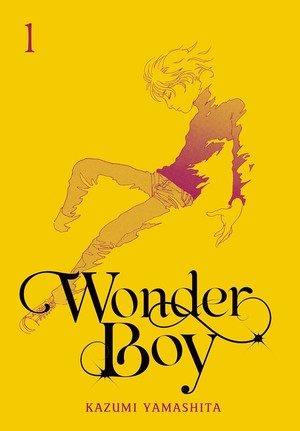
A family, struggling to survive in Japan after the second World War. An orphan girl in London, working her fingers to the bone every day just to pay for the food on her table. A young man in a war-torn world, fighting without knowing his purpose for living. Across time and space, these strangers share just one thing in common―the wonder boy. A mysterious traveler who appears here and there throughout the ages, watching the triumphs and sorrows of humanity…
Wonder Boy has a story and art by Kazumi Yamashita. English translation is done by Giuseppe di Martino, and lettering by Rachel J. Pierce. Published by Yen Press (January 13, 2026). Rated 11+.
Is It Worth Reading?
Erica Friedman
Rating:
I…have no idea if I liked this book or not! It is exceedingly interesting, with a fascinating opening premise. It's fabulously drawn. But individual stories are morally complex in a way that left me unsatisfied, almost short story ironic twist gotcha endings in most cases. The outlook of a clearly non-human entity on human interactions feels almost like a medieval morality play, without any actual specific moral compass.
Vignettes range through time and place, with the titular character, we'll call him The Boy, almost always being drawn in a style different enough from the people around him so that he appears almost mythological; a beautiful boy drawn by a Magnificent 49er. He appears in the middle of a story about brothers, companions or friends at odds with one another. We are warned right away that the defining characteristic of these tales will be Cain and Abel, but our visitor does not explain why humans do these things; he only notes that they do. As a series of philosophical musings on human nature, this work was outstanding. I'd 100% use this as a text for a 18th century philosophy class, I think it would go well with Rousseau. So would the art for The Boy, with his Romantic, almost pre-Raphaelite, beauty.
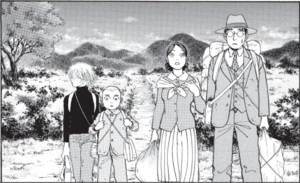
Instead, this otherworldly creation is plopped into the middle of real, but specific, narrative concerns – a family trying to find a place to live after the Americans bombed Tokyo, two orphaned girls, a middle-aged man who has lost his will to live, an explorer, and an ancient Greek philosopher facing his death.
The Boy doesn't understand humans, but he asks questions about them, much as Socrates himself did. This gives them a point of commonality and a point on which to disagree. The chapter where Boy takes Socrates to the future was incredibly moving. But, yet again, I am not sure if I could call it entertaining.
This is a beautiful and harsh book, both narratively and artistically. Yamashita has won several notable awards, deservedly, if this book is any indication. I can whole-heartedly say this was a good book, but I still don't know if I liked it.
Rebecca Silverman
Rating:
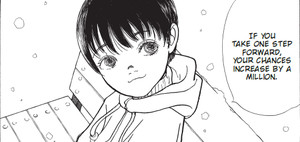
I think sometimes that the world, as it moves on, underestimates the trauma of World War Two. That's on full display in this first massive volume of Kazumi Yamashita's Wonder Boy - through its 800+ pages, the eponymous Boy visits people around the world and through time, but even with this vast landscape, half of the stories involve the Second World War. Most are in the aftermath, most are in Japan, but the war itself seems to serve as the point that the Boy just can't quite process or accept. As he repeatedly tells us, man's inhumanity to man is something he's grown accustomed to, but even so, he keeps returning to this time period. That says something about the effect it had on Yamashita herself; born after the war in 1959, she would have grown up with its ghosts.
That's what makes the Boy's role so interesting. Over the various times and places he visits, he takes on the names and roles of family members (mostly brothers), handsome young men, and a devoted servant. Twice, he appears as an angel with great white wings. He's called a siren, a spirit, a brother, a butler. But even though his name and age change, he's almost always there trying to educate people about human nature, possibly in the hope of changing it – or maybe just to see if it can be changed. Sometimes the answer is yes, but in the worst way possible. More ofte,n the answer is no. In the final story in the book, his time as the butler to a young girl as she grows up and forges her own path, staying true to herself, allows him to fulfill a long-ago promise as she turns out to be better than most of the other people he's met. (This, interestingly enough, is one of the WWII pieces.) It works because everyone is awful in the same basic ways, but good in myriad different ones. The chapter where the Boy takes Socrates on a journey through time in the hopes of convincing him to become an immortal being like him shows this particularly well, especially when Socrates tells him that he will live forever, regardless of whether he drinks the hemlock or not, because 2,400 years beyond his time, people will still be reading his words. That the Boy struggles with this says a lot.
Wonder Boy is one of those books that you read and appreciate rather than love. That's not to say that it isn't good, because it really, really is; Yamashita has a deft hand with symbolism and theme. The art is strong and striking, and Yen Press' edition is pretty wonderful as well – this is a brick of a hardcover, and each story starts with color pages. Cultural notes are weirdly situated three-quarters of the way through, but that's a thing this publisher does, to my everlasting irritation. Ultimately, I think this is best read in multiple sittings – a chapter here, a story there. You need to sit with these and let them sink in, and maybe, just maybe, surprise the Boy with your own actions.
Kevin Cormack
Rating:
Tezuka Cultural Grand Prize-winning author Kazumi Yamashita's work is almost entirely unknown in the English-speaking world, despite her career stretching back to the early 1980s. I first encountered her manga via the Fall 2025 Manga Guide, where I found myself entranced by the first volume of her Yatagarasu-like series Land, the first of her stories to be published in English. Land is a multi-volume epic, and as I voted for it as my number one manga of 2025, I'm keen to read further volumes, once they're eventually localized. For now, I'm content to make do with another of Yamashita's lengthy series, in the form of the very different Wonder Boy.
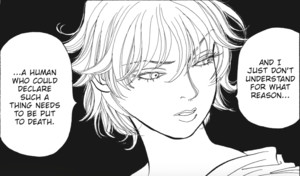
Whereas Land comprises a single, detailed narrative, Wonder Boy is a series of tangentially-related short stories whose only common element is the presence of the unnamed protagonist, the titular “wonder boy”. We learn almost no concrete facts about him, and can only infer his personality and abilities from context clues. In appearance, he's an almost effeminate, blonde bishonen of indeterminate (and shifting) age. He seems to have the ability to travel back and forth through time at will, and can choose who can perceive him, and how. On more than one occasion, he inserts himself into a family by either taking the place of a pre-existing child or by inserting himself as a new member without the others realizing.
The Boy's motives are often at least initially obscure, though it's clear he disapproves of humanity's predisposition towards murder. Indeed, the first story uses the Biblical tale of Cain and Abel as a thematic motif, as the boy watches several generations of siblings murder one another in a seemingly unstoppable cycle. My favorite chapter is the one featuring the famed Greek thinker Socrates, teacher of Plato. The Boy approaches Socrates in prison before his execution via hemlock poisoning, and pleads with him to reconsider his acceptance of death. As he takes the almost pathologically inquisitive philosopher on a whistle-stop tour of time and space to explore his legacy, I'm reminded of the highly-regarded 2010 Doctor Who episode Vincent and the Doctor, featuring Vincent Van Gogh, which has almost the same plot. I doubt there's any relation between them, though.
This hefty 800-page volume features ten stories, each with a substantial length between 60 and 110 pages. This extended page count allows each tale to breathe, which is essential for such an eclectic selection of characters and time periods to make an impression on the reader. As with all such compilations, the quality and memorability of the stories vary, but none are bad. Yamashita's art has a delicate aesthetic to it, with simply-sketched yet expressive characters in a style that sits somewhere between Moto Hagio's otherworldly beauty and Akimi Yoshida's gritty realism. Wonder Boy, perhaps as a function of its anthological nature, isn't as immediately compelling as Land, yet it's a beguiling and intriguing collection with a lot to offer fans of fairy-tale-tinged historical fiction.
discuss this in the forum (14 posts) |

this article has been modified since it was originally posted; see change history
back to The Winter 2026 Manga Guide
Seasonal homepage / archives