

Journal with Witch
Episode 6
by Sylvia Jones,
How would you rate episode 6 of
Journal with Witch ?
Community score: 4.7
I love Makio. That should come as no surprise if you've been reading my work for a while, but I especially love what a rich and textured character she has proven to be. Journal with Witch creates and explores a level of psychological depth within Makio we rarely see in anime, especially in an adult woman. It feels like water from an oasis, and this week's episode delivers three big splashes.
The first splash of insight deals with Makio's neurodivergence. While I can name plenty of anime characters whom audiences headcanon as autistic or ADHD, it is vanishingly rare for those characters to identify or be identified as such within their stories. Shinji Ikari doesn't turn to the audience and read his diagnosis from the DSM-5, but we understand that he deals with depression throughout this arc. Nobody in the world of BanG Dream: It's MyGO!!!!! calls Tomori autistic, but her POV episode details her feelings of disconnect with her peers in a way that many viewers with autism could relate to. And I genuinely love that audiences, in the absence of “confirmed” representation, identify strongly with these and other examples. While art has many vital functions, it can be lifesaving to see a character struggle against the same issues we struggle with. These are the works of people reaching across time and space to tell us we are not alone.
Given that preamble, I think Makio measures up as one of anime's most explicitly neurodivergent characters in recent memory, if not overall. While it lacks the singular focus of MyGO!!!!!'s third episode, this section of the story shows us an evocative slice of how Makio's brain functions differently than her peers. She's disorganized. She's messy. She forgets important things. She loses herself in her work. Her mind races. She tunes conversations out without even realizing it. I have not been formally diagnosed, so I don't want to say anything definitive, but to me, these are signs of untreated ADHD.
However, what's more important than the precise identity of Makio's brain problems is the way they affect her life and her relationships. That short montage speaks volumes. Even minor annoyances tolerated by friends accumulate over time, and we can see (and infer) how it wears on her bonds with family and loved ones. Makio is the outlier, so she assumes the burden of responsibility, whether or not that is correct or fair. Even Asa gets short with her, yelling in a way that mimics Minori and triggers a miniature panic attack from Makio. While we can understand Asa's frustrations as someone who likes to keep her home tidy, Journal with Witch places the audience squarely in Makio's point of view. Yamashita asks us to empathize with her and feel the sting from a lifetime of moments like this one—a mountain of exasperation weighing down on her.
I like how Makio phrases her feelings here. She doesn't use the word “normal.” She uses “obvious” as a descriptor of the gaps between her ability/perception and Asa's, which is a subtle yet meaningful distinction. Asa sees the dirty apartment plain as day, while Makio's brain naturally draws her attention elsewhere. We also have to consider that Makio may be emotionally and mentally overloaded from the cold open, which would skew her focus further. Asa, of course, doesn't see the gears spinning and smoking inside Makio's head, but she stops raising her voice when her aunt clearly looks and sounds upset. Asa is not her mother, and Makio is able to calm down and be honest with her. While they may always have this and other fundamental disconnects in how they experience the world, and while their proximity to each other will inevitably cause future conflicts, they can still work out ways to coexist.
The second splash is only tangentially related to Makio, but it's another exhibition of her acute powers of observation. Namely, she intuits that Emiri is a closeted lesbian who is working through a lot of feelings and confusion. While I had joked about this on Bluesky last week, the events of this episode make me about 99% certain that this is indeed where Emiri's arc is going. Here's my evidence. Emiri is surprised when Makio doesn't force a particular tea on her (the teas symbolize gender). Emiri asks why Makio isn't married, perhaps guessing that Asa's aunt may also be queer. And when Makio asks her about marriage, Emiri trails off in an achingly noncommittal tone. All of this weird behavior makes sense if Emiri likes girls but doesn't believe she'll be allowed to do so.
Makio doesn't know Emiri well enough to directly broach the subject, and Makio would probably be reluctant to bring it up in the best of circumstances. What Makio can do, however, is pull the cool aunt move of lending a meaningful DVD to a troubled teen. While the adaptation obscures the title, there's no room for doubt that Makio hands her a copy of Fried Green Tomatoes. If you've never seen the film or read the novel, the pertinent detail is that the main storyline tells the tale of a lesbian relationship in the Deep South. It is, in other words, Makio's way of letting Emiri know that it is possible to live true to herself, even under dire circumstances. I'm wishing that little gay baby the best.
The third and biggest splash explores Makio as an adult woman navigating a path between her brain and her libido. While I'd be a fool to claim that the anime and manga sphere begs for horniness, it is surprisingly rare to see an introspective approach to sexual desire, and it's practically unheard of for that approach to center on a working woman like Makio. Of course, we'd be talking about far different percentages if we narrowed our focus to josei, and I hope this adaptation opens its audience's eyes—especially American audiences—to the possibilities of josei. We need more of it localized, and stat!
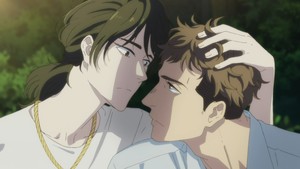
Regardless, Makio's date with Kasamachi is a triumph. We're given a front row seat to Makio's thoughts as she slowly remembers why she had hooked up with her ex in the first place. It's funny, but never farcical. It's sentimental without becoming schmaltzy. It's real! I am so impressed with the adaptation's command of the camera, inviting us to partake in Makio's gaze as she notices the way he licks his lips, his crooked smile, the contours of his neck and arm muscles, and the delicate way he traces his finger over the menu. I am not even attracted to men, yet I could feel myself smoldering in my seat alongside Makio. And I don't mean to harp on this show's uniqueness ad nauseum, but seriously, how often do we get a mainstream anime adaptation that earnestly and intimately adapts a female gaze? It's so refreshing.
The same applies to their casual PDA at the park. Before this episode aired, I didn't know it was possible for me to feel ponytail envy. Now I do. All of the hair touching and ruffling here is good and feels true to the physical familiarity these two have with each other, but the way Kasamachi runs his fingers through Makio's ponytail is on another level. It looks so soft and tender—an idle motion that nevertheless hints at how both of their minds must be racing in that moment. We can picture what they picture, as pages from their previous relationship flip furiously in their minds' eyes. Finally, the kiss itself is very sexily staged, using intense zooms on their hands, eyes, and lips as the flow of the scene guides their mouths toward each other. And in the end, it's Makio, fingers buried in Kasamachi's hair, who pulls him into her.
I was fanning myself like a Southern belle when the credits rolled. That's not an exaggeration meant to conclude this review on a jocular note. This anime made me literally do that. Five stars.
Rating:
Journal with Witch is currently streaming on Crunchyroll.
Sylvia is on Bluesky for all of your posting needs. She is a witch-in-training. You can also catch her chatting about trash and treasure alike on This Week in Anime.
The views and opinions expressed in this article are solely those of the author(s) and do not necessarily represent the views of Anime News Network, its employees, owners, or sponsors.
discuss this in the forum (37 posts) |

back to Journal with Witch
Episode Review homepage / archives