

SHIBOYUGI: Playing Death Games to Put Food on the Table
Episode 5
by James Beckett,
How would you rate episode 5 of
SHIBOYUGI: Playing Death Games to Put Food on the Table ?
Community score: 4.6
You know, when I made that comment about Yuki's voice-over having the flavor of the kind of narration you'd get from interviews for some kind of in-universe retrospective or documentary, I didn't actually think that would literally be true, but here we are. Actually, the truth is even more interesting than simple diegesis, because of course it is. This is SHIBOYUGI, after all. Even more than past episodes, “---- is All You Need” feels like a warped nesting doll of conflicting yet complicit modes, methods, mediums, et cetera. It is at once an interview that Yuki is giving to some unseen audience (presumably the ones who run this game), a recollection of Yuki's measured and hesitant steps into her thirtieth game from some uncertain future tense, a dream of guilt and malaise borne from some unearthed part of her dulled conscience, and the confession of a guilty and fearful girl to some impartial, unknowable observer.
Well, unknowable to Yuki, in any case. We know full well who is sitting in front of their screens, watching these death games play out from week to week.
“---- is All You Need” evokes classic anime like Neon Genesis Evangelion and Revolutionary Girl Utena in the way it accomplishes more with less. These days, when a show's production falls victim to the seemingly inevitable overwork and full-on collapse this industry so often inflicts on its workers, the results are usually just sad. In the hands of wily craftspeople with a flair for razor-sharp direction, though, a budget is not a prerequisite for style. I'm sure, back in the day, there were freaks and naysayers who decried the scene from Episode 22 of Evangelion where Asuka and Rei spend a full minute of stone-cold silence drawing in tension so thick that you could cut it with one of those laser box-cutters that the Eva Units use. Those people were weak, of course, and they undoubtedly did not survive the following winter. The finest art is forged when artists learn that they must not just work within the limitations that bind us from both without and within - they must exploit them. SHIBOYUGI is shaping up to be very fine art, indeed.
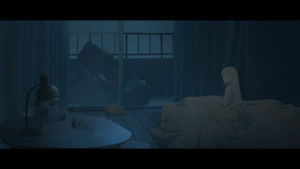
All of this is to say that my brain chemistry was permanently fried by the consecutive acid baths of incredible late-90s Japanese animation, so yes, I did shout with unhinged glee when SHIBOYUGI sat our asses down and made us watch sixty-five uninterrupted seconds of Yuki lying almost motionless in her bed. This was not simply because I appreciated the show's skill in using simple yet effective cinematography to set an evocative mood. What makes this shot so brilliant is that it follows the immediately preceding dream sequence, where Yuki herself is sitting alone in a dark theater and watching a clip-show of all the grisly (but tastefully bloodless) deaths that went down in the Ghost House game.
In her mind, Yuki is barely holding back tears as she insists that she chose the life of a professional death-game girl because she honestly felt like she was good at it, and instead of wallowing in some overwrought show of emotion that spells out exactly how Yuki is feeling, SHIBOYUGI trusts that its audience of adults who know how to use their brain can tolerate a minute or so of meditation as Yuki wakes from her dream (memory? nightmare? confession? prayer?). We sit, while Yuki slowly begins to stir, and we wonder the questions that SHIBOYUGI has planted in our minds.
For instance, what do we make of Yuki's answers to her unseen interrogators? The girl, herself, doesn't seem entirely certain of what she believes, and I'm talking about both iterations of the character that we meet. The Yuki that sits in front of the camera pauses, shifts uncomfortably, and makes a show of slowly admitting that, if she's being honest, she stopped needing the money a long time ago. To the camera, Yuki says that she felt like she could make an honest-to-God career out of these awful, evil games. She knew she had the knack for it. Her mentor, too, seemed to believe in her potential. How else would she have gotten it in her head to go for the record of 99 wins? That's the kind of mad dream that you only pursue for the love of the game.
Except. When Yuki gets that call from the man claiming to be Kinko's father, the man who tells her that she can help tear the death games and their sponsors down for good, Yuki doesn't throw away the tracer pill she's given, even after rebuking the man and declaring her selfish goals. In the car with her handler, on her way to that 30th game, said to break even the most skilled veterans, we see Yuki bring the pill to her mouth, hesitate, drop her hand, and finally commit. Why would the girl who is so determined to reach Game 99 do such a thing? What does she really want?
One of my favorite touches of both the English and Japanese dubs is the way Yuki's narration will split and dissociate, going so far as to adopt different pronouns that make Yuki's connection to these events that much more abstract. In the premiere, the layered voice-over clashed with the “I”s and “She”s nearly drowning each other out. Here, Yuki's narration begins with the already removed third-person, with the completely impersonal “she” fighting to snuff out Yuki's name. First person, third person, omniscient, limited, past, and present — all of the signposts that we use to ground ourselves in the reality of a story become blurry and unreliable once Yuki swallows that second pill and crosses the borderline back into the land of dreaming.
That's why I can't get that sequence out of my head. How crafty, how brilliant, and how perfectly cruel it is. To make the centerpiece of this introspective and emotionally resonant episode a quiet, contemplative minute of Yuki waking up from a terrible dream, when Yuki herself would almost certainly tell you that it has become increasingly impossible to tell where her waking life ends and the games begin again.
.Episode Rating:
SHIBOYUGI: Playing Death Games to Put Food on the Table is currently streaming on Crunchyroll.
James is a writer with many thoughts and feelings about anime and other pop-culture, which can also be found on BlueSky, his blog, and his podcast.
Disclosure: Kadokawa World Entertainment (KWE), a wholly owned subsidiary of Kadokawa Corporation, is the majority owner of Anime News Network, LLC. One or more of the companies mentioned in this article are part of the Kadokawa Group of Companies.
The views and opinions expressed in this article are solely those of the author(s) and do not necessarily represent the views of Anime News Network, its employees, owners, or sponsors.
discuss this in the forum (25 posts) |

back to SHIBOYUGI: Playing Death Games to Put Food on the Table
Episode Review homepage / archives