

Game Review
by James Beckett,Nioh 3
PC, PlayStation 5
| Description: |  |
||
In the year 1622, the ascension of Tokugawa Takechiyo as the next shogun of Japan is spoiled by the betrayal of their jealous younger brother, Kunimatsu. After watching Kunimatsu unleash a horde of yokai across the empire, Takechiyo is spirited through time by their allies, visiting different war-torn eras of Japan's past and future. As they explore vast landscapes and gather the strength of new powers and enemies alike, Takechiyo must prepare to do battle with their brother and his evil masters in order to free the nation from the demonic Crucible that threatens to swallow it in darkness for all time. Nioh 3 is developed by Team Ninja and published by Koei Tecmo, and it is available for PC and PlayStation 5. |
|||
| Review: | |||
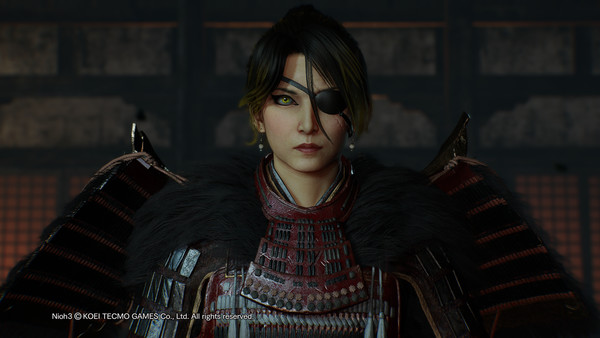 ©KOEI TECMO GAMES CO., LTD. I am a hardcore fan of the Dark Souls games and their legion of siblings, cousins, and imitators, but even I have to regard the Nioh franchise with a certain amount of dark reverence. The Dark Souls games have become legendary for their punishing difficulty and scourging boss fights, but for my money, Team Ninja's Nioh games are the most terrifyingly brutal and sadistic titles to come out of this Soulslike boom, save maybe for FromSoftware's Sekiro: Shadows Die Twice. Even back when I proudly tackled Team Ninja's first two Ninja Gaiden on my original Xbox and Xbox 360, I never got so angry that I've broken a controller or anything like that, but there are some boss gauntlets in those first two Nioh games that pushed me to my personal limits of skill and patience. Then, they sucker-punched me from behind, pinned me into a crippling suplex, and tossed my ragdoll body far past those limits, anyway. The raw, guttural screams of curses and anguish that erupted from my core during some of those runs still echo in the back of my mind, haunting me. So, you can imagine the mix of fear, morbid curiosity, and twisted excitement with which I approached this brand new Nioh title. Here, again, was one of the hardest series I've ever experienced, now bigger and more dense with complex systems than ever before. Would it finally break me, or would I muster up the steel to conquer Nioh once and for all? 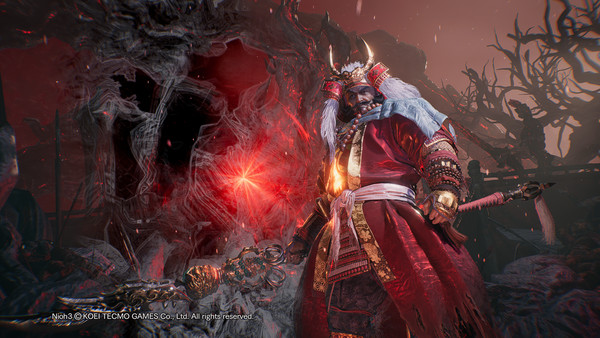 ©KOEI TECMO GAMES CO., LTD. For anyone who is unfamiliar with the Nioh franchise, I will attempt to break down the basics as best I can, but the first thing you have to understand is that there is really nothing “basic” about these games at all. On the very surface, the similarities to other Soulslike titles are apparent: As you explore dark and twisted environments filled with angry monsters hellbent on killing you, you use a mix of light and heavy attacks to wield all manner of weapons and spells against your foes and accrue vast amounts of experience (known as Amrita in the Nioh games). If you die, you lose all your bounty until you brave the refreshed hordes to recover your severed soul. Bosses are large, terrifying, and they can absolutely destroy you in just one or two hits if you don't know what you're doing. The minute you dig into Nioh 3's labyrinth of menus, loot piles, and skill trees, though, it immediately becomes apparent that these games are really a completely different animal from a Dark Souls or a Lies of P. As with previous entires, Nioh 3 puts Team Ninja's years spent crafting technically robust character-action games to good use, as your custom-created protagonist has an absolutely stupefying gamut of tools at their disposal. We're talking thousands upon thousands of potential gear drops, all color-coded by rarity and dropping at obscene rates, Diablo-style. 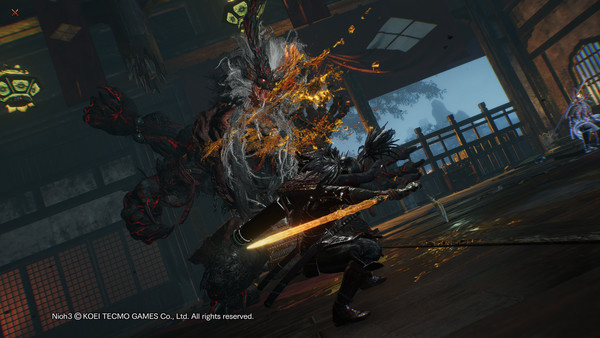 ©KOEI TECMO GAMES CO., LTD. There are 14 different types of weapons, ranging from classic katana and spears to the more esoteric switchglaives and splitstaffs, all of which have unique movesets and individual skill trees that unlock even more variations to add to your combos. “Onmyo Cores” act as modular magic equipment that can summon monsters to attack enemies or add any number of helpful stat buffs. Guardian Spirits provide elemental special attacks and fantastically flashy transformations that can save Takechiyo from an especially ugly beatdown. The “Ki” resource that acts as your universal stamina bar can be regenerated with timely button presses, and depleting enemy Ki meters with specific combos and elemental attacks is often critical to doing any damage whatsoever. I could go on, but you hopefully get the idea. Where other Soulslikes are games to survive, Nioh 3 demands to be mastered. It is a grueling and unforgiving path to success, but I'll be damned if it isn't satisfying as all hell when you finally eke out a victory by the absolute skin of your teeth against a boss that can insta-kill you if you so much as sneeze at the wrong moment in the middle of the onslaught. So far as key changes to the core formula is concerned, Nioh 3 comes with two major deviations that have game-changing implications for the entire experience. The most obvious change to the general pace of the game is that it has adopted an “open field” approach that follows in the footsteps of Elden Ring while still retaining the Nioh games' more systems-heavy approach to design. For one, the Nioh games are not here to get you lost in hours of moody, naturalistic exploration. That isn't to say that the huge and environmentally distinct maps of the different historical eras aren't beautiful - they're absolutely gorgeous to behold on even my base PlayStation 5, and the mostly rock-solid 60-fps of the game's performance mode makes each of these zones fun to run and jump around in. It's just that Nioh is all about getting the player into a flow state of yokai massacreing and ki-pulse activating that would not benefit from having to constantly stop and wonder just where in the hell you're meant to go next. So, Nioh 3 has adopted a more traditional system of waypoints and slowly unlocking map-markers to keep the traversal of the different eras smooth and constant. 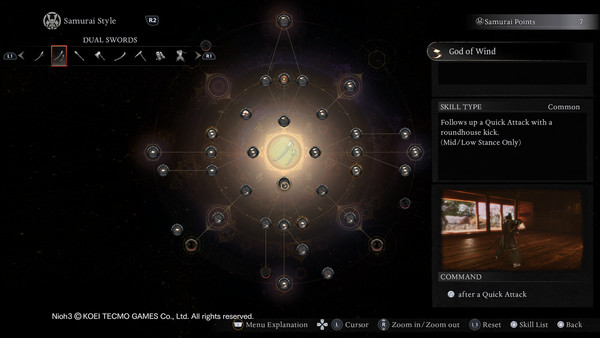 ©KOEI TECMO GAMES CO., LTD. This isn't a bad approach by any means, though it is always divisive when titles treat maps more like video-game checklists than organic environments that exist for their own right. Still, there is still a lot of fun to be had in searching hidden corners for kodama to usher back to the shrine save points and finding the occasional hidden dungeon or mini-boss by deviating from the main story path. What's more, seeking out all of the collectibles and loot-chests is practically necessary for players to manage the difficulty of the game. While the miniscule half-percentage point stat boosts that a lot of these goodies end up providing may not seem like much on their own, in aggregate they deliver meaningful boosts to Takechiyo's killing power. Whenever a boss proved too challenging for me to beat the first few times, I would simply run off to clear chunks of the map I had yet to visit, and I would inevitably earn the requisite loot drops and stat boost to give me just enough of an edge to win the day. It may not be the most sophisticated or paradigm-shifting approach to an open-world design, but the gameplay loop it creates is addictive as all get out, and it goes a long way towards making Nioh 3 the most engaging and rewarding game of the series. 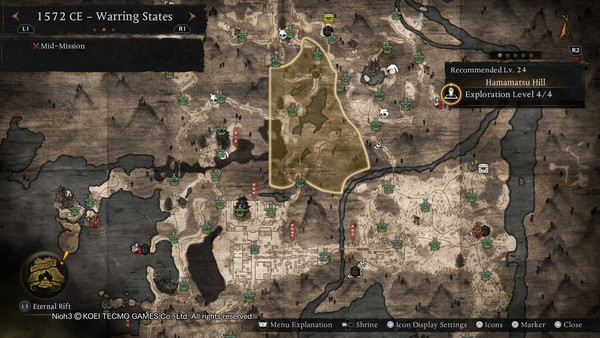 ©KOEI TECMO GAMES CO., LTD. The other big shakeup to the Nioh framework is the division of weapons and skills into two distinct, instantly changeable playstyles: Samurai and Ninja. The Samurai class keeps the stance-switching and heavy-hitting weapons that players know and love, trading mobility and ki-regeneration for higher defence and more tactical combat options. With one press of the right trigger, though, Takechiyo can shift to Ninja mode, where they lose the vast array of weapon stances and combos but gain access to an armory of swift and deadly arms that overwhelm enemies through sheer force of speed and agility. When you add the Ninja's ninjutsu powers and a shadow-clone generating quick-dodge, you get a form that is just as deadly as the Samurai, albeit in completely different ways. 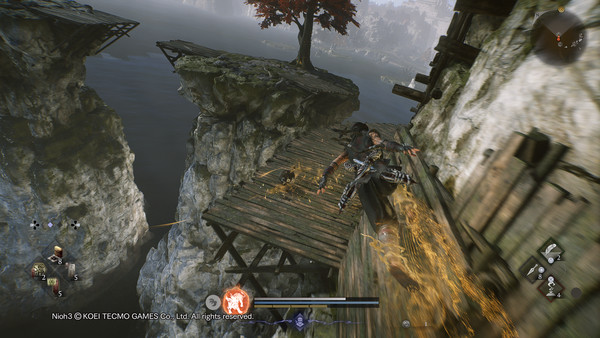 ©KOEI TECMO GAMES CO., LTD. I anticipate that this change will be the most controversial for fans of past Nioh games, but I, for one, think it makes for the best combat experience of the whole franchise. The distinct utility of either class makes it easier to instinctively feel out whether an enemy is going to require the Samurai's cold steel or the Ninja's shadowy strike, and the game constantly provides skills and combo options that makes it fun and rewarding to balance your time with both classes. The more relevant stealth mechanics of the Ninja class also help give the open-field sections of the game more variety in pace and tone. Sometimes I want to blast through a whole enemy camp with my Samurai form's double-katanas, but every now and then I get the craving to sneak around as a Ninja and take out unsuspecting goons one by one. If you ever worry that your current weapon and style combos are wearing thin, a quick experience and stat respec is just a button press or two away. While Nioh 3 is just as unforgiving in its difficulty as the first two games, the glut of options that this game gives to its players makes it very difficult to stay mad at any one boss or Crucible gauntlet for too long. More than any other game in the franchise, Nioh 3 is just an absolute blast to rip and tear your way through for hours on end. 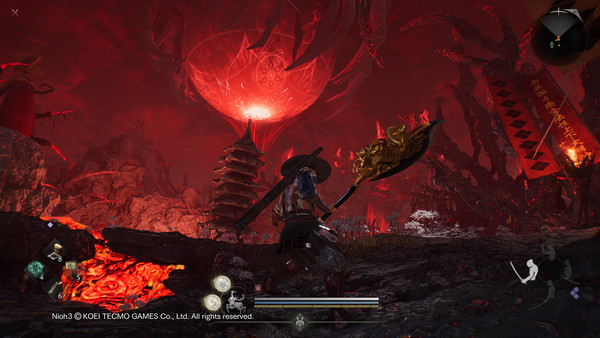 ©KOEI TECMO GAMES CO., LTD. Now, you've probably noticed that I've spent thousands of word extolling the virtues of Nioh 3's mechanics and design, and yet I've hardly mentioned other presentational cornerstones like narrative, worldbuilding, music, and the like. Well, that's because these have always been the franchise's weak spots compared to its competitors, and in Nioh 3, not much has changed on that front. To be clear, nothing about the world, characters, or overall atmosphere of Nioh 3 is bad. In fact, I quite like some of its flourishes, like the stylistic animation used for the flashback cutscenes we get whenever Takechiyo runs into some historical figure or another. In the end, though, all of these elements come together as little more than window dressing and context to spruce up the dozens - if not hundreds - of hours you will spend gorging yourself on Nioh 3's sterling gameplay. 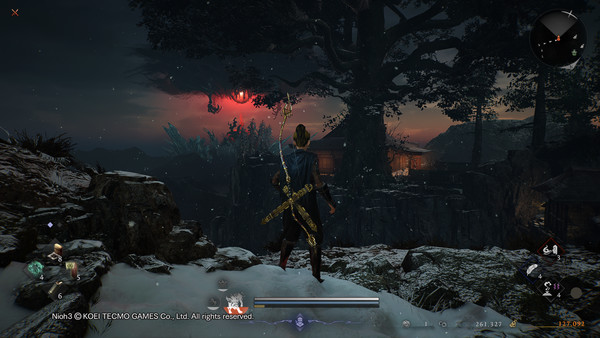 ©KOEI TECMO GAMES CO., LTD. Case in point: I spent nearly 40 hours in just the Warring States Period alone, which is the first huge map that Nioh sets you up in. Across a span of time that would be enough to fill most standalone games to the brim, I did dozens of main and sub-quests for the likes of Hattori Hanzo, Tokugawa Ieyasu, and many others. By the time I conquered half-a-dozen “final” area bosses and made it to the frigid setting of the Heian Period, I had more or less completely emptied my mind of whatever narrative or character motivations had sent me bouncing around Japan for the previous dozens of hours. 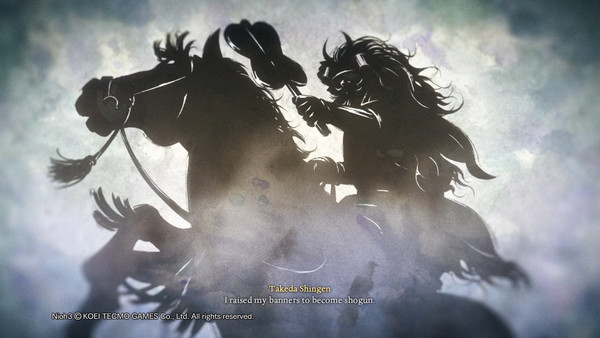 ©KOEI TECMO GAMES CO., LTD. What I do remember, though, is the rush of dopamine and adrenaline that hit when a boss dropped a high-level set of legendary tonfas that I completely respecced my entire build to accommodate so I could cave in the skull of a campaign boss I'd been stuck on for an entire evening. Even now, I am itching to dive back into the map so I can uncover more skill points and maybe try out a weapon I haven't given enough love to yet, like the Samurai's cestuses, or the Ninja's splitstaff. So what if the most recent tumble I had with a hidden boss just had me grinding my jaw into dust for an hour straight? I've been the underdog plenty of times before. That just makes it all the sweeter when I kick the big dog's ass. 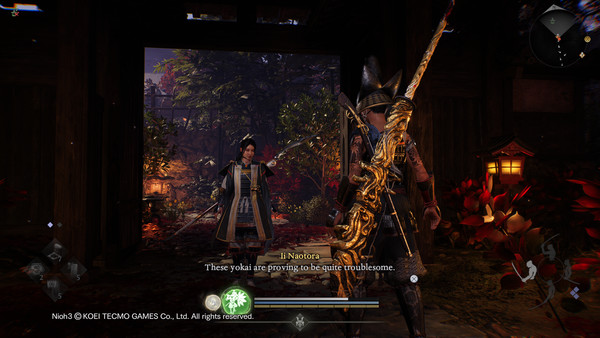 ©KOEI TECMO GAMES CO., LTD. That emotion, that feeling of primal victory over the monstrous hordes who are just begging to taste the steel of your blades, is what Nioh 3 excels at. You could spend a hundred hours mastering this game's systems, and you would still find yourself on the edge of your seat and baring your teeth as you rip conquest from the bloody jaws of some new hell-borne abomination. For a lot of folks, Nioh 3 might sound like some form of divine punishment. For sickos who crave a truly hardcore descent into bloody hell, though, Nioh 3 is just plain divine. |
|
The views and opinions expressed in this article are solely those of the author(s) and do not necessarily represent the views of Anime News Network, its employees, owners, or sponsors.
|
| Grade: | |||
Overall : B+
Graphics : A-
Sound/Music : B
Gameplay : A+
Presentation : B+
+ Enhances the series' blistering combat and dense mechanics with new combat styles and weapon options; Open maps provide rewarding spin on the classic Nioh gameplay loop; Expansive replay and completionist potential |
|||
|
discuss this in the forum |
bookmark/share with:

|
|||