

My Thoughts After 20 Hours With Monster Hunter Stories 3
by Kennedy,
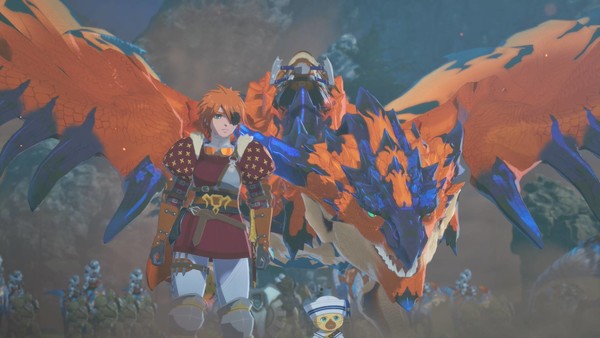
Playing as the voiced but customizable-looking, Rathalos-riding prince or princess of Azuria, MHS3 follows said prince or princess (you get to name them) as they discover the dark truths of Azuria's conflict with neighboring Vermeil, and their world more broadly. It's got some solid world-building, political intrigue, and a pretty charming cast of side characters. While none of the writing is anything too unique or exceptional—certainly nothing likely to find itself in the all time greatest JRPG story hall of fame any time soon—it still consistently checks all the boxes to keep you interested in what's going on, and wanting more.
Still, for as curious as I'm sure many players are about the story and whether or not this is a good jumping in point, especially if you're already familiar with Monster Hunter, I wouldn't blame you for immediately wondering how or if its combat translates into turn-based combat. Going into MHS3—my first Monster Hunter Stories game—that was the biggest thing I was skeptical about, certainly. So you can imagine my surprise at how well it did. Battles are fast-paced and can go as in-depth as the player wants them to thanks to the sheer multitude of weapons and mechanics this game has.
The cavalcade of killing methods this game allows for is just as much of a blessing as it is a curse. On one hand, it's really easy to find your rhythm and play in a way you want to play. But on the other, discovering that rhythm can be a time-consuming process that has the potential to be as arduous as it can be rewarding—and it won't necessarily always be easy to discover. Right off the bat, the combat isn't always as well-explained as it could be. Usually, the combat is pretty intuitive—you have skills and regular attacks, you can switch weapons to use new skills—and you can also use your monsties in battle (including special attacks with the monsties). But if that sounds like there might be a lot going on here, it's because there is. And inevitably, perhaps due to the sheer quantity, some of them are explained better than others.
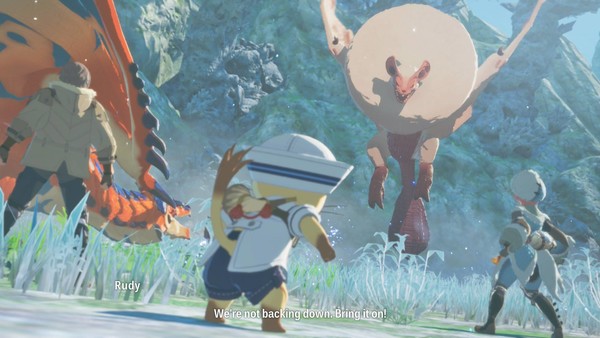
However, depending on your perspective this could actually be one of the game's greatest flaws, rather than something to hype up. More specifically, the world is peppered with monsters intended for you to, well, hunt. And another element of the main Monster Hunter games that's been translated into MHS3, is arguably the most divisive part of Monster Hunter overall: Fights are often intended to emphasize strategy and endurance, and encourage you to experiment with new weapons, items, and armor that you forge after beating other monsters. To word that more directly, there's a lot of grinding baked right into the game, and it's not unusual for fights (which, I can't emphasize enough, there will be a lot of) to last a while. You can auto-win if you're fighting something you've already fought before and you're markedly over its level but that's only going to be a small fraction of your grinding in most cases. Some will see all this as a feature—after all, the game gives you more than plenty of stuff to experiment with that never makes these fights feel terribly monotonous—but it's not hard to understand why others (especially those who don't particularly like grinding) may see it as a massive Bnahabra.
Still, while combat is at the heart of everything in MHS3, that doesn't mean it's the only thing for you to do when you're not progressing the story. In particular, as per usual with a Monster Hunter game, crafting items, armor, and weapons are a big part of it. There's a lot of fun and creative side quests, including a poogie hunt which is just as fun and adorable as it sounds. There's a lot of cool environments to explore. Furthermore, by doing stuff like taking monster eggs and releasing monsties, this game also gives you a lot of opportunities to power up your monsties in ways that feel really fresh and unique—at least to a player like myself who hasn't been keeping up super hard with Monster Hunter.
There's a lot of cool, small quality-of-life stuff that helps this game feel streamlined, despite how much it has going on. For example, it makes it clear when you're about to enter a segment that'll progress the story substantially and has menus that are pretty robust and organized despite how much stuff is in there. It's also helpful that this game allows the players to make the text bigger, although frankly, even its largest size feels like it's maybe medium at best.
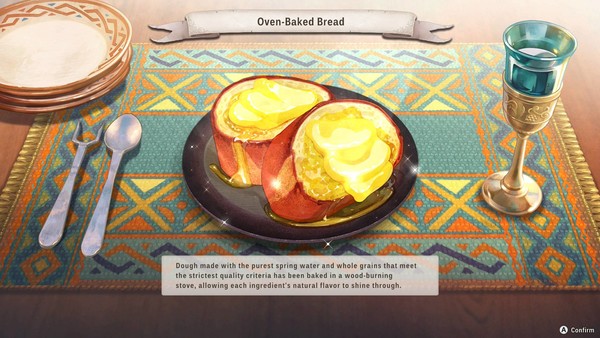
With regards to production value, it's easy to see where this game's strengths lie—the environments and character designs look excellent, as expected of a Monster Hunter title. The art style feels like a cool, almost seinen anime-ish change of pace that really help this game visually stand out, even among other Monster Hunter Stories titles. And it's good that the style is so strong, because the graphics themselves err toward a simpler side of things, and sometimes textures sometimes need an extra beat or two to load. A notable exception to all this is the food when you cook, which is drawn to punch you in the face with how mouthwatering it looks.
For better or for worse, this is a game that you can really sink your teeth into as deeply as you want. And if that's what you're craving—a turn-based JRPG that you can easily lose yourself in—this game will absolutely deliver. The same things that will inevitably make it more tedious for some players, will also scratch a hyper-specific itch that others will be grateful to have so thoroughly scratched.
Monster Hunter Stories 3: Twisted Reflection is scheduled for release on Nintendo Switch 2, PlayStation 5, Xbox Series X/S, and PC on March 13, 2026. (A review code of the game for the Nintendo Switch 2 was supplied to ANN for the purposes of this preview.)
discuss this in the forum |
