

The Spring 2026 Anime Preview Guide
Agents of the Four Seasons: Dance of Spring
How would you rate episode 1 of
Agents of the Four Seasons: Dance of Spring ?
Community score: 4.0
What is this?
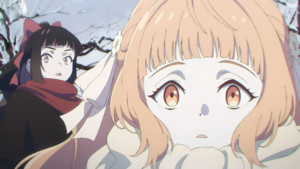
In a world where the only season is winter, the creation of spring chips away at the solitary lifestyle of those enduring the cold. Before long, in accordance with the earth's wishes, summer and fall are born, and the four seasons are complete. The one who carries the burden of the cycle is called the "Agent of the Four Seasons." Now, one young goddess—granted spring by the god of the four seasons and called "Daisy" by her mother—holds that sense of purpose to her chest with pride. However, spring disappeared from this land ten years ago, and she must overcome hardship, fight back against disgrace, and return to the current god. Like a legend, the deepest part of her heart sends love to winter.
Agents of the Four Seasons: Dance of Spring is based on the Agents of the Four Seasons light novel series by author Kana Akatsuki and illustrator Suoh. The anime series is streaming on Crunchyroll on Saturdays.
How was the first episode?
Rating:
A lot is going on in Agents of the Four Seasons, which isn't necessarily a bad thing—goodness knows that I have spent many a word in Preview Guides past bemoaning the chronic lack of ambition and creativity that often plague seasonal debuts. The price of an ambitious and complex premise, however, is that it becomes exponentially more difficult to convince new viewers to stick around. I think anime fans have a much higher tolerance for vague or confusing writing compared to many demographics, but the point stands. In Agents of the Four Seasons, we're operating in a fantastical version of our reality where the seasons are all apparently sentient god-beings who also appoint a flesh-and-blood avatar of their will on Earth, and each of these Agents has its own Guardian responsible for their safety. This is important because there's a whole web of tragic backstories and deadly conspiracies and capital-letter “Agencies” that we haven't even gotten into yet, which means that being the living embodiment of Spring isn't as simple as just making some flowers bloom and dancing with the local wildlife in the woods like a Disney Princess.
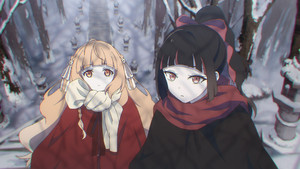
As I said, a lot is going on, and while Agents of the Four Seasons tries to be naturalistic with how it doles out new characters and bits of exposition, it struggles to completely sell its story in the twenty minutes and change a single premiere episode affords. At least, that was my takeaway. For as much as I enjoyed the general atmosphere of the artwork and the interesting possibilities presented by the premise, I could never quite get any closer than arm's length when it comes to actually engaging with the story that Agents of the Four Seasons is trying to tell. A big reason for this is probably the Agent of Spring herself, Hinagiku, who is the kind of hush-voiced waif who refers to herself in the third person in between strained and painfully feeble breaths. She's the kind of character that almost immediately sets my eyes rolling these days, because it signals that an anime is relying on overdone cliches to try and grab my attention instead of creating a genuinely interesting character. Sakura does better as the Agent's stern and faithful guard, but she, too, is little more than a reference to a reference to a reference that we've all seen plenty of times before.
There's nothing wrong with falling back on archetypes and familiar story beats, but I can't shake the feeling that Agents of the Four Seasons is a show that thinks itself to be a lot more interesting and creative than it actually is. The languid pacing, the insistent soundtrack, and the overly serious air of this premiere all scream, “Please, take me seriously!”, but no amount of unique lore or mysterious plot details will amount to much if viewers can't get invested in the story's main characters. Then again, more and more series these days are treating the “Three Episode Rule” as a blueprint for pacing instead of a broad suggestion of good faith, so it could very well be that Agents of the Four Seasons will be easier to love with a couple more weeks under its belt. It's certainly a pretty and intriguing anime. I just need a bit more substance to carry it through.
Rating:
As a certified bibliophile, it pains me to say this: the best way to experience Agents of the Four Seasons: Dance of Spring is its anime adaptation. There's one very specific reason for that: it is significantly less annoying to hear Hinagiku's halting speech than to read it. In both original novels and manga adaptation, Hinagiku…talks like…this. And it…gets really…old…very quickly. While the English subtitles retain this format for her vocalizations, the added dimension of sound keeps her speech from lagging, because Yuka Nukui sets the pace rather than your own brain. And maybe my brain is just particularly annoying about how it processes ellipses, but this just works better.
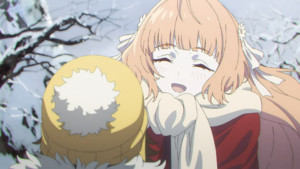
In some ways, this means that, despite it being my third time experiencing this chapter of the story, it's the first time I've been able to appreciate it. Agents of the Four Seasons is built on the interesting mythology that the gods assigned human avatars to specifically summon forth each season. But Spring's agent has apparently been missing for a decade, leaving Japan without that transitional time – winter gave way to summer after dragging on for extra months. (Like where I live.) And while you might think that this wouldn't be that big a deal, it wreaks havoc on seasonal businesses. Nazuna, the little girl Hinagiku and Sakura meet, is frustrated because her father's tourist business is suffering from the longer winters, and she personally laments that her mother's grave is cold for far too long. Nazuna may not remember spring, but the adults in her life have made her understand how its lack is a problem.
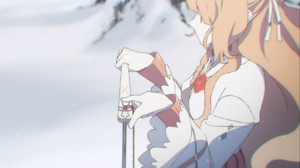
While Hinagiku's ritual song and dance to summon her season is undeniably the most beautiful part of the episode, it's Nazuna who is the strongest element. She's the embodiment of human frustration, even though she doesn't fully understand why. Sakura and Hinagiku know academically that Hinagiku's mysterious ten-year absence wasn't a good thing, but when Nazuna says that adults always yell, she makes the toll real. When businesses and the circadian rhythms of life are interrupted, adults get testy and, unwittingly, take it out on kids. Nazuna's immediate association of anger with adults' speech to children says a lot, both about the springless world and about her life specifically. It makes Hinagiku willing to flout godly dictates and just perform the ritual even though Nazuna is right there, because the world needs to be put on the right track immediately, if only so this child won't suffer anymore.
With a strong folkloric element, Agents of the Four Seasons has a lot of potential. While I do have other frustrations with the source material (besides Hinagiku's speech), I'm feeling decently confident that this adaptation will avoid them, or at least streamline the overwriting in the texts. Wistful and lovely, this episode didn't fully win me over, but it assuaged a lot of my concerns.
Rating:
I feel like the most useful recommendation I can give for Agents of the Four Seasons: Dance of Spring is that if you liked Violet Evergarden, you'll like this. It is, after all, based on a novel by the same author and operates in a similar emotional mode: a young woman tries to heal in the wake of a traumatic event, in the process encountering and helping others who are struggling with their own demons.
Reader, I hated Violet Evergarden.
I suspect a lot of people are going to be put off by Hinagiku's halting, clumsy way of talking. While I wasn't wild about it myself, I understand the idea behind it. She's been through something awful, kidnapped for ten years, so that she can't bring about spring. It's implied that she might even have brain damage. I can't get mad about a person with a traumatic brain injury struggling with what may be a symptom of their injury. I've spent too much time training on trauma-informed practices for that.
No, what bothered me is that in the world of Kana Akatsuki, grief must always be expressed in the most histrionic manner possible. Hinagiku and Sakura are about to perform the Rite of Spring when they encounter Nazuna, a twelve-year-old girl dragging a sled up a mountain for some reason. Because it could be dangerous to change the seasons with her there, they accompany her on her mission. By Nazuna's third outburst, I was having flashbacks to Violet Evergarden's love of beating the audience over the head with melodrama. Rather than seeking to express something honest or reach a greater truth through exaggeration, I felt like Akatsuki was begging me to cry, to weep, to rend my clothes over this poor preteen who must shovel the snow on her mother's grave, because what if her dead mother is cold, even though Hinagiku is about to literally banish it with magic.
One thing that I will grant: it's pretty. There's a lot of care put into the backgrounds to emphasize the seasons, as is appropriate for the subject matter. Winter is desolate and cold, but the camera lingers over icicles and blanketed snow, emphasizing that it has its own beauty before transitioning to the vivid greens and soft pinks of spring. The animation doesn't have the shampoo commercial gloss that Kyoto Animation gave Violet Evergarden, going for more understated flat colors. It works much better for this type of story.
The others with whom I watched the episode were also able to identify its connection to Violet Evergarden, cementing my perception that it's operating in the same emotional mode. I must reiterate: if you liked its predecessor, it's worth giving Agents of the Four Seasons a shot. If you didn't, you're just going to find more of everything you disliked about it.
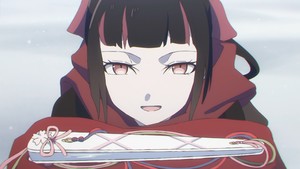
Rating:
I often play a little game with myself when delving into fiction. I ask: “What is this story about in a single sentence?” By doing this, you get the root of what the story is truly about—often on a thematic level. In the case of this episode, what I came up with is a bit pedantic (while still true): “Three traumatized girls hike up a mountain.” However, it is how these three traumas interact that makes the story interesting.
Hinagiku, for one, was kidnapped a decade before the events of this episode and held captive all that time. Because of this, she suffered the guilt of not being able to fulfill her divine responsibilities—knowing that countless lives and the country's climate were thrown into chaos due to her absence. While she never truly gave up, biding one's time for a decade is no easy task, and the mental scars are basically still open wounds.
Then we have Sakura. She, despite being 9 years old when Hinagiku was kidnapped, blames herself for what happened. She failed at her duty as a guard and carries both that guilt and the guilt for all of what Hinagiku blames herself for. And on top of all of that, Hinagiku was her friend—so she failed on that level as well.
Lastly, we have Nazuna, a girl who still grieves her dead mother, and, longing for a connection, spends her winters clearing the snow off her mother's grave. While she claims it's because she's afraid her mother will be cold, the deeper truth is that doing something for her mom—an act of service—is her way of showing love.
As the girls climb, their traumas clash with each other—all three hurting the others unintentionally. But in the end, they can help each other overcome their traumas—if only for a fleeting moment. Nazuna brings her mother the warmth of the first spring in 10 years. Hinagiku sees through Nazuna that, even on a personal level, spring is needed–and thus she is as well. And as for Sakura, her choice to follow Hinagiku's lead when it comes to Nazuna and her success at protecting Hinagiku on the first step of their journey have started her down a path of personal redemption.
My only worry with this first episode is that we're really thrown into the deep end lore-wise—with the exposition of what's really going on only granted to us in the closing seconds of the episode. While I do believe that this is the correct choice on an artistic level, I do fear some will feel lost and not be able to engage with the emotional beats of the story. However, I am certainly open to watching more and hopefully getting the answer to the big mystery set up in this episode: Why would anyone want to erase spring?
Disclosure: Kadokawa World Entertainment (KWE), a wholly owned subsidiary of Kadokawa Corporation, is the majority owner of Anime News Network, LLC. One or more of the companies mentioned in this article are part of the Kadokawa Group of Companies.
discuss this in the forum (9 posts) |

back to The Spring 2026 Anime Preview Guide
Season Preview Guide homepage / archives