

Champignon Witch
Episode 9
by Rebecca Silverman,
How would you rate episode 9 of
Champignon Witch ?
Community score: 4.0
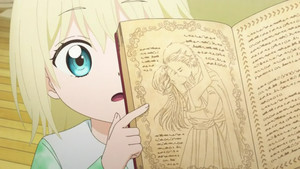
We've all heard the apocryphal story about how the children's rhyme “Ring Around the Rosie” is about the bubonic plague. Scholars largely don't believe this, but it is true that many children's stories and songs have darker themes and meanings. Heinrich Hoffman's 1845 children's book Merry Stories and Funny Pictures is a horrifying look at purportedly amusing cautionary tales that have haunted me since I read it in elementary school because of its cruelty. Some children are quite keen on this sort of story; others don't fully understand the implications of what they're reading or singing. That may be the case for the children playing a game with stones that opens this episode of Champignon Witch: the song is a horrific account of what will kill (and perhaps did kill) the black witches, ending with a note about how Luna will end the world. The way they sing it while moving their game pieces implies that they don't really know that they're singing about brutal murders. But Lize absolutely knows.
It's a chilling reminder about the world Luna lives in, and thematically, it forms the throughline of the entire episode. It's adorable when Lize pretends not to know what kissing is, but that's the brief moment of light in the darkness. The rest of the episode is a reminder of how harsh the world is to black witches and magicians, as well as a snapshot of how deeply ingrained those prejudices are. Ariadne's thread traces a pathway through the twisting labyrinth of Lize's education, showing the route between the children's nursery rhyme and the fairies' true feelings about black magic, and it's a wake-up call for Lize.
The ostensible plot is that Luna and Claude want Lize to run the errands in the village and environs by himself, with only Minos for company. In a fantasy parallel to the idea of a small child going on their first errand alone with parents carefully following at a distance, Claude and Luna secretly watch Lize's progress thanks to the Mushroom Lord of the Black Forest's magic. Most of the trip goes just fine, although they're surprised to hear Lize speak the spirit language to get Minos back on track. But the important moment comes at the end, when Lize and Minos meet a bird that the poison miasma of the world has corrupted. Luna, Minos explains, has been giving magic sheets to poisoned animals, who are in constant pain from their condition. The bird wants one, too, but Lize doesn't have one to give. But when he realizes how bad the bird's situation is, his desperation induces him to use the fairies' gifts to save the animal.
It's a classic fairy tale moment. Many folklore protagonists give something to a witch's familiars to help them, and Lize's actions mirror that standard plot point. But where most fairy tales paint that as a good thing and the right choice, the fairies here are furious with Lize. Why, they want to know, did he waste their gifts on a monster?
In the film Labyrinth, heroine Sarah is shocked when a fairy bites her, telling Hoggle that she thought “fairies did nice things, like granting wishes.” Hoggle snorts that that “shows what you know,” and in this episode of Champignon Witch, we see his statement play out again. Lize doesn't understand why the fairies are angry with him for using their gift to save someone from pain. He thought the fairies wouldn't mind, and I could see him also assuming they'd be proud of him, because Luna certainly would be. But their anger tells us everything we need to know about the beliefs of the story's world. You don't do nice things for those who are Other. They don't deserve it. It doesn't matter that the bird wasn't tainted of its own volition; it was tainted and is therefore unworthy. Only white magic is good. Black magic destroys any value someone has once it touches them.
This puts Lize at a crossroads. He's a good person (kissing thing aside); he's not going to ignore someone in pain just because he's supposed to. And if the white witches and their fairy companions think that he should, maybe that means they're not as good as everyone says they are. History is written by the victors, after all.
This is something that we, as viewers, know. Ignoring the bad things doesn't make them go away. Luna's tear mushroom tea shows that you can make good out of bad if you try and take the time to deal with it properly. It looks like that's a lesson that the rest of the world could stand to learn.
Rating:
Champignon Witch is currently streaming on Crunchyroll.
The views and opinions expressed in this article are solely those of the author(s) and do not necessarily represent the views of Anime News Network, its employees, owners, or sponsors.
discuss this in the forum (16 posts) |

back to Champignon Witch
Episode Review homepage / archives