

This Week in Mobile Games
The Years Start Walkin' and They Don't Stop Walkin'
by Josh Tolentino,

Hello, and welcome once more to another issue of This Week in Mobile Games, and the last installment of February, the worst month of the year (allegedly). I wouldn't know about all that; I live in the tropics, so the main thing distinguishing February is the nice cool breezes of December and January giving way to the creeping oppression of March's heat and humidity, where you pray for opportunities to huddle around a fan or in an air-conditioned room to play video games rather than sweat your life away.
Anyway, I'll be kicking off coverage of the latest in news about mobile games by turning my all-powerful spotlight on...a game that launched last year...exclusively on the Nintendo Switch and PC...what's going on?
The Simogo Legacy Collection Recalls the Halcyon Days of Mobile Gaming Potential
While it's true that this specific release is technically not a mobile game, it's nevertheless a must-play if you're interested in mobile gaming as a distinct medium, as it collects games developed by Sweden-based Simogo. Founded by the duo of Simon Flesser and Magnus "Gordon" Gärdeback, Simogo was one of the most feted mobile game developers in the industry during its time as a largely iOS-centered studio. Their games won accolades at prestigious events such as the BAFTAs, the Independent Games Festival, and the Apple Design Awards.
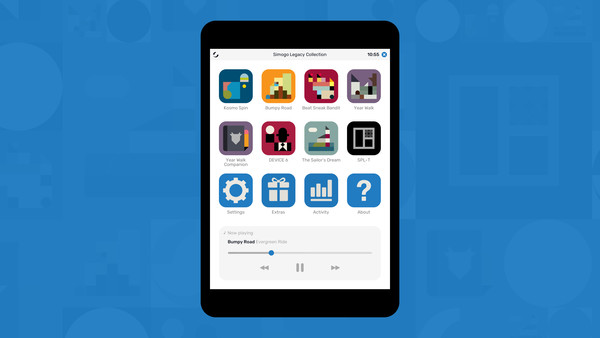
The Simogo Legacy Collection bundles together a total of seven games released by Simogo on the Apple App Store between 2010 and 2015, namely Kosmo Spin, Bumpy Road, Beat Sneak Bandit, Year Walk, Device 6, The Sailor's Dream, and SPL-T.
Classic game anthologies are becoming increasingly common, but they can sometimes feel like perfunctory remasters designed to milk nostalgic players who'd rather not go through the arguably minimal fuss needed to emulate an old game (Where's my Ace Combat collection, Bandai Namco?). Not so with the Simogo Legacy Collection, though, which not only adapts the games for play on new platforms but also repackages each game in a way that never ellides its mobile roots. The main menu is framed like an iPad, with each game having a profile that looks tellingly like an App Store page. In fact, if you're on Switch, you can even play the whole thing just as intended by holding your Switch vertically, as if it were a large smartphone. It's a bit of an awkward lift if you don't detach the Joy-Cons, but it's the right way to play Simogo's old mobile entries. The collection also includes bonus materials, such as playable prototypes and supplementary media, including the Year Walk novella and companion app.
Of course, the games themselves are well worth playing. Even the simpler ones convey a sense of whimsy and melancholy that helps them stand apart from the old mobile-game stereotype of a one-handed diversion to play while waiting in line or sitting on the bus. Kosmo Spin is a cutesy take on Breakout that wraps things around a circular playing field you spin, like the wheel in Ouendan. Bumpy Road is a platformer where you touch the road to form inclines and guide an elderly couple along a journey through their memories, communicating a sweet little romance alongside the goofy cartoon car physics. Beat Sneak Bandit uses a rhythm-based central mechanic and adapts it to a gorgeously cartoony heist theme that predates the likes of Crypt of the Necrodancer. I frankly still don't fully understand the rules of SPL-T, but once I finally get how to play its conceit of splitting up a set of squares to form score-boosting blocks, I figure I'll feel really smart.
For me, though, the biggest highlights of the Simogo Legacy Collection are the three games that boosted Simogo's name into the stratosphere: Year Walk, Device 6, and The Sailor's Dream. These latter three are all notable collaborations with writer Jonas Tarestad, who wrote the stories. Year Walk is a moody, mysterious first-person adventure game loosely based on the Swedish custom of Årsgång, and its haunting, darker-toned tale of going on a walk in the winter and seeing a vision of an undesirable future was my personal "breakout moment" when it came to really recognizing how much smartphones could do when it came to interesting game design.
Meanwhile, I would have, frankly, paid full price just to get Device 6 somewhere other than an Apple device, and the world is richer for being able to read (yes, it's a reading game) the best game-based equivalent to House of Leaves yet made. Device 6 is also why playing the Simogo Legacy Collection on Switch is recommended over PC, as there's nothing quite like rotating your screen every which way and putting your ear up to the speaker to hear a clue. It's a level of physicality that even today feels as revolutionary as playing with a Wii Remote did way back in 2007.
Lastly, The Sailor's Dream seems like a culmination of the metafictional elements of both Year Walk and Device 6, combined into an initially simple tale of guiding a sailor to different islands, each with a small story and screen-to-screen navigation. Ironically, The Sailor's Dream does illustrate one shortcoming of the Legacy Collection on Switch, in that the Switch is not technically a smartphone, so it isn't possible for the game to fully recreate one of its gimmicks, where it uses Apple's AirPrint feature to produce illustrations and messages from your connected printer to read in physical space. It's a small compromise to make to get all this goodness out into the wider, non-Apple world, though.
You might have noticed that I've already mentioned the significance of getting these games outside an Apple device several times in this review. That's because, underneath all the sentimental celebration of some true classic games becoming accessible to a new audience (or an old audience looking to relive some fun memories), there runs an undercurrent of grim pragmatism, one that's spelled out rather explicitly in Simogo's own website describing the Simogo Legacy Collection itself. There, they mention not just celebrating the studio's 15th anniversary, but also releasing the collection to better preserve the games, "which are in constant danger of disappearing or ending up being unplayable with new OS versions or hardware configurations."
There's the rub. The very need to release those games in this way underscores how direly transient the state of the mobile game scene can be these days. It's bitterly ironic that, in those earlier days of the digital revolution, the seeming continuity of app compatibility across different versions of iOS was seen as a boon for game preservation. At the time, the thought was you could just get the latest version of whatever smartphone or tablet you had, and take your apps with you. The reality, 15 or 20 years later, has been far thornier, across virtually every platform digital games are sold (which is the majority of games these days). The present is heavily dominated by similar-looking and playing live service titles that, if not immediately successful out of the gate, can be unceremoniously shut down the second funding runs out, or even be ignominiously stillborn like Love Live! School Idol Festival 2 Miracle Live!.
As such, I'm increasingly glad that more developers have begun seeing diaspora as a better answer, pushing more games (mobile and otherwise) to more platforms. In The Simogo Legacy Collection's case, I'm also glad it exists, as the games in it, now available to more people in more places, feel like a look back to a bolder, more inventive, more joyful era of mobile game development.
Genshin Impact Luna V Update Takes the Traveler "Home" on February 25
Speaking of anniversaries and long legacies, it's almost hard to believe that we're closing on the 6th anniversary of Genshin Impact, a game that helped kick off the current era of mobile gaming (or gaming in general, when you think about it). Considering that Fortnite has been trading in outright nostalgia for its own launch era in recent updates, it's about time that the slightly younger Genshin took that step as well. The next update, "Luna V," is due out on February 25th. Titled "Homeward, He Who Caught the Wind," the main thrust of the Luna V update returns Travelers to Mondstadt, the game's opening zone and the first territory players visit in Genshin Impact's gameworld of Teyvat.
There, they'll take part in the "Echoes of Memory" event, where they'll relive altered retellings of the game's earlier storyline. The trailer shows as much, with color commentary on the game's opening cutscenes and reunions (of a sort) with familiar Mondstadt faces like Diluc, Fischl, Venti, and Knights of Favonius Acting Grandmaster Jean. Players will also get to hang with Jean's boss, the man who's been missing in action for the past 6 years, the actual Grandmaster of the Knights of Favonious, Varka.
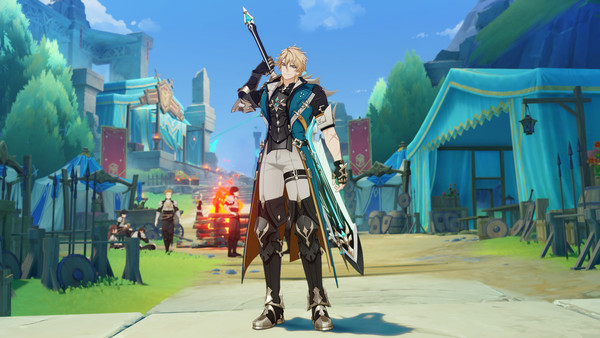
Also known as the Knight of Boreas, Varka enters the playable roster as a dual-wielding Claymore user that can deal two types of elemental damage simultaneously: Anemo and another type based on the elements of his teammates. Players will also be able to burn their primogems trying to recruit Flins, Skirk, and Escoffier in other banners, if Varka isn't their type.
I last checked in with Genshin proper to close out my Traveler's adventures in Natlan, so I'm lagging pretty badly on story developments and have been wanting to catch up a bit, time permitting. That said, Genshin's the toughest of the miHoYo games to keep up with, for me, due in part to the sheer size of each new zone added. It's not as simple as, say, kicking back in Fate/Grand Order and reading through a new chapter or two when the mood strikes.
On top of that, there's the looming specter of miHoYo's apparent love for generative AI. A recent piece in the South China Morning Post mentions the depth of miHoYo's apparent commitment to using generative AI in its development pipeline. The piece doesn't specify where the machines are involved in miHoYo's current work, but it does mention Honkai Star Rail by name as a particular beneficiary of involvement with Large Language Models from the Chinese AI startup MiniMax. Genshin Impact's Miliastra Wonderland mode, a platform for user-created content, also caught heat from players late last year over the seeming use of AI voiceover for its English-language tutorial videos.
Of course, it should be said that we're at the peak of the AI hype bubble, where corporate leadership will boast wildly about the tech's actual capabilities to attract irrational investors who'll throw money at anything with the right combination of buzzwords. A lot of evidence for AI hype has also been rendered suspect, like the widely publicized video of Hollywood stars Tom Cruise and Brad Pitt fighting. In short, I'd take claims that miHoYo is prompting the likes of Zenless Zone Zero (a game I hailed as one of my games of the year in 2024) with a grain of salt. Nevertheless, I can't help but have my excitement to see what's next for myself be blunted at the same time.
RAMpocalypse Threatens the Near Future of Mobile Game Hardware

Speaking of the AI hype bubble, have you tried to buy some memory recently? Computer memory of all kinds is suddenly very scarce, thanks in part to the insatiable demand of companies building vast AI data centers. Memory manufacturers have responded to the sound of all the money sloshing around by shifting their production resources away from consumer products. For example, in December, Micron announced that it was taking steps to exit the consumer RAM business almost entirely to supply these lucrative deals. PC gaming enthusiasts - yours truly included - have seen prices for RAM sticks and NAND memory shoot up significantly.
The forecasts have gotten so dire that Valve delayed its recently announced Steam Machine and Steam Frame hardware, and even now hasn't announced a final price beyond flatly admitting that it'll probably be higher than they wanted it to be at first, whenever they do get around to announcing it. Meanwhile, a Bloomberg report suggests that Sony is considering pushing back its plans for the next PlayStation console by as much as 3 years (to 2029), and that Nintendo is considering raising the price of the ultra-popular Switch 2.
Unfortunately, the memory crisis is going to hit more than just folks who love to game. Virtually every category of consumer electronics uses RAM, from laptops to smartphones to cars, TVs, and even simple media drives. An analysis by IDC suggests that smartphone makers could begin cutting production targets for new models and/or raise prices by 10% to 20% in the next year or two.
While memory manufacturers are working to increase RAM supply by building out more production capacity, none of that will get done before at least 2028. Fabricators take time to set up, after all, which could mean a very rough year or three if you're in the market for new electronics. Not to mention that the prices might not come back down all that much, either, at least not while the demand from AI hyperscalers is so all-encompassing.
On the brighter side, at least, a potential slowdown in hardware advancement could also help set a spec floor for potential new games. Mobile game developers tend to be fairly aware of the graphical capabilities of their audiences' devices, and might be spurred to push the envelope a bit less in the short- and medium-term. As someone who hates getting their phone hot (and also lacks the scratch to get a new one on a whim), I welcome an excuse to get more out of what I've got on hand.
And now, a few more news tidbits to close out this installment!
-
Digital Extremes' free-to-play live service shooter Warframe is officially available on Android devices via Google Play. With an initial launch on PC slightly predating Bungie's Destiny, Warframe evolved from an unusual and idiosyncratic third-person shooter into a quiet powerhouse of the live service scene, with a loyal fanbase and a presence on all the relevant platforms, including the Switch (with a Switch 2 edition promised later this year). The Android edition of Warframe supports full cross-platform saves and play, and players jumping in on that platform will receive a free Cumulus Collection pack of weapon and armor cosmetics and boosters if they download the game and start playing before March 4, 2026. Back when both games seemed to be rivals, I was more on Team Destiny than Team Warframe, but it's hard not to respect the dedication the game's fans have for it. The game's also been successful enough to draw comment when Duet Night Abyss, Hero Games' free-to-play gacha action-MMO, showed off gameplay that looked eerily close to Warframe's distinct blend of high-mobility melee and shooting.
-
The global editions of tactical RPG Girls' Frontline 2: Exilium received the latest major story event, titled "Corposant," on February 19th. The game adds Alva and Balthilde, a new pair of playable characters, to the roster. Alva's a fan-favorite character, returning from playing major roles in the plot of the original Girls' Frontline while operating with the same name as her gun, the AN-94. Unlike many games that tend to use limited-time events to diverge from the main plotline, Girls' Frontline 2 continues the GFL tradition of using events to further the main plot, for better and worse. Players returning to the game can claim a free copy of Balthilde, as well as free gacha rolls and other goodies. I've been playing GFL2 dutifully since its global launch, and while I like its visuals, I feel like it lacks the charisma and story quality of the original so far. That said, for casual players, it's quite generous, so I haven't come to see it as a burden quite yet.
-
Lasengle announced a mid-March 2026 release window for "Ordeal Call II," the next phase of Fate/Grand Order's main story. I'm actually still in the midst of plugging away at the pre-Ordeal Call main story chapter (specifically Lostbelt No. 7), but I'm looking forward to seeing what FGO has in store for me in what some players criticized as a filler arc of sorts for the long-running Fate franchise RPG.
-
Nexon Games, developer of Blue Archive, reported losses of approximately 60 billion Korean won (about $41 million USD) for 2025. The company cited declining sales among some mainstay titles and development costs for new projects, including "Project RX," a new game under IO Division, the same "subculture-focused" (read: targeting anime nerds and otaku) umbrella that hosts Blue Archive. Project RX was teased late in December 2025 and features full-3D graphics and what seems to be a daily-life component in addition to fantasy combat.
-
NetEase reported significant growth in its games segment during its 2025 financial results, spurred almost entirely by growth in its online games. NetEase manages a number of mobile online games, including survival horror game Identity V, Diablo Immortal, and Destiny: Rising, but its headline grabbers of recent days were the wuxia-themed MMORPG Where Winds Meet and the upcoming "Anime Grand Theft Auto" title Ananta. Where Winds Meet also attracted attention for using LLM-powered "chatbot NPCs" in some spots, spawning a few viral moments and some annoyance among AI-averse users who'd otherwise be interested in a proper wuxia-themed online game (yours truly included).
That's it for me this fortnight. Stay safe and warm (if you're in a cold place) and cool (if you're in a hot place) and try not to waste all your free time on Fortnite (unless you're way into it, I'm not your boss).
discuss this in the forum (2 posts) |
