

Journal with Witch
Episode 12
by Sylvia Jones,
How would you rate episode 12 of
Journal with Witch ?
Community score: 4.5
I told myself I would not be as personal and intimate with this week's review as last week's, yet I am going to break that promise. At times, Journal with Witch acts like a trained killer sent here to assassinate me specifically. I know, logically, this feeling is merely the result of Tomoko Yamashita's keen eye and ear for conversational subtext and the powerful subtleties of the human experience. Her technique is acute and her methods are ruthless. She writes with the intent to kill, and I do not make any effort to dodge her blows. But it still feels personal.
As I've previously discussed, Journal with Witch is primarily a story about women and womanhood—not as a monolith, but as a mélange of personalities and experiences that intersect each other in richly complex ways. However, the show's comparatively small male cast similarly enjoys the sting of Yamashita's incisive social commentary. After all, none of us exist in a vacuum, and guys are subject to the same overarching societal forces as gals, although they manifest in distinct ways. We see this most obviously in the conversation between Kasamachi and Tono, two men who are all too familiar with the pressures of masculinity in a patriarchal society. More importantly, they are two men who realized you can reject those pressures.
This is where I can feel Yamashita breathing down my neck. Just this week, after dinner on Saturday, my mom and I slipped into our usual conversation about recent events and life in general. We've always been close, but it's been special getting to know her now as her daughter. It's one reason why I've been so affected by the theme of motherhood running through this series, and by its visual refrain of Asa and Makio sharing their meals together. Anyway, this time, our dialogue turned to my childhood, and I spent a good deal of it reflecting on being raised as a boy when I wasn't a boy. I did not like being in the Cub Scouts or Boy Scouts. In fact, I hated basically every part that wasn't collecting the merit badges. I felt alone and uncomfortable, especially on camping trips, trapped in cramped canvas tents with a bunch of boys my age. They spoke and horsed around with an ease I could not emulate. I did what I could to blend in and not stand out, but that took effort, and when I faltered, I felt like I was failing a test I needed to pass. It made me miserable. I dropped out of Boy Scouts after less than a year.
That experience maps cleanly onto every attempt I made at fitting into a boy-oriented space, or a “male-centric ritual,” as described in this episode. Obviously, for me, the cause and solution are one and the same: I was never a boy. Rejecting these rituals is not in itself a sign of transness, however, and that's where Kasamachi's and Tono's recollections come into play. The broader issue is the narrow avenue of “acceptable” behaviors reinforced in boys and men, which are themselves ways of reinforcing absurd and harmful patriarchal ideals. It calls back to Motsu's comments on identity and the “hamster wheel” on which we run in order to conform to those identities. We feel these pressures, which can be as nebulous as societal expectations, or they can be as concrete as a rebuke from your father. Either way, it's a system of control that seeps into all of life's cracks, widening and worsening them.
The question, therefore, is how we push back against that all-encompassing pressure, because it is not easy. I think Journal with Witch gives a good example here: you forge friendships and communities outside of that influence. Although Tono's and Kasamachi's experiences aren't exactly the same, they are united in taking a path outside what culture and their families designated for them. Tono experienced ostracization from his social group, while a lifetime of accumulated pressure eventually gave Kasamachi a depressive breakdown. Still, both men landed in a space that is far more comfortable for them. This current act—eating a meal together while sharing their feelings and vulnerabilities—flies in the face of what “men” are supposed to be, and it strengthens their bond. They better understand each other. I, too, relate to them, and it makes my own childhood experiences feel a little less lonely.
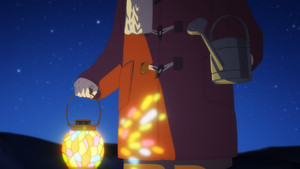
Asa, on the other hand, comes to nurture her sense of loneliness, and it ends up being exactly what she needs. As always, the visual language here is impeccable, with Asa carving out a secluded little nook for herself in Makio's closet. It's not somewhere she can sleep. It's not somewhere she can live. But it's a space where Asa can go when she needs it, illuminated in the rainbow of colors cast by her new and somewhat expensive lamp. Unlike her earlier purchase of a MacBook, this act of superfluousness is carefully considered and earned. She's not using it as a totem to compensate for a lack inside of her. The lamp is just one part of her new routine. It exists alongside the cool quiet of a desert at night, as Asa takes the opportunity to slow down and water her cactus. She can withdraw when she wants to, and she can stand out when she wants to. She does not have to let any single trait define her.
Asa's newfound maturity affects Makio deeply, who continues to mature herself. She can relax and enjoy a lunch with Emiri's mom now. She can feel proud of Asa's sense of initiative on public and private fronts. And she can be stunned by her niece's newfound thoughtfulness. Asa lashes out less. She settles on a date of remembrance for her parents. Makio, in turn, realizes how far they've both come since that meeting in the hospital. She, too, is haunted less frequently by the specter of her sister. Both of their wounds are healing, however slowly. And while she may not technically be her parent, Makio nevertheless acknowledges the new emotions Asa stirs in her heart.
Thankfully, Journal with Witch never becomes too schmalzy. I love the extremely human moment of Makio totally blanking on the words Asa took so close to heart, before outright rejecting and amending them. Asa's frustrations, funny as they are, make sense. Children, especially teenagers with developing brains, seek out guidance and tend to fixate on any nugget of wisdom that speaks to them. Unfortunately, communication is imperfect, and human beings are contradictory creatures. That realization is also an important part of growing up. The series similarly recognizes that our childhoods inform our adulthoods in ways we cannot always control. Kasamachi, like me, spent most of his life being deferential in order to avoid being the nail that sticks out. In the present, he may have matured and grown a backbone, yet he remains attracted to headstrong women like Makio who “compensate” for his prior lack. There are many such cases.
Finally, the synchronicity between the adult and teen storylines continues to impress. Snapshots of the high school baseball team provide an object example of the toxic masculinity discussed by Tono and Kasamachi. Dismantling these ideas will be a multi-generational project, but it can be accelerated by kids like Yoshimura who have the conviction to stand up for themselves. Meanwhile, of equal importance are connections like the one between Asa and Chise. While they are different people on different paths, those journeys can intersect and alter each other's trajectory. Asa needed to hear Chise's outburst in order to perceive another side of the pressures they both face. Now, united by chance at the train station, Asa's nosiness and pushiness may be what Chise needs to take her next step.
Rating:
Journal with Witch is currently streaming on Crunchyroll.
Sylvia is on Bluesky for all of your posting needs. She is a witch-in-training. You can also catch her chatting about trash and treasure alike on This Week in Anime.
The views and opinions expressed in this article are solely those of the author(s) and do not necessarily represent the views of Anime News Network, its employees, owners, or sponsors.
discuss this in the forum (71 posts) |

back to Journal with Witch
Episode Review homepage / archives