

The Fall 2025 Manga Guide
D.N.Angel New Edition
What's It About?
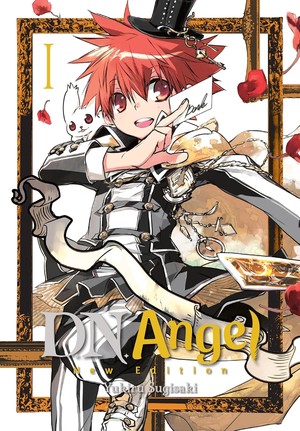
He was an ordinary boy. Seriously, Daisuke Niwa cannot stress it enough―he was just a regular guy with a normal crush on one of the pretty girls at his middle school, end of story. If only that were the case…Instead, he's stuck body-swapping with a daring phantom thief every time he sees the object of his affections, and his totally average life has been turned upside down by the people chasing after him in some crazy game of cat-and-mouse!
D.N.Angel New Edition has story and art by Yukiru Sugisaki. The English translation is by Athena Nibley and Alethea Nibley, with lettering by Chiho Christie. Published by Yen Press (November 11, 2025). Rated 8+
Is It Worth Reading?
Rebecca Silverman
Rating:
Revisiting D.N.Angel years after I initially read the old Tokyopop releases, the same plot point jumps out at me: unlike magical girls, magical boy Daisuke has no control over his transformation. His alter ego, Dark, is in his D.N.A., and his transformation occurs not when he says the magic words, but when his “love D.N.A.” is triggered. The same thing will turn him back, only it has to be the girl Dark likes, and it's only by living a requited love that Daisuke can get his body to himself again.
It's a fascinating dialectical difference. Magical girl stories are nearly always about a girl claiming her own power, learning that she can be more than “just a girl,” and a, if not the key element is learning that she is the one in charge of herself, her life, and her body. That Daisuke is robbed of those aspects of his own transformation suggests that his journey is about something very different, and there's very possibly an entire thesis in a comparison of his involuntary transformations (where the best he can do is control himself around the girl he likes) and the way transformations function for similar magical girls, such as Saint Tail or Phantom Thief Jeanne.
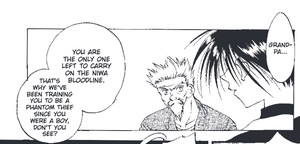
In a lot of ways, this does beg a comparison with Saint Tail. Dark, Daisuke's inherited phantom thief self, leaves calling cards, is friends (or at least acquaintances) with people on the side of the police, and he's always after works of art. Unlike Meimi or Maron, though, he seems to just steal art because he can; this first omnibus doesn't give him any humanitarian motives…or any motives at all, really. In fact, his mom and his grandfather just seem to want him to be Dark and steal stuff because it's the family tradition, and that's frankly the most annoying part of the story. (That goes double for his mom's increasing investment in his nonexistent love life.)
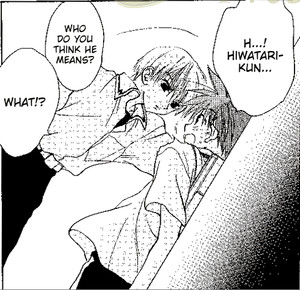
Well, maybe it's tied with the tangled love geometry, although that latter's arguably actually important to the story. This has some of the most garbled love lines since Marmalade Boy, with red strings crossing and tangling in ways that are simultaneously predictable and kind of irritating. Initially, Daisuke likes Risa, who rejects him, but Dark likes Risa's twin sister, Riku. Then Risa develops a crush on Dark, while Riku has a thing for Daisuke, only then Daisuke starts to like Riku while he's still sort of crushing on Risa. Plus, there's Hiwatari, a boy who works with the police, who frankly has more chemistry with Daisuke than either of the girls. It's exhausting.
Still, D.N.Angel is an interesting take on the phantom thief genre. The new translation reads really well, and I do like Yukiru Sugisaki's art, especially the color images, and this volume provides a nice color gallery at the end as well as color splash pages throughout. I'd probably still suggest hunting down Saint Tail, but this is fun, too.
Erica Friedman
Rating:
To say that a lot is going on in this new edition of this classic shoujo manga is a wild understatement.
At its most basic, this is a coming-of-age romance paired with magical thief-ishness to make a love/rival quadrangle with only 3 people. Daisuke's family genes force him to turn into Dark, but his family also expects Dark to carry on their traditional craft of art theft. The addition of Hiwatari gives Dark a Sherlock to his Moriarty, but also provides Daisuke a counterpart who comes to his rescue in a way that makes the girls squeal. Hiwatari seems to understand that Dark and Daisuke are the same, but here in Volume 1, we don't know why.
This all makes for a story that is both slightly repetitive and also throws new vectors at us with each chapter. There is a lot of teenage awkwardness in this volume, as well, which can feel a bit over the top, until one reminds oneself of what one was actually like as a teen.
Both art and story here provide an interesting sense of nostalgia for the late 1990s and the early boom of manga and anime in the west. It immediately brings to mind the rom-com and thievery hijinks of Saint Tail, with a little more emphasis on the romance aspect as a key component. Hiwatari adds a whole extra, vaguely BL-ish component to all of this, a component that will become more important as the series continues. Character designs (that hair) scream “late 1990s” loudly. The Nibley's translation also feels a bit early days of manga in the west, as characters lack distinct voices. D.N.Angel is definitely a trip back in time to early, messier days of western manga fandom, where throwing all the things at the wall, then stealing the wall, was the standard for shoujo manga.
Disclosure: Kadokawa World Entertainment (KWE), a wholly owned subsidiary of Kadokawa Corporation, is the majority owner of Anime News Network, LLC. Yen Press, BookWalker Global, and J-Novel Club are subsidiaries of KWE.
The views and opinions expressed in this article are solely those of the author(s) and do not necessarily represent the views of Anime News Network, its employees, owners, or sponsors.
discuss this in the forum (22 posts) |

back to The Fall 2025 Manga Guide
Seasonal homepage / archives