

Spring 2026 Manga Guide
Voices in the Sea Foam
What's It About?

Aito used to think he was an ordinary kid—until the day he fell in love at first sight with a boy at school. Suddenly, memories of his previous life as the tragic little mermaid came flooding back, leaving him unable to speak or stand without agonizing pain. The terrifying ordeal made him swear off love entirely, but a fateful encounter with his charming college classmate Toru now threatens to shake his resolve—and push him into dark waters that might drown him for good.
Voices in the Sea Foam has story and art by Kotarō. English translation is done by Cat Anderson and lettering by Elena Pizarro Lanzas. Published by Vertical (May 5, 2026). Rated T+.
Is It Worth Reading?
Rebecca Silverman
Rating:
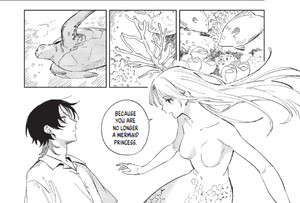
The Little Mermaid is not a nice story. It's also only romantic if you squint – Hans Christian Andersen's 1836 literary fairy tale isn't, as Disney would have you believe, the heartwarming tale of love across species. It's about a mermaid who gives up everything for a man only for him to have her sleep outside his room on a cushion like a dog and then marry someone else. Since she refuses to kill him, she kills herself and turns into sea foam. By the religious and moral standards of 19th century Denmark, the fact that she has the possibility of gaining a Christian soul in 300 years is considered a happy ending.
For modern readers, that doesn't really cut it, as Kotarō amply demonstrates in Voices in the Sea Foam. This single-volume BL manga isn't so much a retelling as it is a continuation and refutation of Andersen's original. Aito is the reincarnation of Andersen's mermaid (called the Mermaid Princess here, after the Japanese title of the tale), and he believes he still suffers from the Sea Witch's curse. Whenever he falls in love, he becomes unable to speak and his legs give out, or if he is able to walk, it feels like he's stepping on knives with every movement. So when he falls for Toru, he tries to stay away from the other man, desperate to avoid love and what he assumes will be his eventual fate – to turn to sea foam once more.
The thrust of the plot is that Aito must learn that he's living his own life now. He may have memories and/or generational trauma from when he was a mermaid, but that's not who he is now. And, as his friend Mizuki points out, the Sea Witch didn't technically curse the Little Mermaid. She granted her wish and told her the risks; it was the mermaid's choice to go through with it. Mizuki stands in for the fairy tale readers in the audience, gently reminding Aito about the actual tale and working with him to break the curse he believes he's under…even though Mizuki's pretty sure that true love's kiss would just do the trick. (Mizuki is very invested in their roommate's love life.) And maybe they're right, because before Aito can fully love Toru, he has to love himself and accept his past. Not true love in the traditional sense, but true love nonetheless.
Voices in the Sea Foam is an exceptionally good fairy tale reimagining. Aito's human status almost three hundred years after Andersen's tale was written shows the truth in that ending and Kotarō understands the inherent cruelty in the original story. There's a bit of Urashima Taro thrown in for good measure, and the characters are all fully-realized. Mizuki, as either a trans woman or gender fluid, is never treated poorly, and in fact we're allowed to just extrapolate from the way they're depicted and their pronouns in a beautiful example of casual representation. If you hate Andersen's The Little Mermaid or love it, or if you're looking for something a little different in your BL, do not pass this by.
The views and opinions expressed in this article are solely those of the author(s) and do not necessarily represent the views of Anime News Network, its employees, owners, or sponsors.
discuss this in the forum (20 posts) |

back to Spring 2026 Manga Guide
Seasonal homepage / archives