

The Spring 2026 Anime Preview Guide
Even a Replica Can Fall in Love
How would you rate episode 1 of
Even a Replica Can Fall in Love ?
Community score: 3.3
What is this?

Nao is not a human; she's a replica. As a child, Sunao felt there were things she couldn't handle, so she created a replica of herself to deal with them. But Nao's the one experiencing things and growing… and now she's falling in love.
Even a Replica Can Fall in Love is based on the light novel series by writer Harunadon and illustrator raemz. The anime series is streaming on Crunchyroll on Tuesdays.
How was the first episode?

Rating:
I think we all had imaginary friends at one point. Whether they were manifestations of fictional characters (I used to make my mother buckle Peter Rabbit into the seat next to me), fantastical creatures, or just reflections in the mirror, imaginary friends can serve an important function in life. But how do those friends feel? Are they aware of their own existence? And what does that mean for their sense of self?
Although Even a Replica Can Fall in Love doesn't explicitly say that it's about imaginary friends, that's what this first episode feels like: when Sunao, as a little girl, wished she wasn't alone or didn't have to do something uncomfortable, Nao, her perfect double, appeared. Nao isn't just a figment of Sunao's imagination; she's basically Sunao's identical twin, only one who can be shoved into a metaphorical box whenever Sunao doesn't need/want her around. Nao can fill in for Sunao without anyone noticing, as well as be her playmate, and as far as Sunao is concerned, it's a perfect situation.
But is that how Nao feels? Because this isn't Sunao's story. By the time they're sixteen, Sunao has taken to sending Nao to school in her stead with what seems like decent frequency. And Nao is very much feeling lost in the shuffle. Where the girls used to play together and interact, now Nao's entire existence is just being Sunao, and that's something she's very aware of. As the narrator of the episode, Nao never really says that she's unhappy with the situation, but she makes that abundantly clear nonetheless. She's living someone else's life, and that's not okay with her, even if she doesn't know what to do about it, because even in her own mind, she's not a real person. She's just a replica.
The worldbuilding, although a little scanty in this episode, is particularly interesting. Neither girl knows how Nao really came to be, but they've experimented with how her existence functions…to a point. While Nao clearly remembers whatever Sunao has experienced, the end of the episode shows that that doesn't go both ways. That makes it even more imperative for Nao to be Sunao in every way, but her interactions with Sanada and Ricchan make it clear that's not something Nao wants to do. There's also no guarantee that Nao's the only replica running around; surely I can't be the only one to notice that Sanada's limp comes and goes and that Ricchan's acceptance of a childhood fight seems far too simple.
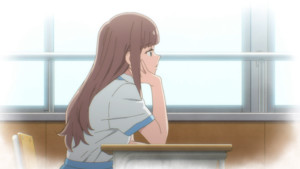
I really enjoyed the first light novel for this series, and while this is fine, I do think that may still be the better option. The filters used here are annoying, though I think the point is to show how hazy Nao's existence is. The animation isn't great; the fan in the clubroom stands as a prime example. Still, it's an interesting enough story that it's worth checking out in one form or another, and this certainly isn't bad – it's just not as good-looking as it could be.
Rating:
Reading the premise of Even a Replica Can Fall in Love, I figured that Nao would end up being, like, a robot created by Sunao Prime's family to act as a convenient substitute, or a body-double, or even a conveniently identical-looking stranger that could do a Prince and the Pauper-style switch when needed. It didn't take long for me to realize that the truth is much more insane, since Nao seems to be some kind of tulpa who materialized out of thin air one day to serve Sunao's whims. Before the opening credits have even finished, Even a Replica Can Fall in Love has delivered a protagonist whose very existence as a walking affront to the laws of physics invites impossible existential paradoxes that could drive any sane person to madness.
In other words, it's a typical case of Puberty Syndrome ripped straight from the pages of Rascal Does Not Dream of Bunny Girl Senpai. I mean that literally - this exact premise happens to one of Sakuta's gal pals early on in the first season, though in Bunny Girl the tulpa was more of an expression of Cute Scientist Girl's insecurities about her own femininity and romantic appeal. Here, in Even a Replica Can Fall in Love, Nao is standing in for her creator on account of Sunao living as a depressed shut-in. Anyone who has seen a supernatural teen drama like Rascal Does Not Dream… or Bakemonogatari can easily figure out how this goes: Nao is able to experience all of the joys that come from simply walking out the front door and living life, while Sunao misses out on everything thanks to this convenient excuse to indulge in her worst impulses.
I don't actually mind the magical-realist approach to this premise, with Nao appearing out of thin air to serve as an Instant Adolescence Metaphor (Just Add Water). Honestly, my main objection to Even a Replica Can Fall in Love is a philosophical one, which is to say that the philosophical core of the show feels like it's setting up an awfully predictable story. All throughout the premiere, I was distracted by the nagging question of how this story could possibly end any other way than having Nao and Sunao reunite, or merge, or whatever, with the latter inheriting the former's memories and learning a valuable lesson about bearing the brunt of life's challenges so she can experience the good stuff along with the bad. In other words, can a replica fall in love, without it all just being an overwrought metaphor for social anxiety? The only alternative would be that Nao just eventually goes on existing as her own person, while Sunao figures her shit out, which is a ludicrous situation that invites way too many questions for me to get lost in for a simple preview.
The reason it was so easy for me to be distracted by hypotheticals during this premiere is the fact that, frankly, it just isn't very engaging. Nao is far too plain and flat as a protagonist, I'm sorry to say, and the supporting characters are too simplistic to be interesting. The artwork is mediocre, with the only “unique” visual element being the weird, beige vignette filter that's plastered on top of practically every shot of the show. It's not a very flattering enhancement.
While I can appreciate the themes that this show is trying to tackle, Even a Replica Can Fall in Love would have worked so much better if the Replica Girl in question were living a life that felt more fulfilling than whatever the Original Girl gets up to when she's shut up in her room all day.

Rating:
I think I may have a problem. The moment you put one of these high-concept shows in front of me, I suddenly go all in on trying to figure out what is really going on. Oh, sure, on the surface, things are well explained. Nao was created from seven-year-old Sunao's wish to patch things up with her friend when she didn't want to say “sorry” herself. From there Nao was summoned again and again to do the dirty work—though more rarely in recent years.
The show treats this as a supernatural event—that Nao is a real, separate being from Sunao, appearing and disappearing at Sunao's whim. However, maybe that's not the case. Maybe Sunao simply has a case of dissociative identity disorder, and there is, and only ever has been, one of her.
But regardless of whether Nao is a magical doppelgänger or the remnants of the way a young child dealt with not having to do things she didn't want to do, the results are the same. Sunao is a kid who has never had to struggle and grow. Whenever things get tough, she simply passes her life over to Nao until the problem is resolved. She hasn't needed to study hard or work on her interpersonal relationships, and, slowly but surely, this has led to her being selfish, socially isolated, and completely disengaged from the world around her.
Building on this, while both have Sunao's memories, Nao also has all her own. This has made them completely different people. Nao has had all the personal growth Sunao should have had—she's the person Sunao would be if she hadn't run away from every problem growing up. And Nao, despite being treated as more of a slave than a friend, is instinctively driven to do all she can to help Sunao.
Of course, what Nao doesn't realize is that her “help” is precisely what is preventing Sunao from growing up. Sunao needs to learn to struggle on her own—to face both the hard choices and the often painful consequences. The true tragedy is, once that happens, the whole life that Nao has built, along with her entire being, will be gone as if they never existed at all.
All in all, this looks like it will be a solid show with enough deep themes, teen drama, and bittersweet tragedy to suit anyone even a little bit into this sort of anime—myself included.

Rating:
We can all agree that Sunao has Dissociative Identity Disorder and Nao is an alternate personality, right? Nao blinks in and out of existence whenever Sunao doesn't feel like doing anything, always wearing whatever clothes Sunao had on at the time, and the two of them can never be seen together at the same time. She manifested as a result of Sunao knowing she needed to apologize for a task but deeply wanting to avoid it.
At the very least, Sunao is deeply, deeply depressed. Nao describes how she's never gone to the literature club and how she just “stares at” the living; Sanada is surprised at her interest in reading because she seems uninterested in anything in class. Even if she's legitimately missing school because of menstrual cramps, this is not the behavior of a mentally well young woman. That's genuinely the most interesting part of the episode to me: Nao as an externalization of Sunao's internal illness, and the splitting of oneself required to mask depression symptoms.
This is bolstered by Sumire Morohashi's strong performance, carrying the episode largely through Nao's narration. She balances Nao's soft-spoken calm without making her feel blank, hinting at the turbulence under the surface. The character writing is subdued, but I appreciated how they built a sense of connection between Sanada and Nao as they whispered over literature in the library. Nao's disconnection from life and Sanada's struggle to heal from his injury will almost certainly come to play together.
Unfortunately, there are some major issues with the visual presentation. Makiko Doi is a skilled color designer who has worked on a number of anime I've loved, and others I didn't love but begrudgingly acknowledged as beautiful. However, in seeking to create a soft, nostalgic tone, the colors she's picked out for Even a Replica Can Fall in Love are universally washed-out and beige. The edges of the picture are faded, like you're looking at a tattered old photograph, but it's unnecessary, distracting, and doesn't actually add anything to the mood. I do, however, like the character designs a lot.
I am curious about Sunao and Nao and whether their situation is literalized or will turn out to be related to Sunao's mental illness. However, this season is full of bangers, and by now, I simply do not have time to indulge that mild curiosity.
Disclosure: Kadokawa World Entertainment (KWE), a wholly owned subsidiary of Kadokawa Corporation, is the majority owner of Anime News Network, LLC. One or more of the companies mentioned in this article are part of the Kadokawa Group of Companies.
discuss this in the forum (131 posts) |

this article has been modified since it was originally posted; see change history
back to The Spring 2026 Anime Preview Guide
Season Preview Guide homepage / archives