

The Spring 2026 Anime Preview Guide
I Made Friends with the Second Prettiest Girl in My Class
How would you rate episode 1 of
I Made Friends with the Second Prettiest Girl in My Class ?
Community score: 3.5
What is this?

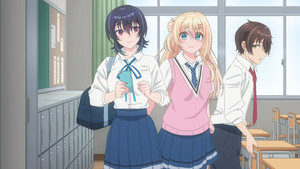
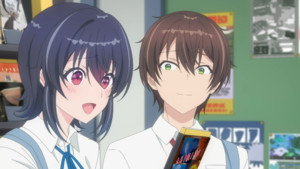
Maki Maehara is a boy who has not made any friends or acquaintances at school. He makes his first friend Umi Asanagi — whom the gossip among male classmates has nicknamed the "second cutest girl in class." She usually hangs out after school with the No. 1 cutest girl, the naive Yū Amami. However, on Fridays, Asanagi would come to Maehara's home instead, thanks to their shared hobbies like movies, games, and manga.
I Made Friends with the Second Prettiest Girl in My Class is based on the Class de 2-ban Me ni Kawaii Onna no Ko to Tomodachi ni Natta light novel series by author Takata and illustrators Azuri Hyūga and Tom Osabe. The anime series is streaming on Crunchyroll on Tuesdays.
How was the first episode?
Rating:
I try not to judge things by their titles, but sometimes that's a difficult proposition. This is a fancy way of saying I was more or less dreading this episode because I intensely dislike the title. Why does it need to clarify that Asanagi is the second prettiest girl in class? What possible bearing could that have on the story? Is "pretty" synonymous with "popular?" (It's set in high school, so probably.) The mere sight of the words on my screen aggravates me.
But wouldn't you know it, that old saw about not judging books by their covers (or light novels by their titles) does have some truth to it. I did not loathe this show. I didn't even strongly dislike it. I wasn't particularly interested in it, either, but I'll take bland neutrality over seething hate any day. I Made Friends with the Second Prettiest Girl in My Class' first episode is mostly harmless, a kind of nice story about the class nobody and one of the popular kids becoming pals because they share an interest in soda, video games, and B monster movies.
Maehara and Asanagi's friendship is very clearly the real deal. Knowing he'd never approach her, Asanagi makes a point of talking to Maehara outside of school after his introduction in homeroom reveals their shared interests. This shows not only a good memory for what the social hierarchy of middle and high school is like, but also that Asanagi's a good person. She saw how embarrassed Maehara was when the teacher read his introductory form aloud. She saw how he clearly wanted the floor to open up and swallow him when the teacher wasn't sure how to handle things. She then went out of her way to make sure that they could talk without any of that being a factor. She doesn't hide her teasing personality, but she's trying to meet him where he lives, and I really like that.
This is still fairly blatant wish fulfillment. It's obvious that Maehara is going to end up interacting with the actual prettiest (most popular) girl in class, and the third, who rounds out their trio of loveliness. But if the story can move away from the “pretty” angle, it has potential. I actually don't want a romantic element introduced into the story, though I'm sure there will be one, because as friends, Maehara and Asanagi are very appealing. I don't love the way Asanagi's eyes and mouth are drawn, or the way the camera loves to focus on girls from the neck to the knees, but this was still a pleasant surprise. I'm not sure I'd watch more of it, but I also wouldn't scream if I had to.

Rating:
It's funny how much work that the hyphen (or lack thereof) is doing in the title of I Made Friends with the Second Prettiest Girl in My Class Preview. Grammatically, you need the hyphen to create the compound adjective that distinguishes the titular girl's status as being one place below the actual prettiest girl in the protagonist Maki's class. However, the official artwork and listings make it clear that Umi is no hyphenate beauty, since her (and the show's) title can be read to mean that she is the second of the girls in the class who could be considered “the prettiest.” Now, of course, you could argue that the superlative implications of the “-est” suffix make the inclusion or exclusion of a compounding hyphen irrelevant, though I would counter that argument with a reading of the missing hyphen as an intentional inflection point of ambiguity. Is it not true that the person you love will always be the prettiest in the class, in your eyes, regardless of their placement on any hierarchical rankings of socially constructed standards of—
Ah, shit, I'm sorry. I let the part of my brain that has been infected with the English Teacher and Language Nerd Virus take over for a minute. It's just…Look, I have to be honest. I actually watched the premiere of I Made Friends with the Second Prettiest Girl in My Class first out of today's big batch of episodes, but I had to hit pause on this write-up and tackle a few other Preview Guide entries first, since I just could not figure out what in the hell I was supposed to say about this one. It's just so bland. Here we have a show that fully commits to every single misty-eyed, twinkly-music-scored trope of every wistful teenage romance ever made, and the best it can possibly do for us is trot out a setup as tired as, “Can you believe that the girl I like is cute but she also likes…horror movies!? And soda!?!? Video games!?!?!?”
Why, yes, I Made Friends with the Second Prettiest Girl in My Class, I can believe it, and all of those interrobangs in that rhetorical plot description indicate that I may, in fact, possess too much life experience to be swept off my feet by your trite perspective on teenage romance. I don't want to brag, but I've been married to the pretty girl from class who also likes soda, horror movies, and video games for over a decade. It's awesome. This Umi chick is down an entire dimension of spatial reality compared to my real, human wife. Such a pale cartoon imitation is going to have to do better than “kind of nice, I guess” to pass muster.
I could forgive how derivative and simplistic this silly little teenage wish-fulfillment show was if the cast had the personality and chemistry to carry the story. Alas, Maki is the typical mannequin of anxiety, self-doubt, and generic male protagonist energy that drags down so many of these anime romances, so the odds were stacked against this one from the very beginning. Umi is, for her part, an admittedly charming and cute young lady, but the show can't just show us a bunch of scenes of Umi playing Monster Hunter and noshing on some 'za with da boys and pretending that is a replacement for a real story. If anything, I'd say the biggest hook the show has is Umi's friendship with Yuu, which I have to imagine has more depth to it than being a flimsy excuse to introduce more girls that will inevitably latch on to Maki for no particular reason. Then again, am I really paying the show a compliment when I strongly imply that it would be much more interesting if its main character were removed from the equation entirely? Since that's never going to happen, anyway, I figure that I Made Friends with the Second Prettiest Girl in My Class is an easy title to drop from the seasonal watchlist.
Rating:
We get so many sub-par rom-coms these days that my attention is always piqued when we get something more akin to a romance drama instead. Now, that's not to say this isn't a light-hearted show so far (it's not like it's White Album 2 or something), but the tone is closer to Oregairu or Too Many Losing Heroines!—which means more room for dramatic growth and less for ecchi pratfalls.
But why I'm rating this show so highly is because of the shape of the story—or, rather, my interpretation of it. While Maki may think his friendship with Umi is based only on their common interests, it seems that there is much more to it than that, based on what's happening in the background.
Umi's school life is defined by her relationship with Yu. I mean, it's right there in the title: “the second-prettiest girl in class.” She is the childhood friend—the sidekick—in Yu's story. That's got to be exhausting even if they are the best of friends. Perhaps that's why Umi switched schools. She wanted to forge her own identity alone in a new place—only for Yu to follow her and even end up in the same class. Then, when she hears that Maki likes the same things she does—and, more importantly, the things that Yu does not—she pounces on him. I mean, she goes so far as to make a plan and lie to her friends in order to corner him on the day she knows he's alone (thanks to his class intro).
If you look at the situation this way, her reason for keeping her friendship with Maki a secret isn't one of embarrassment, but rather to protect the peace she has found. Through Maki, Umi is figuring out who she is without Yu. If Yu finds out that Umi has a new friend, it seems like she's the kind of person who would force her way into the relationship and try to take over—ruining the whole thing.
In other words, this show looks right up my alley, with the kind of layered, complex characters I love.
Disclosure: Kadokawa World Entertainment (KWE), a wholly owned subsidiary of Kadokawa Corporation, is the majority owner of Anime News Network, LLC. One or more of the companies mentioned in this article are part of the Kadokawa Group of Companies.
discuss this in the forum (123 posts) |

this article has been modified since it was originally posted; see change history
back to The Spring 2026 Anime Preview Guide
Season Preview Guide homepage / archives