

The Spring 2026 Anime Preview Guide
Kujima: Why Sing, When You Can Warble?
How would you rate episode 1 of
Kujima: Why Sing, When You Can Warble? ?
Community score: 2.9
What is this?

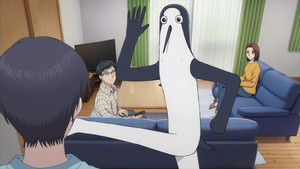
First-year middle school student Arata Kōda meets a mysterious bird-looking creature named Kujima in autumn. Hungry and craving Japanese food, Kujima ends up staying with the Kōda family at their house, where the atmosphere is tense because of Akira's older brother, who failed the college entrance exam. Kujima lives with the Kōda family until winter passes and a warm spring arrives.
Kujima: Why Sing, When You Can Warble? is based on the Kujima Utaeba Ie Hororo manga series by Akira Konno. The anime series is streaming on Crunchyroll on Thursdays.
How was the first episode?
Rating:
Attention, sound sensitive viewers: are high-pitched, shrill voices one of your triggers? If so, consider giving this show a pass. Yuria Kōzuki's Kujima is like nails on a chalkboard, a constant grating sound that only gets worse as it goes on. Is it the right voice for the character? Probably; Kujima themselves is such an odd duck that they needed a distinct, and possibly annoying, voice to really drive home the fact of who they are. But I kept turning the volume down and moving further and further away from my computer while watching this, because it was just that awful. By the end I felt like one of my cats when they see the neighbor cat from the window, ears back and fur standing on end.
It's not that Kozuki doesn't do a good job, either. Kujima, a bipedal bird creature, was raised in Russia by an old man, and their pronunciation of Japanese is meant to reflect that. Emphasis is put on odd syllables, R's are rolled, and other little indicators of a non-native speaker pop up. If your ears are okay with it, it's actually quite impressive.
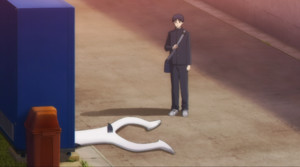
The plot, on the other hand is a bit less so. Arata discovers Kujima fishing a coin out from under a vending machine (which is apparently illegal?) and ends up bringing them home with him because the poor bird-thing is so hungry. This morphs into Arata's family being convinced to let Kujima stay for the winter like a feathery exchange student. Just how this happens isn't clear; both Arata's mom and dad initially say no, and his stressed older brother Suguru is actively resentful. But Kujima stays nonetheless, and by the end of the first episode, he's working on bringing the family closer together.
This stems largely from the fact that Arata misses his brother. Ever since Suguru failed his college entrance exams, he's been locked in his room studying nonstop, and although Arata doesn't say it outright, he mentions that he's “getting used” to eating alone when his parents aren't home. Kujima correctly interprets this as Arata wishing Suguru would emerge more often, and so they take action. Kujima is grateful to this family, and Arata in particular, and they want to show it…even if they're not all that good at it.
For a deliberately wacky show, Kujima: Why Sing, When You Can Warble? has its heart in the right place and is really trying to show it. It does get wrapped up in its own zaniness to the point where this almost gets lost, but I could see it evolving over time into something both silly and sweet. It's not tickling my funny bone right now, though, and I can't deal with Kujima's voice. But if that's not an issue for you, it's worth at least checking out.

Rating:
Look, I don't mean to be cruel or anything, but I'm just saying: If Kouda were my son, and he brought home this shrill, freaky-ass bird abomination into my home, I would grab my shotgun and drag the godforsaken thing to behind the tool shed. If my son questioned this decision (which he would not, because I would have raised him to be decent), I would only respond, “My boy, sometimes it is a father's terrible burden to right the mistakes that God has inflicted upon this world.” It's nothing personal, Kujima. You were simply never meant to be.
This may be an overreaction on my part, but I cannot simply ignore the visceral sense of physical and psychological rejection that this Kujima creature inspired within me. His stupid face. His awful voice. The absolute insanity of every otherwise sane and rational person greeting this affront to nature with those cheery, eyes-closed anime grins and a parade of “How do you dos?” It's too much for me. I just hate Kujima so goddamned much.
Now, there are some visual gags that play up Kujima's off-putting nature, so I know that the creators are at least somewhat aware of what they have unleashed upon their poor, unsuspecting audience, but herein lies the other great failure of Kujima: Why Sing, When You Can Warble? It's not very funny. Either Kujima is being too annoying to generate any meaningful laughs, or all of the other human characters are sucking the lifeforce straight out of the room with their sheer lack of personality. Again, I get that this is the point; how else do you contrast Kujima's “hilarious” and “entertaining” antics but by contrasting him against a cast of relatively plain, normal people?
Comedy is a fickle and enigmatic alchemy even at the best of times. Nothing kills a joke worse than explaining what makes it funny, because laughter is simply the jovial flipside of our brain's lizard-brain fear response. An instinctual outburst of surprise and joy that comes when you just know that something funny has occurred. So, while I do not doubt that plenty of viewers out there will find lots of warm chuckles in Kujima: Why Sing, When You Can Warble?, the only response it inspired in me was to back away from it and hiss as if I was being confronted with some disgusting, venomous snake. The show looks fine, though, and it is otherwise put together effectively enough, so I suppose I can award it an extra star for effort. May God have mercy on its soul.
Rating:
I have minor beef with the English version of Kujima: Why Sing, When You Can Warble?. While the words are an accurate enough translation, they fail to capture an essential nuance: Kujima talks in the heavily-accented, grammatically simple structures of a second-year Japanese student. It's why sometimes he'll shrug things off that Arata and his family say with the excuse that their Japanese is too complicated for him. It's a shame that they didn't achieve one of the most important elements of translation, robbing countless thousands of viewers of the full viewing experience.
Oh hell, who am I kidding. Kujima is not going to be a big hit. I don't have an issue with the surrealism of his presence, since it's not too different from other sitcoms where something weird shows up and everyone goes, “Okay, this is just my life now.” The problem is that Kujima is extremely off-putting, to the extent that my husband and I had an in-depth conversation about whether Arata and his friends should have beaten him to death with hammers. (Don't freak out, this is a paraphrase of a tweet.) He grows over a foot over the course of the episode, is built like one of those inflatable tube guys, and has a proboscis. That's not a bird, that's a mansquito. He's as unpleasant to listen to as he is to look at.
To the show's credit, it's at least partially in on the joke, as we learned when Arata worries that Kujima asked for a saw to murder his whole family. But at the same time, it really wants to be “””””wholesome””””””””” and “”””””””cozy””””””””” as Kujima brings the once-fractured family together. Thanks to this discomfiting mansquito's obsession with Japanese food, they're eating meals together! He even contrives a way to get Arata's exams-obsessed ronin older brother to join in. I'm sorry, if one of my younger siblings brought that thing home, I would lock myself in my room and never come out.
I'm raising a fuss but when the end credits started, a heady mix of emotions welled up from within me. I was terrified that we were only halfway, surprised that it was actually the end, and shocked that the episode had zipped by fast enough that it felt plausible that it was only the halfway point. As they say, time flies when you're having fun so… yay?

Rating:
I'm going to let you all in on a bit of a secret. When you, as a foreigner, come to Japan, you gain a superpower. Colloquially known as the “Gaijin Smash” it basically means you can do whatever you want, pretend that you didn't know it was against the rules, customs, or minor laws of Japan, and thus avoid the consequences of your actions. It is a superpower that is built upon exploiting the kindness of your average Japanese citizen who is trying to give the benefit of the doubt to a guest in their country.
Of course, as the saying goes, “with great power comes great responsibility.” Each time you use the powers of the “Gaijin Smash,” you devalue them—make it less likely that someone who was actually ignorant, who truly needed to be cut some slack, will get the understanding they need. This, of course, leads us to the walking eldritch abomination that is Kujima.
Kujima is the epitome of the worst type of foreigner in Japan. He's a self-centered mooch who Gaijin Smashes with impunity. Each time he played on the emotions of Ataru and his family to get his way or did something against the law for his own satisfaction and claimed ignorance I got more and more irate. By the end of the episode, I came to hate him on a deeply personal, almost spiritual, level. People like him ruin Japan for everyone else.
But even taking Kujima out of the equation, this first episode doesn't have anything going for it. The characters are completely one note—be it Arata or his family members—and the plot is so Kujima-centric that literally every interaction in the episode revolves around him. Honestly, the most interesting aspect of the whole anime so far was the baffling choice to open on two characters doing stretches who are then given name cards (marking them as important characters) only for them to say nothing of substance and never appear again.
I'm sure that somewhere there are those laughing their butts off at the walking fever dream we call Kujima—his angry faces, weird way of talking, and comical antics. I, however, am not that person and I look forward to the day I forget this show even exists.
discuss this in the forum (141 posts) |

this article has been modified since it was originally posted; see change history
back to The Spring 2026 Anime Preview Guide
Season Preview Guide homepage / archives