

How to Compose an Anime Soundtrack: An Interview with Haikyu!! and My Hero Academia's Yuki Hayashi
by Richard Eisenbeis,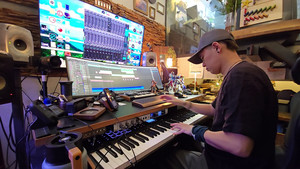
To start off, we talked a bit about how far into production he is usually contacted to score an anime. “It can vary depending on the show in question. It can be about six months in advance. But recently, with NETFLIX and simultaneous international releases, they can start a year or so in advance,” Hayashi began. “Some can be pretty short—like three months in advance. But normally, it's about six months.”
But how does he come to decide on whether to take on a job or not? “It's probably if it excites me or not,” Hayashi told me. “I'm sometimes a little too busy to take on a project. But sometimes, if they insist that they want me on the project—I mean, I really appreciate that they'd insist on it being me, so I might try to rework my schedule so I can help them out. It mainly comes down to if I really want to work on it or not.”
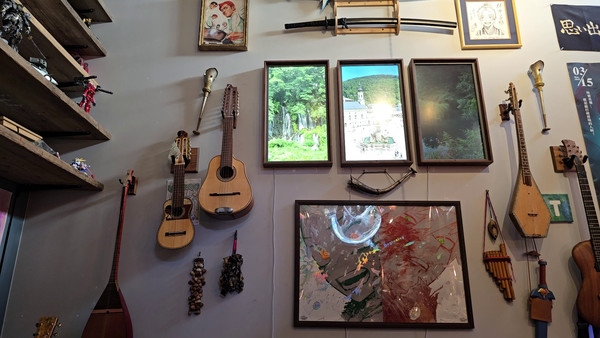
So what exactly was it that got Hayashi excited enough to work on what would become some of his most well-known scores? “For Haikyu!! it was it being a sports story. I played sports myself. That was one of the big influences on how I got into making music. So sports stories have a special place in my heart.” Hayashi said. “When I accepted the Haikyu!! job, I hadn't worked on a lot of sports stories yet. So, to get that opportunity was really… I remember being really happy.”
“For My Hero Academia, that was about a decade ago. I don't really remember all that much,” Hayashi admitted. “It was a really popular Shonen Jump manga. And reading it, I really felt it was something that was worth making an anime out of. I remember thinking that it was a chance to make music for a genre I'm good at.”
Once into the creative process, Hayashi has to figure out how much to get into the source material—be that a manga, book, or previously done anime. “There are times when I really dive deep into the source material, and there are times when I don't. [...] Basically, I always ask the director or producer how they're changing things from the source material. How do they want to portray this anime? Do they want to diverge completely, or basically do a remake?” Hayashi explained. “If they say they want to diverge, I try not to let the source material influence me too much. Obviously, I'll ask a bit and maybe read a bit, but I'll avoid going too deep. I'll try to prevent myself from having any preconceptions.”
“For original anime, it depends on the script, or the director or producer,” he added. “I'll ask what sort of piece they're making. I'll often also make suggestions like, 'What if we try it like this?' Stuff like that helps lead to creating new things.”
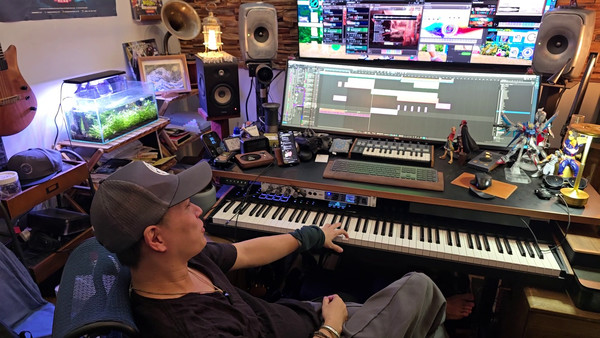
From there it comes time to get onto the actual composing. “Well, I basically use this computer to compose,” Hayashi said, gesturing to the massive combined computer/piano setup behind him. “Basically, when I'm at my piano, it's a lot of trial and error. There's finding melodies and cord progressions and such. But the important thing is what sort of concept is it—what sort of image to have at first overall when creating the anime music. It's important to have that down before composing. Without that, you end up really lost.”
“I mean, with anime, you've got 40 or 50 pieces all for a single season. If you compose without thinking first, there's no balance to it,” he continued. “'I'll try this for this sort of music…' 'It's this sort of story, with this sort of plot, and this sort of protagonist…' That helps with deciding on instruments, music genre, and tempo. I generally get the concept down first before I start actually composing.”
All that said, Hayashi tends to compose his songs, in his own words, “backwards.” “I'm a little different from others. A lot of times, I compose the melody or the leitmotif at the very end,” he told me. “I compose the orchestral foundation, then I inject what I've felt listening to that music. And then I often hone the melody last. I'll consider the individual characters or the plot when I'm working on the orchestral part, I create the back track, and finally I'll often shape what it is that comes up inside myself.”
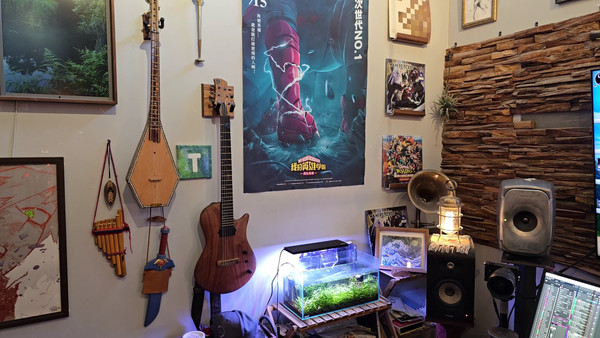
While part of this is personal preference, part of it is also based on how the music is delivered to and then used by the anime's sound director. “There's the technical term: 'stem.' Basically, when sending in music, if a piece has drums, guitar, and vocals, you send in the drum track, guitar track, and vocal track separately so they can match it to a scene: 'This part isn't dramatic, so leave out the drums.' 'Add the drums when the protagonist starts running'—that's what the sound director does.”
“If you put too much emphasis on the leitmotif, the music can become too specific, like just for one character,” Hayashi continued. “This is especially true for [Masafumi] Mima, the sound director for My Hero Academia. He often takes music for one character and uses it somewhere completely different. So I sometimes get requests to keep the leitmotif down to a minimum. Or he'll ask to have it in a separate stem file.”
One of the most challenging parts of being the composer for several hit anime is coming back to score the subsequent seasons and movies. “[Using My Hero Academia as an example], I did season one, but at the time, I had no idea there'd be a 'final season'—that the series would go all the way to season eight,” Hayashi said. “With any series, at first you always give it your all. I actually often laugh about this with my composer friends.”
“Basically, we get a request sheet from the sound director,” he explained. “It describes it like, 'They're giving 100% fighting.' It mentions that there's this ultimate battle. So we do our best to make an exciting piece to go with it. Season one ends, then we get the order for season two. And there's another boss battle. And when you read [the sound director's instructions] it says there's an enemy even more powerful than the last one. So it has to be more than last time where we put 100% into composing. Maybe we add a vocal chorus or add tons of rock music elements. Then season three comes and there's another boss battle. There's this progressive musical inflation going on! So we always talk about how the heck we get through all that amongst ourselves.”

Hayashi is well aware of how his work has been received by audiences outside of Japan (especially when it comes to “You Say Run” which he talks about at length in the previous part of this interview). “I've gone as a guest to overseas live performances. I've sometimes been asked to appear for a special encore, or just as a guest to an orchestral concert. Most times, I don't perform. I just listen as a member of the audience.”
“There's a difference in audiences. Japanese audience members tend to be shy and quiet, but going to America, they're all… To have them listen to our music and cheer so loudly is such an experience,” he related to me. “For a performer, it's really fortunate to be able to perform overseas. It's something I'm really looking forward to.”
To close out the interview, Hayashi had the following words: “I'd like to say thank you for always watching and listening to my music. Starting in 2026, I'm hoping to go overseas more to play or have more opportunities to perform more. By doing so, I hope it'll give people an opportunity to know my music and Japanese anime. I hope everyone continues to enjoy more series, and will listen to my music. Thank you very much.”
To see this interview in full, check out the video below.
discuss this in the forum |
