

Hundred Scenes of AWAJIMA
Episodes 3-4
by Sylvia Jones,
How would you rate episode 3 of
A Hundred Scenes of AWAJIMA ?
Community score: 4.8
How would you rate episode 4 of
A Hundred Scenes of AWAJIMA ?
Community score: 4.8
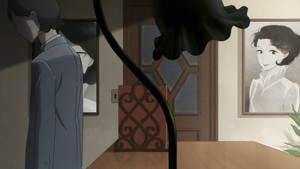
When the second episode ended on a quick sketch of Katsurako Ibuki as a teacher, I appreciated it as a pithy yet meaningful statement on the ways people do and do not change over the course of their lives. Awajima's third episode takes the opposite tack with its long and meandering journey through the women who raised her. It's a monstrosity of narrative to summarize, let alone analyze. It leaps back and forth across decades, blurring spacetime into a single chaotic point on a cosmic scale. The mix of emotions is even more disorienting, with hate, love, respect, and resentment bleeding into each other. Awajima hardly factors into it. However, Awajima is more than just a building filled with theater students. It is a metaphysical space—a crystallization of the systemic factors that grind all but the strongest and hardest carapaces into ashes.
It's instructive to think about what Shimura doesn't show us. She largely avoids the stage and the craft involved in acting. She focuses instead on the idea of family and legacy, particularly in how these concepts manifest within each of these three women. At times, it feels like the slow-burn psychological horror of a ghost story, with Natsuko's portraits looming frozen and flawless over all of them, including Natsuko herself. Ruriko reflects that Natsuko must have many “daughters” as a result of her reputation as an actor, and that their relationships to her mother must be more authentic than her own. Natsuko never gave her the hairpin. She hugged Ruriko only once. In another sense, though, these tiny morsels and memories are the most authentic part of Natsuko. The idea of Natsuko—the one admired by many and locked within the four sides of the picture frame—is an afterimage. It's intoxicating because it's ephemeral, and Natsuko finds herself similarly attracted to ephemerality, with the visages of her mother and husband imprinted on her heart.
Therefore, Shimura asks us to sympathize with Natsuko as much as we sympathize with Katsurako, who calls her grandmother a bitch on her deathbed. As a mother and as a grandmother, Natsuko certainly behaved in ways that warranted this admonition. But “mother” and “grandmother” are also roles, and the women of Natsuko's generation had little say in them. As an actor, she could achieve a modicum of independence, even if it came at a high cost that was paid, in part, by her daughter. Ruriko is both the most well-adjusted and most pitiable member of this trio. She forged healthy bonds with her husband and daughter, and she treasured the scant happy memories with her mother. However, she also comes to realize that the open resentment Katsurako throws at Natsuko is actually her own doing. By stifling that side of her, Ruriko left herself unable to stand between her daughter and her mother. She let it foment until it frothed over into hatred. That is her sin.
I could go on for quite a bit longer. Awajima's third episode is a tremendous accomplishment that raises the bar for the other scenes to come. It's a rich snapshot that denies the audience catharsis while avoiding the treacle of melodramatic tragedy. It is 20 minutes of a flower slowly wilting, animated in heartbreaking detail. Speaking of, the episode is a brilliant achievement from storyboarder and animation director Gin-san, who knows how to both meaningfully stage a scene and add a tactile sadness to the smallest of gestures. For something completely different, be sure to check out his work on the third episode of Botan Kamiina Fully Blossoms When Drunk. He's clearly a name to look out for.
The fourth episode is not as emotionally exhausting, but it similarly benefits from strong creative leads. First and foremost is Atsuko Ishizuka directing and storyboarding. I feel like I haven't seen her in ages (A Place Further Than the Universe is eight years old, and I haven't watched Goodbye, Don Glees! yet), but she's in peak form here. The colors in the first half are especially good. Meanwhile, yuri expert Yuniko Ayana takes over writing duty, and Kayo and Saori's story feels like it would fit right at home in one of her original works. While these are broad sketches of an intimate relationship that, despite the ladies' protests, is obviously ongoing in some form or another, the visuals and narrative structure evoke their yearning to an achingly palpable degree. I look forward to their wedding.
I love the quick aside with Wakana's mother, Saeko. There are echoes of the previous episode, in which Ruriko fixates on her lack of traditional beauty. Internally, Saeko also resigns herself to a simple life devoid of glamour, but the Awajima DVD awakens a latent longing (as well as her bisexuality). We've spent so much time inside and close to Awajima that it's prudent to remember how it looks from the outside. For all of its problems, the institution persists because it produces works of art that stir the imaginations of its audience. There's magic in the theater and its players of larger-than-life roles. If Awajima can make even more moms realize that they're attracted to women, then we have to question whether that offsets some of the psychological damage the school causes. Maybe. Maybe not.
Finally, the last scene of the fourth episode takes on another external perspective, this time through the eyes of Awajima's small cadre of male admirers. It's incredibly sweet. Both Takuto and Sayaka remind me of myself at different parts of my life—Takuto as the awkward and soft-spoken teen, and Sayaka as the nerdy yet more comfortable adult. Shimura, an author quite familiar with the concept of gender, utilizes Takuto's story well to show how society denigrates and otherwise instills shame in enjoying “feminine” activities, particularly in the boys who enjoy them. But obviously, there's nothing wrong, weird, or inherently gendered about carrying handkerchiefs, loving theater, or taking nice photos. Anyone can do so, and it's nice to see two guys forge a friendship over these shared interests.
On the other hand, because Shimura wrote Wandering Son, and because I am who I am, I feel obligated to conclude with another paragraph. And holy shit, Takuto, you egg. Honey, you are absolutely right that it's perfectly fine for a guy to have that kind of idealistic infatuation with Awajima, or with any “girly” hobby. You alone get to define what your gender means to you. But if you find yourself dreaming those dreams, saying, “it's not like I wish I were a girl” that many times, and feeling this vague unease/guilt at being a man, you might be a woman. Speaking from my own experience, I did all of those things literally, and once I started transitioning, it was like everything clicked into place at once. In my perfect world, I'd follow this storyline to its transgender conclusion: Sayaka starts hormone therapy, Takuto sees how happy his friend is, and we close on a shot of Takuto, framed by one of his Awajima posters, swallowing an estradiol pill. The ball is in your court, Shimura.
Episode 3 Rating:
Episode 4 Rating:
Hundred Scenes of AWAJIMA is currently streaming on Crunchyroll.
Sylvia is on Bluesky for all of your posting needs. In high school, you could catch her in the pit orchestra, but never on stage. You can also catch her chatting about trash and treasure alike on This Week in Anime.
The views and opinions expressed in this article are solely those of the author(s) and do not necessarily represent the views of Anime News Network, its employees, owners, or sponsors.
discuss this in the forum (4 posts) |

back to Hundred Scenes of AWAJIMA
Episode Review homepage / archives