

Hundred Scenes of AWAJIMA
Episode 5
by Sylvia Jones,
How would you rate episode 5 of
A Hundred Scenes of AWAJIMA ?
Community score: 4.0
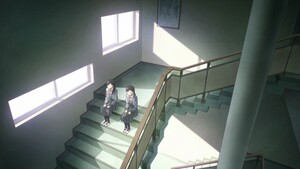
A Hundred Scenes of AWAJIMA is full of surprises. Last week, while it's not out of character for Takako Shimura to write about gender, I was not anticipating transfeminine feelings so early into the season. This week, similarly, I did not expect religion's presence, nor the nuance of Asami's narrative. And these are good surprises, to be clear. I'm happy to see Awajima explore the breadth of ways that art, especially theater, intersects with real life.
Asami's story is both generalized and specific. We never find out the identity of her parents' faith, so we can project any number of beliefs or sects onto her experience. I saw an online mutual comparison to her experiences leaving Mormonism. I could recognize some of my own memories growing up in and drifting out of the Catholic faith. Religions all over the world indoctrinate children into their unique collections of beliefs, and it's tempting to think of those children as unilaterally passive participants. And there's no doubt that a child growing up in a single-faith household is very likely, through inertia alone, to accept that faith as their own. Many children have no other choice. Yet children are also people who possess autonomy, and there will always be kids like Asami who question and doubt at a very young age.
On the other hand, Asami's childhood is rooted in a specifically Japanese experience. We intuit that her parents likely belong to a new age cult, of which there are more than a few in Japan. This is a complicated topic that I have not studied to any appreciable degree, but I do know that in the wider cultural sphere, these cults come laden with certain connotations. One such cult, Aum Shinrikyo, perpetrated the 1995 Tokyo subway sarin gas attack. Tetsuya Yamagami, the man who assassinated Shinzo Abe, cited Abe's financial ties to the Unification Church (a.k.a. the Moonies) as the reason for his actions. Meanwhile, films like Love Exposure and books like 1Q84 use real cults as touchstones for their salacious fictional ones. In short, these facets and more make up the context in which Asami finds herself, and it's not a good context.
Awajima, however, is characteristically muted in its approach. Asami's parents do not force her to participate; they're not abusive, and they seem pretty normal. But this situation nonetheless proves difficult for Asami. Even though she has no desire to join their church, she can't help but be exposed to it to some extent. She used to go to their youth group. Her parents put up some resistance to her doing a “normal” shrine visit. She gets recognized by another girl who belongs to the church. Moreover, she can't discount the possibility that she's already been brainwashed into their doctrines, despite her skepticism. Asami believes she has been fundamentally tainted by her proximity to this unnamed cult, and although she finds herself climbing the golden thread of the Awajima Revue School, she can't help but feel her parents' influence weighing down her feet.
I totally get Asami's frustrations. She can't bring herself to hate her parents because she knows they love her and support her. However, she can't help but be frustrated with them and with herself. It hurts to have your own hard work be ascribed to a higher power. It sucks when you can only relate to the kind of people you want to escape from. And it feels awful to sulk behind the walls one constructs to defend their vulnerabilities and insecurities. Asami knows that Awajima is good for her, because it allows her to live by her own values. It's not an immediate fix. She shrinks from the public bath, projecting a germaphobia that belies her buried self-deprecating truth. But it also gives her a voice that she can explore through art and performance, and that can illuminate a path forward.
This week's second and final scene focuses on Midori Asaka, a.k.a. Leo Asagami, a.k.a. the heartthrob who made Wakana's mom swoon last week. Midori, we learn, found her calling through her own infatuation with Reona Tsukasa, another Awajima alum, renowned for her male roles. The anime doesn't do a full dive into Takarazuka politics, but the otokoyaku players (those who perform as men onstage) have a unique set of cultural mores and expectations, as do the musumeyaku (those who perform as women). The otokoyaku are expected, to some extent, to be more masculine on and off the stage, and we see hints of that in Midori. She states that “Midori Asaka had to become Leo Asagami,” as if Leo is an identity distinct from her usual one. We also see this in practice more humorously when Midori reverts to a fangirl in Reona's presence, with Midori seeking forgiveness for breaking Leo's facade in that moment. I would expect, with Shimura's history of writing about gender, that she will return to this topic in the future, so I'll leave things here for now. Suffice it to say, gender is pretty darn interesting.
These are scenes from Awajima. They're not full stories. They have neither a set beginning nor a satisfying conclusion. One student fades into another. Awajima itself exists as a tesseract whose projection and role are in constant flux. This is not an “easy” series. The anime's website includes a character chart that it has been updating each week, which is a useful reference to have. But it's also a funny admission of the series' scope and difficulty. You have to put work into getting the most out of Awajima, and even then, Shimura's brand of drama might not be to your liking. I count myself lucky that I sync with this series' wavelength.
Rating:
Hundred Scenes of AWAJIMA is currently streaming on Crunchyroll.
Sylvia is on Bluesky for all of your posting needs. In high school, you could catch her in the pit orchestra, but never on stage. You can also catch her chatting about trash and treasure alike on This Week in Anime.
The views and opinions expressed in this article are solely those of the author(s) and do not necessarily represent the views of Anime News Network, its employees, owners, or sponsors.
discuss this in the forum (4 posts) |

back to Hundred Scenes of AWAJIMA
Episode Review homepage / archives