

The Winter 2026 Manga Guide
About a Love Song
What's It About?
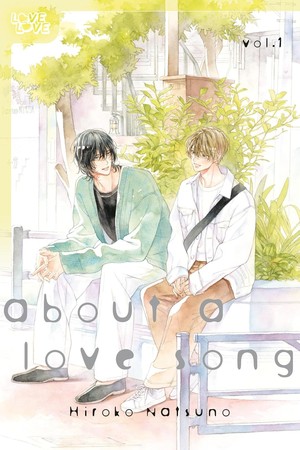
Hoshina dreams of making it big with his band—but writing love songs has never come easy.
That is, until he meets Seto, a sweet and disarming part-timer who shines a little too brightly in Hoshina's jaded world.
When a rainy night leads to an unexpected encounter, Hoshina finds himself drawn to Seto's honesty and warmth. But discovering Seto is still in his final year of high school leaves Hoshina spiraling with guilt...
As Hoshina tries to distance himself, Seto only steps closer—determined to love, and be loved, even if he's still figuring out how to be a grown-up.
Maybe love doesn't have to be perfect to be real... Maybe it just needs a good melody!
About a Love Song has story and art by Hiroko Natsuno . English translation is done by Carissa Tenorio with lettering by Vibrant Publishing Studio. Published by Tokyopop (December 9, 2025). Rated OT.
Is It Worth Reading?
Rebecca Silverman
Rating:
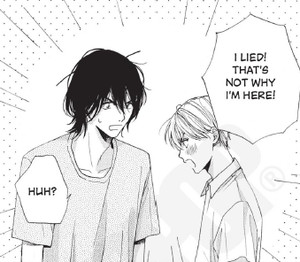
There's a serious dearth of age gap romances where the older partner puts the kibosh on things the minute they find out about it. In my reading experience (which, although vast, is hardly the final word on these things), the older partner often tries to end things but is instead persuaded to overlook their scruples. That is not the case for Hoshina in About a Love Song - he sleeps with Seto thinking he's a college student, but once he learns that the younger boy is, in fact, in his final year of high school, that's it. He's out. It doesn't matter to him that Seto's of age; he's not messing around with a high school boy.
If that sounds like a problem in a romance manga, that's fair. This book is less about Hoshina and Seto romantically and more about them finding a way to be together that's comfortable. Seto is all-in on his crush on the older man, and in his mind, the fact that he's eighteen should be all that needs to be factored in. But Hoshina knows better – eighteen is still very young, and even without factoring in Hoshina's budding fame as a musician, being an actual adult means that he's aware of the pitfalls should they begin a romantic relationship. He feels he made a mistake early on; he's not keen to repeat it or risk grooming Seto.
What all of this means is that the bulk of the volume is Seto trying to come to terms with the fact that the guy he's in love with thinks it's a bad idea for them to be together. Neither of them can truly give up on the other, but Hoshina is sticking to his guns in a way Seto can't understand, holding back until he feels Seto is old enough to really make a good decision. It's not what I'd call compelling, but there's something so grounded about the whole thing that it's hard to find fault with it. Hoshina's not taking any chances, and I respect that.
The short answer here is that if you're looking for an overtly romantic or sexy story, you're not going to find it here. It's also not quite developed enough to be a character study, although there's some real effort made in that direction. But if you're looking for something a little different in your BL age gap reading, this is interesting. I didn't love it, but I'd be curious to pick up volume two and see where it goes from here.
Caitlin Moore
Rating:
About a Love Song is one of those manga that leaves me faintly baffled. There's not a lot that's wrong with it, per se, but there's also not a lot that's good about it either. It's driven by relationships and dialogue, but the character writing is just a touch off in a way that makes me slightly uneasy.
I thought I would connect with a character who's attending a high-level college prep high school but wants to become a preschool teacher, but Seto didn't end up giving me much to work with. Some people may fall into the field by accident, but if you're someone who's setting out to enter it as a goal, it's the kind of career that defines you as a person. I didn't get any of that from Seto, however. There are no indicators that he likes kids, or is naturally nurturing or creative. It just seems like a generic “wholesome,” non-prestigious job for him to desire, to set up the tepid conflict that he's worried that his family won't support a smart kid like him going into. And it ends up being a non-issue anyway!
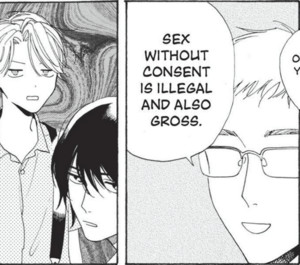
At the start of the book, Hoshina's bandmates warn him that having sex without consent is a crime, which is an extremely uncomfortable joke but also meant to tell us that Hoshina tends to take whatever he wants and start problems. We don't actually see any of that happen–his bandmates tease him about starting fights at their gigs, but whenever we see him play, he just stands meekly onstage. At the end of the volume, Seto complains about Hoshina's passivity, i.e. the exact opposite of how he's supposedly characterized at the start of the story.
If it were going for something more meditative like Witch Hat Atelier or even generic manga-style tropes, it would be easy to dissect what I did or didn't like about it. Instead, it aims for naturalism but misses the target, creating an uncanny effect. The dialogue is mostly vaguely connected non sequiturs, where no statement seems to quite follow what it's meant to respond to. The vague, unintentional wrongness makes it feel a bit like I'm reading a conversation between two different chatbots: a facsimile of humanity that's just off enough to give me the heebie-jeebies.
The art in About a Love Song is fine, but it's certainly not good enough to make up for the amateurish, inconsistent writing. With the firehose of short BL manga coming out these days, you can definitely do better than this.
discuss this in the forum |

back to The Winter 2026 Manga Guide
Seasonal homepage / archives