

The Winter 2026 Manga Guide
Centuria
What's It About?
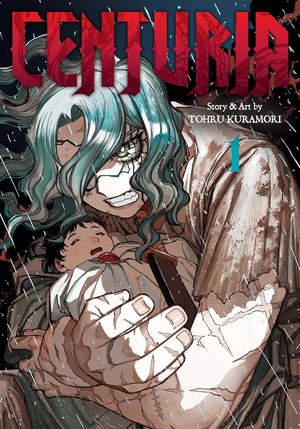
Sold into slavery by his own mother, Julian has known nothing but pain and brutality. All that changes when, aboard a slave ship, he experiences the kindness and tender touch of a loving person for the first time. But fate has plans for Julian in the bloody awakening of an ancient god who strikes a cruel bargain: an innocent life in exchange for extraordinary powers—abilities he must use to protect a helpless baby in a cruel and violent world!
Caught as a stowaway aboard a slave ship, Julian narrowly escapes death by the kindness of fellow slaves who take pity on him, especially a pregnant slave by the name of Mira. But when the slaver decides to liquidate his holdings, the bloodbath calls forth an ancient god from the sea. A deal is made at the cost of a life and Julian is forever changed, gaining fantastic powers. But even with his new abilities, monsters at sea and on land pose a threat in this dark and dangerous world!
Centuria has story and art by Tohru Kuramori. English translation is done by Jan Mitsuko Cash with lettering and touch-up by James Ganbatz. Published by Viz Media (February 17, 2026). Rated T+.
Is It Worth Reading?
Rebecca Silverman
Rating:
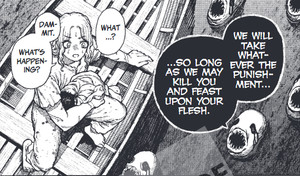
Although I knew that Centuria was historical fantasy with an element of brutality, I was not prepared to watch a woman give herself a C-section to save her baby so that a knockoff Cthulhu would spare the young teen she was traveling with. I also wasn't expecting said teen to have to fight Junji Ito-style fish monsters, nor for him to be saved by a very buff lady knight. I certainly wasn't ready for all of this to happen within the first two (of four) chapters. Centuria's first volume is a book that clearly aims to get the story started, and in as little time as possible.
But although it was surprising, it's also not bad; it simply takes a bit of getting used to. Julian, the protagonist, escapes from his owner, an abusive blacksmith, onto a slave ship, where he's saved by the other one hundred slaves, who all offer him a portion of their provisions. He's particularly taken in by Mira, a pregnant woman who recently lost her young son. They're the only two left alive when the vessel ends up in a version of the waters new Charybdis, and the abyssal mistress of the sea tells them that if one of them gives up what is most precious, they and they alone will live. Mira at this point sacrifices herself (after cutting baby Diana out of her womb), telling Julian to live on. Although we've only known Mira for a single chapter, the scene is still both visceral and effective – she's making the ultimate parental sacrifice, which is important for Julian to see, since his own mother is the one who sold him to the blacksmith.
As you may be putting together by now, the title refers to the hundred slaves who banded together to save Julian from the slave ship's captain. Their lives, strengths, and memories all become Julian's as a gift from the abyssal mistress, giving him his own Centuria, which Roman history buffs will recognize as the Latin term for a group of one hundred soldiers. They're essentially his own army to help him fight for his and Diana's lives. The series isn't rooted in Roman times, however; it's more a pastiche of numerous historical time periods. Julian seems to come from a Greco-Romanish place, he washes up in pseudo-Viking times where armor looks Medieval, and the captain of the slave ship appears to have escaped from the 17th century while he talks like a combination of Captain Jack Sparrow and Vizzini. The story's interesting, but the setting is all over the place. If Diana grows up to be Wonder Woman, I won't even be surprised.
Still, it's an interesting book, and it does make me curious to know what will happen next. It's no Vinland Saga or Orb, but it still may appeal to readers who are fans of both.
Kevin Cormack
Rating:
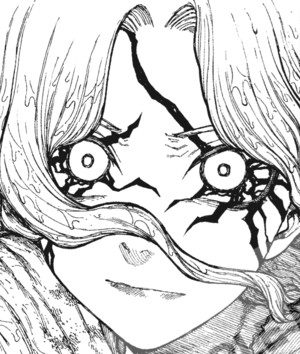
Fans of dark fantasy take note – here's a new author to keep an eye on. First credited with assistant work for Chainsaw Man's Tatsuki Fujimoto, Centuria is writer and artist Tohru Kuramori's first foray into solo manga creation. At least that's the case for Centuria's extra-length first chapter, which Kuramori reportedly slaved away over for six months by himself, before eventually hiring his own assistants once serialization began.
As a young adolescent, protagonist Julian is sold into slavery by his callous mother, where he is physically abused by his blacksmith master, his slim body criss-crossed with burn scars. Eventually, he finds himself on a slave ship bound for another country, where he meets the pregnant Mira, who shows him the kind of love he should have experienced from his own mother. It feels bizarre that I need to say this, but considering the questionable material in many recent anime, light novels, and manga, Centuria is a manga that at least treats slavery appropriately – as a hateful practice that brings nothing but harm and suffering to those forced under its yoke.
We don't learn a whole lot about the wider world, as everything we see is filtered through Julian's limited experience, but taking cues from Berserk, there are bizarre, dangerous Elder Gods who grant mysterious boons in return for horrific sacrifice. Through no actions of his own, Julian becomes the unwitting recipient of a gargantuan underwater octopus god's blessing, receiving functional immortality, greatly increased strength, and the ability to protect the tiny child with whom he has been entrusted. So begins his fight to provide baby Diana with the life and love he himself never received.
Centuria's most obvious initial strength is in its excellent, detailed art. Kuramori makes an excellent first impression, which I hope signals the start of a successful and productive career. Julian is a good boy, cursed by fate, and we desperately want to see him succeed. His heart is in the right place, and instead of becoming bitter due to his suffering, he's motivated to improve the lives of those around him, almost to the point of self-sacrifice. He's an easy protagonist to root for. The book's last chapter introduces some fun new characters, bringing a sweet found family vibe to the story that I hope is fleshed out in later volumes. I'd really like to read more of this.
Bolts
Rating:
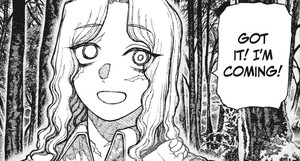
Have you ever seen a story where you could predict everything that was going to happen, and yet you somehow still got drawn into every action that was taking place? I wasn't sure what to think about Centuria because from the first handful of pages, I felt like I already knew what kind of story it was going to be. By the time I finished the first volume, I don't necessarily think I was wrong in my prediction, but I was surprised at how emotionally moved I was by almost every chapter. The best way to describe Centuria is that it is a dark story that never loses its heart. If anything, this is a story that wears its heart on its sleeve, starting from an overly pessimistic place while slowly peeling back the layers to reveal a more optimistic future.
Maybe I'm just a sucker for these types of stories, but the fact that I was able to feel this way about a story that has a lot of brutal imagery beautifully portrayed by its art is noteworthy. Centuria tells the story of a young man who is given every reason to be cynical about the world as a slave that was sold by a mother who made it very clear she didn't care about him. However, every chapter gives him more and more reasons to keep on moving. The bonds he makes with other slaves, and even a small baby is enough to keep him going. Even the final chapter perfectly portrayed this idea of how heavy life can still feel, but the important thing is that you don't stop moving forward. It's really hard to get into the specifics of what I like about the story without completely spoiling it, so let me just start by saying that it does get my full recommendation. If you could handle some edgy and dark imagery like a mother giving herself a C-section with an old knife, then trust me, there is actually something here that might emotionally sway you.
This is the type of story that feels like a fable. It feels less like a story I am reading and more like a story I am being told or shared with. It's the type of story that you tell somebody when they're feeling down about a cynical world where everybody is sort of out for themselves. But here we have a protagonist who literally and metaphorically carries the lives of 100 people with him. There is a burden with that gift, but there are also blessings that come with it, and how you use them is what defines you. If we have more people who protect those bonds, then that is how you build a stronger community. I feel like this book barely even scratches the surface of its own world, and yet there is so much that I can extrapolate from it, which is a sign of a good start. Pick this up if you ever see it at the bookstore, and while you're reading volume one, I'll read the rest.
discuss this in the forum (14 posts) |

back to The Winter 2026 Manga Guide
Seasonal homepage / archives