

The Winter 2026 Light Novel Guide
Sowing Vengeance: The Eldest Son's Disgraceful Green Thumb
What's It About?
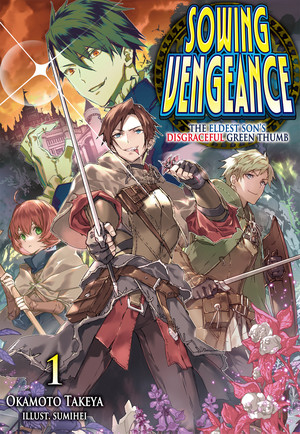
Disowned, disgraced, and doomed to be a farmer. Being “blessed” with a farmer's affinity is practically a death sentence for Chris Sparring. It's nothing close to the sword-wielding class he'd been raised to inherit, that's for sure. To make matters worse, his twin brother receives the affinity of a sword god instead, and wastes no time funneling years of jealousy into an attempt on Chris's life. With nothing left to lose, Chris must find a way to make it on his own and avenge his name. And this “useless” poison resistance of his may be just what he needs to turn the tables!
Sowing Vengeance: The Eldest Son's Disgraceful Green Thumb has a story by Okamoto Takeya and art by Sumihei. English translation is done by Caroline W. Published by J-Novel Club (January 16, 2026).
Is It Worth Reading?
Erica Friedman
Rating:
Sowing Vengeance: The Eldest Son's Disgraceful Green Thumb, Volume 1, isn't a bad book. It is, on one hand, one of the most honest books I have ever read, as Chris's plan for his future is “destroying his shitty brother.” On the other hand, I am confused about the premise. Nothing about Chris's affinity says “farmer.” He spends the whole book foraging. I suppose in later chapters, when he has a house, he will build a garden in which he will grow his poisons, and maybe I am being very picky, but that does not sound like “farming” to me. This is a shame because the title is very clever, if the story does get around to farming.
In the meantime, this worldbuilding story is filled with broken people trying to survive, people whom Chris effectively adopts and builds a surrogate family with. Any negativity one might have about the abuse suffered by the characters is alleviated as they end up wholly honest with one another and align their goals. The motivations of angry and abusive people are not given any time at all, to my great relief.
Other than the dissonance about the “faming,” the only other thing this story does badly is missing opportunities for moments where, if this were real life, one might expect to see emotions. We can chalk it up to Chris's behavior as a trauma response, but I can't help but feel that seeing him process some of his trauma more realistically might make for a better story. Or, perhaps, it might not, and all we'd get is a much more emo version of this same story.
In any case, if you're in the mood for some dispassionate victims planning on destroying the assholes, this book might do it for you.
Lauren Orsini
Rating:
Well first of all, there's no farming in Sowing Vengeance: The Eldest Son's Disgraceful Green Thumb—none at all. Second, sometimes a reviewer simply doesn't click with a main character's brusque, ice-cold personality. Needless to say, I didn't have as fun of a time as I thought I would reading this otherwise serviceable revenge fantasy. On the surface, Chris' story of being unjustly persecuted for a trait he can't control feels like a premise anyone could relate to. But in execution, the story's strawman villain and overly convenient power-up system take away its luster.
As the eldest son of a sword-fighting family, Chris' future seemed all but secured: he simply needed to go to the Heaven's Blessing Ceremony, which every teen in this fantasy world attends to learn their skill attribute, and get a sword-related affinity. When Chris unexpectedly receives an affinity for “farmer,” and his brother Claus receives an affinity for “sword god,” Chris is unceremoniously kicked out of his house—barely with his life. Chris vows vengeance on his family, escaping to chow down on poison plants (that's what farmers do, apparently!) and register himself with the guild as a sword-slinging adventurer. That's right, even though the crux of the plot is that Chris is destined to be a farmer, he spends his days swordfighting, just like before the ceremony! Chris soon meets Hester, the requisite pretty girl, and Ralph, the government-assigned loyal male follower, to form a party but make no mistake: they are NOT friends. “[O]urs was a party formed out of pragmatism,” Chris narrates while making judgements about how “useful” Hester and Ralph could be to him based on how much he invests in developing their superior affinities of “mage” and “paladin.” That's why I can't give the generous interpretation of “Chris swordfights even though he's a farmer to show your affinity doesn't define who you are!” For most of the book, Chris sees Hester and Ralph as objects to be used toward his ultimate goal: to kill that cartoonishly evil brother of his. Claus' cruelty, born of envy for his big brother, feels over the top and unearned. Meanwhile Chris, who harasses customer service personnel and views every interaction as a transaction, only gets to portray himself as the hero of this story because he's the narrator.
This fast-paced novel makes for an easily-digestible read, unlike the poison plants that Chris is constantly ingesting in order to power up his stats. It follows the standard isekai novel trope of showing people's numerical stats like in a video game, and weirdly Chris's farmer affinity means he can eat any poison plant and level up. (The logic here is that since most people die from eating poison plants, they never discovered the plants' power up abilities. But what about other farmers?? This is apparently a very common affinity to have.) My favorite part of this book were following Chris, Hester, and Ralph's journey from rags to riches and seeing Chris very slowly begin to see Hester and Ralph as fellow humans, and perhaps even friends. But his awful personality and the story's nonsensical poison/farmer connection left a bad taste in my mouth.
discuss this in the forum |

back to The Winter 2026 Light Novel Guide
Seasonal homepage / archives