

The Winter 2026 Light Novel Guide - The Art of Witch Hat Atelier
What's It About?
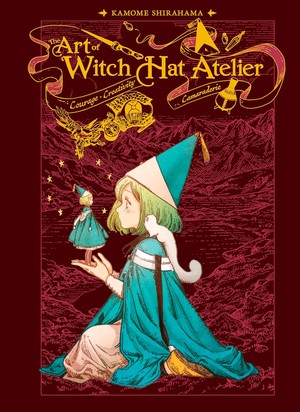
Soar into the world of Witch Hat Atelier with this beautiful, large-sized hardcover packed with full-color artwork by creator Kamome Shirahama. The 184 pages of this archival-quality, gold-stamped keepsake are packed with illustrations that have never been published in English before, featuring characters like Coco, Agott, Olruggio, and Qifrey, and, of course, the adorable brushbuddy. The ideal holiday gift for the diehard manga fan or newcomer to the hit anime!
The Art of Witch Hat Atelier is illustrated by Kamome Shirahama. Published by Kodansha Comics (December 23, 2025).
Is It Worth Reading?
Caitlin Moore
Rating:
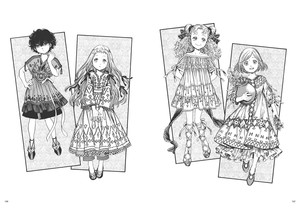
There are few creators these days as revered as Kamome Shirahama, and if you didn't know why, The Art of Witch Hat Atelier will show you without needing any words. Shirahama, best known for the manga series highlighted in this collection, has won awards in Japan, the US, France, and Spain, illustrated dozens of US comic book covers for DC and Marvel, and contributed to Star Wars: Visions. She's an obvious choice for a glossy hardcover collection of her artwork.
The Art of Witch Hat Atelier is only available as a physical volume, which Kodansha was generous enough to provide. If you are the kind of collector who likes to buy art books, this one is definitely worth it. Chances are, you won't see much you haven't before, but there's a certain magic (heh) to seeing it all laid out on the page like this. Looking at it printed out in front of you, the inks replicating Shirahama's own preference for drawing in traditional media have a much stronger impact than seeing it mediated through pixels on a screen. You can take your time here, soak in the trueness of the blacks, linger on each pen stroke without giving yourself eyestrain from staring intently at a backlit screen.
As someone who has Mucha prints proudly displayed on the walls of my living room, I could get lost in the soft, curving lines and natural details in the dozens of illustrations, both color and black and white, of Coco, Qifrey, and their friends. The book itself is gorgeous, too, a worthy vessel for Shirahama's artwork. Kodansha has truly put in the effort to create something fans will want to keep on their shelf, from the russet-brown cover with gold lettering to the illustrations printed on high-quality matte paper.
However, I found myself wanting something a bit more. It's a pleasure to look at Shirahama's art so beautifully presented, but I wanted to know more about it. The book opens with a three-paragraph description of Witch Hat Atelier and Shirahama's influences, and closes with a brief, boilerplate artist biography. While I didn't need an art history textbook, I would have loved a bit more discussion of the art and the context it was made in. The back of the book has a small, hard-to-read guide, but it still left me wanting. What's Shirahama's process like? Does she color her pen-and-ink with real watercolors, or does she scan and do her color work digitally? Do any of the illustrations in the book have particularly interesting inspirations? The beauty of her lines and colors alone may justify the purchase for diehard fans, but I think a lot of people would have welcomed the opportunity to learn about the real-life magic behind Witch Hat Atelier.
Still, US$30 is a very reasonable price for such a stunning volume, worthy of display as a coffee table book. If you have a Witch Hat Atelier fan in your life, this would make an excellent Christmas gift.
Kevin Cormack
Rating:
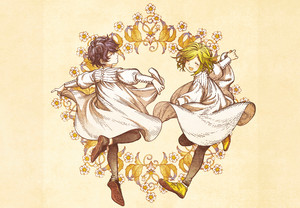
Witch Hat Atelier is more than just one of my current favorite ongoing manga series, it ranks up there in my top ten manga series of all time. A huge component of this is author Kamome Shirahama's frankly astonishingly beautiful art. As much as I love the individual printed volumes that take pride of place on my bookshelf, the standard book size can't always do justice to the intricately detailed, delicate linework that makes the series so special.
Enter this gorgeous hardback art book that grants Shirahama's peerless art the room it needs to breathe. Collected here are almost 180 large pages of both confident, expressive black-and-white pen and ink, and sparkling color prints. There are so many lovely images here I've never seen before, depicting the wonderful, diverse cast of characters in varied, active poses, fabric billowing and light illuminating. We see snapshots of Witch Hat Atelier's rich fantasy world, from villages and towns to forests, fields, and dungeons.
Shirahama's eye for image composition borders on the supernatural, with excellent use of perspective, color and character posture that seemingly effortlessly conjure a sense of both place and emotion. Many images are incredibly playful and sweet, especially when depicting the younger characters playing, or even napping together. I'd be hard pressed to pick even a top twenty images from this book, so many could be framed and put on my wall.
This is very much an art book. Apart from a brief text introduction, and a later potted biography of the artist, the images are presented without explanatory notes or authorial comments. A handy image index at the back lists from where each picture originates. I think the images presented here stand well enough on their own without reams of redundant words, as the art is so detailed, such a joy to examine, that it's easy to spend an hour or more just staring in wonderment at the artist's skill.
Shirahama's style is evocative of older fantasy book illustrations, the kind found now only in musty old tomes. Think artist John Tenniel's work on Lewis Carroll's two Alice novels. I've always loved that kind of super-detailed pen and ink style, and it reminds me fondly of the books I read as a child, borrowed from my grandparent's attic. For me, Witch Hat Atelier conjures that childlike sense of wonder evoked by only the very best fantasy art. This volume, full of so many wonderfully composed pictures unavailable anywhere else, deserves a place on any fan's shelf.
Rebecca Silverman
Rating:
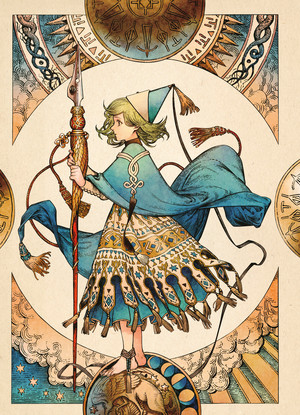
It almost doesn't matter if you're familiar with the Witch Hat Atelier manga – this is simply an exquisite collection of art. Replete with images all bearing a fairy tale sensibility, Kamome Shirahama's works borrow their style from both the art deco and art nouveau movements of the early 20th century and combine them with a hint of Arthur Rackham and Kay Nielsen to create a book that's meant to be savored. Yes, you'll get a bit more out of it if you know the characters, but you could just as easily get lost in the illustrations with no knowledge of who Coco and Qifrey are, like flipping through a Victorian fairy tale collection.
One of the most immediately noticeable features of this book is the way that Shirahama often draws her characters barely contained within the images. Many pictures involve Coco and the other apprentices in circles, with limbs or heads poking out of the shapes, symbolic of how magic is both freedom and a carefully regulated profession. Interestingly, Qifrey is rarely drawn in such a position, although he's often shown holding a finger to his lips, cautioning silence and secrets. In two images Coco is fully trapped within a container, one a crystal or magic water container and the other in an ornate black cage. This invites manga readers to think about the symbolism of how magic is regulated, since both of her enclosures are ostensibly magical in nature.
Another theme in the art is the fanciful clothing that the girls wear. Much of it is central Asian or Slavic in its embellishments, calling to mind Kaoru Mori's art to a degree. Shirahama also often puts the girls in poses that call to mind Alphonse Muca's work, although she doesn't make as much use of whiplash lines as he does, the seasonal elements and poses all speak to his art.
The volume is divided between color art and black-and-white, and both are equally gorgeous. Black and white images are a bit more detailed and tend more towards landscapes with a single character than the color art, which has more of a portraiture sensibility. A brief introduction gives a summary of Shirahama's career while an appendix reveals where each piece of art is from, be it a social media post or a book cover. But really, all the book needs is to be looked at – extra information is interesting, but Shirahama's art truly speaks for itself.
discuss this in the forum (4 posts) |

back to The Winter 2026 Manga Guide
Seasonal homepage / archives