

The Winter 2026 Light Novel Guide
Thou, as My Knight
What's It About?
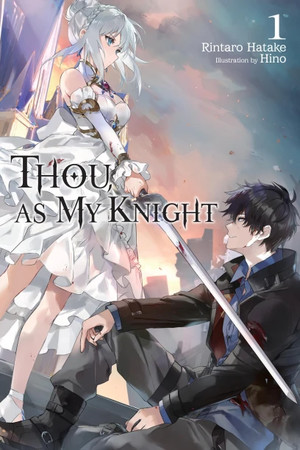
In this world, people known as Informationists sell their supernatural abilities for use in armed conflicts. When Tsuhima Rindou, an ordinary Informationist, agrees to help a fallen noble named Holly defect from the Balga Empire, he isn't expecting anything more than a typical escort mission. But there's much more to his client than she's letting on, and Balga is intent on keeping her within its borders, dispatching their army and several elite Informationists to apprehend the duo by any means necessary. Can these two souls, bound only by a business agreement, survive the grueling journey and web of conspiracies that await?
Thou, as My Knight... has story by Rintarō Hatake with illustrations by Hino. English translation is done by Zoe Womack. Published by Yen On (February 10, 2026).
Is It Worth Reading?
Rebecca Silverman
Rating:
In his afterword, author Rintarō Hatake says that he started writing this novel in high school. I am being sincere when I say that I'm very happy for him that his childhood project eventually transformed into a published work – I can't say the same for the Gothic novel I spent my junior year of high school math class writing. (Hatake wrote his during Modern Japanese, he says.) But I'm also not surprised at the origins of this book, because it really does feel like an immature novel penned by a teenager.
I don't mean “immature” as a statement on, for example, the level of humor or anything like that; rather this is a story that clearly came from a writer who hasn't yet mastered their craft. The plot feels contrived and the male protagonist, Rindou, reads very much like a self-insert character. He's almost impossibly edgy – he smokes because of a “curse” even though no one in the futuristic world smokes anymore, he's more powerful as an “informationist” than his level ranking would suggest, and he's got an attitude that screams, “I couldn't care less” even as he proves otherwise. Heroine Holy, on the other hand, is less a character than she is an archetype, and the big reveal about her true identity is anything but surprising. The plot unfolds in a series of contrived events that you've probably seen in many other similar light novels. It's not bad so much as it is uninteresting.
The names, on the other hand? Those are kind of bad. While “Holy” isn't the character's real name, there is a guy whose actual name is “Causa Insania,” and there's both a Canus and a Lupus. (I assume the latter isn't for the disease, but is intended to be the Latin word for “wolf.”) Rindou sounds suspiciously like the author's own given name, although without seeing the Japanese characters, I can't back that one up. All in all, it's a book that reminds me why Arabella and Isabella will continue moldering in their haunted manor, safely contained within my 11th grade math notebook – but I'd still like to read something Hatake writes after he gets the hang of it.
discuss this in the forum |

back to The Winter 2026 Light Novel Guide
Seasonal homepage / archives