

Rewriting the Chivalrous Yakuza: Interview with Stray Manga Writer Ryu Kamio
by Rebecca Silverman,Writer Ryū Kamio and artist Yu Nakahara's newest work available in English is Stray, a twisty crime drama that follows Hachiya Ken, a man who just finished serving time in prison for a crime he did not commit. Not long after his release, his past comes back to confront him in the form of Hana, a young girl. Now, the pair must navigate a criminal conspiracy and the wounds of their pasts.
We spoke with Kamio about the enduring "chivalrous yakuza" trope and what it means to stand up to injustice.
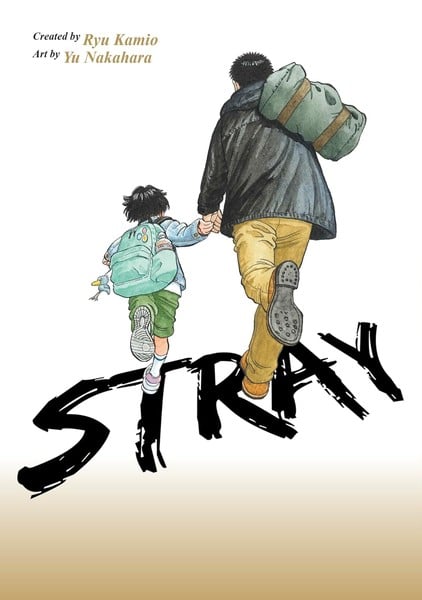
What do you believe is the appeal of “chivalrous gangster/yakuza” stories? Ken's entire arc is based on him overcoming the trials his notions of what's “right” have forced him into; how does the yakuza figure into this?
Ryū Kamio: Japanese cinema once featured a genre known as “chivalrous gangster films.” These
depicted protagonists of unwavering loyalty who, despite facing unjust circumstances, would risk their lives fighting for those who had shown them kindness, steadfastly upholding their own sense of justice. I believe such works gained popularity because the protagonists of these films offered a refreshing escape from the oppressive atmosphere of Japanese society, often criticized for prioritizing organizational logic over individual will.
However, films featuring “honorable yakuza” protagonists are now scarcely made. I believe this stems from a trend, increasingly pronounced in recent years, where individual will is suppressed by collective pressure to conform. There is a Japanese proverb: “Bend to the will of the powerful”. As if putting this into practice, an atmosphere has intensified, particularly centered around social media, where people kowtow to those in power, and even voices critical of the government are pushed down.
To symbolize this recent state of Japanese society succinctly, I made the protagonist a man who was once a member of the yakuza – an organization despised by society. He possesses his own sense of “justice,” yet his will is suppressed by those wielding greater power. This situation renders him a true “outcast”, marginalized by society. I wanted to explore how he might break through the oppressive atmosphere of modern Japan and strike back... just once. For the record, I will clarify that I am not glorifying the yakuza as a real criminal organization.
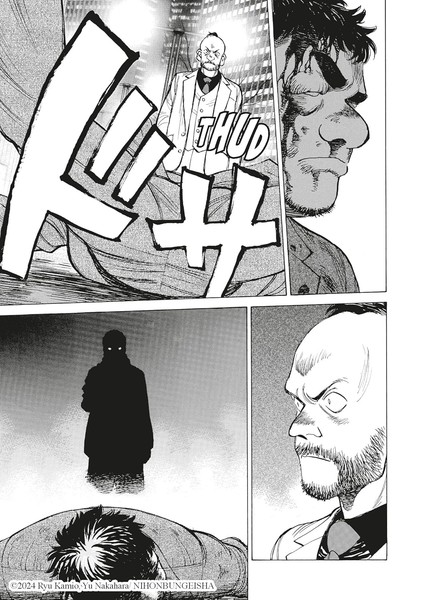
How did you decide to have Hana team up with Ken? Were you concerned about how readers would react to having a nine-year-old child be in the middle of yakuza violence? Is Hana meant to be a parallel to how Ken was initially saved by his crime family?
KAMIO: Hana symbolizes an innocent being worthy of protection. Precisely because of her innocence, she keenly senses society's oppressive atmosphere and speaks and acts with sharp insight into its contradictions. Through his interactions with her, the protagonist Ken rediscovers the loneliness he himself felt as a child, and the principles taught to him by the gang boss and senior members who looked after him: "Never bully the weak" and “never resort to cowardly acts” – the way of life as a man.
This leads him to protect Hana and act in accordance with his own sense of justice. In essence, Hana is the focal point of this work. She never wavers. Though powerless, she refuses to yield to violence and forges ahead on the path she believes in. She is the compass and the driving force of this story. She is not merely a nine-year-old girl. She is one of the most powerful characters in my extensive body of work.
In your opinion, is there much difference between criminal groups like the yakuza and corrupt politics? Was that a point you were looking to make in Stray?
KAMIO: In Japanese organized crime, there exists an absolute hierarchy, encapsulated by the saying: 'If the boss says white, even black becomes white.' This same dynamic prevails in the political sphere and within corporate organizations: those who gather numerous followers sharing their views wield power as the de facto leaders.
The entourage surrounding those in power uses peer pressure to suppress differing opinions until only yes-men remain, and the organization becomes corrupt. I aspire to always be the child who shouts, 'The emperor has no clothes!'
Ken isn't your first protagonist who has just gotten out of prison; Hatogaya from Last Inning is also falsely accused of a crime and sent to jail. What draws you to write stories about people getting second chances? What do you think that brings to your readers?
KAMIO: Many Japanese people harbor an extreme fear of failure. This stems from a deep-seated sense that in their society, a single misstep can prevent one from ever climbing back up. There exists a prevailing sentiment that the greatest success is simply being able to say, upon retiring from a company after many years of service, "I'm glad I got through it without any major mishaps." But is such a life truly enjoyable?
I admire characters who confront adversity. I wish to continue portraying characters who persist in their challenges, refusing to give up no matter how many times they fail. I believe such stories can inspire readers.
Is there any relationship between Last Inning and Stray? The epilogue to Stray seems to indicate that there might be. Can you explain it for English-language readers who might not have had the chance to read Last Inning?
KAMIO: For me, manga artist Yu Nakahara is the finest partner imaginable. Baseball manga is where his talents shine most brilliantly, and Last Inning stands as a prime example of that success. When considering creating a new work with him, I wanted to add another element beyond baseball. Thus emerged the character of a man living within the underworld. He risks his life to rescue a star professional baseball player facing dire straits.
His motivation stems from a sense of obligation to this star player, once his rival. He must repay this debt. Even if it means being hunted by the organization and becoming an outcast. I take pride in believing this narrative structure is something unprecedented in baseball manga to date.
Both Hana and Ken believe that they were abandoned by their families, with Hana being sent to a group home and Ken being taken in by the Yakuza. How does the theme of abandoning children work with the greater story of Stray?
I have always believed that individual independence is paramount. Yet people seek fulfillment within the places they belong. While family should be the most secure place of all, neither Hana nor Ken knows their families. This story depicts two lonely souls, devoid of family, who clash yet gradually come to recognize their mutual need, eventually forging a new, quasi-family bond.
Ken seems to believe that it's more honest to fight with your fists than to use a weapon like a gun. Does this make him old-fashioned? How does it distinguish him from the other yakuza in the story? Is it part of why he was framed?
Ken is fundamentally a serious individual. Precisely because he is earnest, he continues to adhere to the teachings imparted by his boss and senior members: "Never resort to underhanded tactics" and "Settle fights with your fists." His earnestness is why he ended up beating his senior member to death due to a misunderstanding, and it's the same reason he flies into a rage at the police and organization members who abducted Hana. In essence, fists are Ken's justice; he believes those who resort to weapons and power to oppress others are utterly despicable.
Can you describe what you were hoping readers would take away from Ken's journey? How does interacting with Hana and the police officer, as well as people he knew from before his incarceration, contribute to his new view of the world, or at least his own life?
I have no time for those who uncritically submit to authority. If one senses that the direction their group is heading is misguided, I believe they should have the courage to cry out that it is wrong. Ken and Hana gain that courage during this story's journey and confront those in power. Even the black market doctor, the active police officer Momoka, and Inukai –who served the organization as an assassin – ultimately defy them. Through their actions, I hope readers, too, will find the courage to declare, 'What's wrong is wrong,' and 'The emperor has no clothes.'
Did you have any specific inspiration for this story? It has echoes of classic gangster tales in hard-boiled novels and film; did any of them contribute to how you wrote the story?
I like old films and still watch them often. While there is clearly no direct reference to this work, the basic premise of a man being manipulated by a little girl may have been influenced by Peter Bogdanovich's Paper Moon (1973). I've just looked it up and discovered that the girl in that film, played by Tatum O'Neill, was also nine years old, just like Hana.
Do you have anything you'd like to say to your English-language readers?
I am deeply moved that this story, born in my mind and brought to life through Mr. Nakahara's artwork to become a complete manga work, has now spread beyond Japan to reach the world. I sincerely hope this story will remain long in the hearts of each and every reader and continue to be read for years to come.
Stray is a single-volume manga available now from Titan Manga. You can read ANN's review of the series in the Winter 2026 Manga Guide.
discuss this in the forum |
