

Game Review
by Lucas DeRuyter,Mario Tennis Fever Game Review
Nintendo Switch 2
| Description: |  |
||
Join Mario and friends for some Mushroom Kingdom style-tennis! Use topspins, slices, lobs, and other familiar shots—along with other fancy footwork and new defensive maneuvers—to outpace your opponents on the court. Keep a rally going, build up your Fever Gauge, and unleash powerful Fever Shots that can be augmented with special effects by equipping Fever Rackets. |
|||
| Review: | |||
First and foremost, I should note that Nintendo and Camelot Software's Mario Tennis Fever is, for all intents and purposes, a fighting game. There's a story mode and various trial modes to help new players learn the controls. The many characters that make up this game's roster lend themselves to specific playstyles, and memorizing various button inputs is necessary to execute different moves. A high level of skill isn't necessary to pick up and play Mario Tennis Fever but, like all good fighting games, this title's lasting appeal and acclaim will depend on if the sickos (used affectionately here) who are deep in the Mario Tennis community decide to pour hundreds if not thousands of hours into this game over the course of its lifespan. I am not a fighting game sicko, and do not have the right brain chemistry to dedicate myself to these kinds of games long enough to participate in competitive play. So this review is very much going to be from the perspective of a casual whose last experience with the franchise was playing Mario Tennis for the Game Boy Color to kill downtime while on a class trip to Spain. All of that being said, I see the appeal here and Mario Tennis Fever is just intuitive and invigorating enough that a small part of me wants to try to become the best player in the world at this specific game. 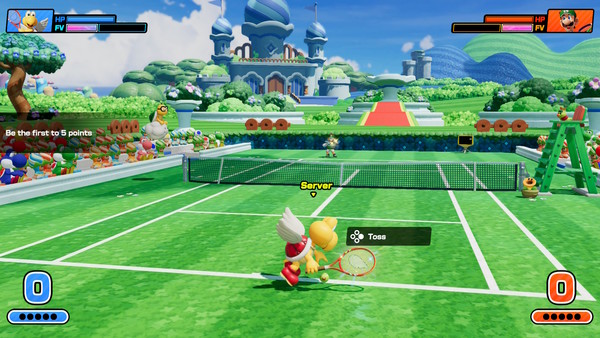 © Nintendo / CAMELOT Perhaps the strongest element of Mario Tennis Fever is just how legible it is. If you have even a basic understanding of how tennis as a sport works, how Mario Tennis Fever is translating the various verbs present in that game into a video game, and iterating on them in some creative ways, becomes apparent after even just a few moments in any game mode. Tennis is a sport about spatial control, and forcing your opponent into a position where they can't possibly return the ball to you. Fever successfully translates the strategy of a tennis match into video games by mapping different kinds of shots to different button inputs and giving characters different reaches, movement speeds, and degrees of ball control to mimic different playing styles. The game then enhances these strategies with the introduction of “Fever Rackets,” which become usable as a meter fills and possess effects like setting AoE hazards or buffing movement speed tremendously. A doubles match with multiple of these “Fever” effects active can definitely feel a bit busy, but they do add a new and informed layer to the game of tennis that I really appreciate. 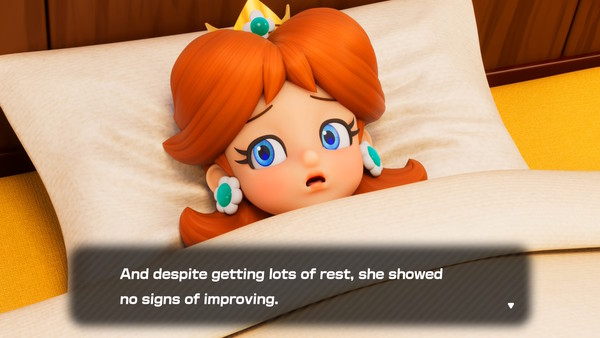 © Nintendo / CAMELOT If you don't form a deep connection to the core mechanics of this game, though, there's not much for you in Mario Tennis Fever. While a couple of different game modes aim to shake things up, it's clear from the onset that this game was principally designed to be played semi-competitively in either local co-op or in online ranked games. This is best displayed in Mario Tennis Fever's story/adventure mode, which is narratively nuts even for a spin-off Mario title and one of the most flagrant instances of “the writer's barely disguised fetish” I've ever seen in a modern Nintendo game. Mario Tennis Fever opens with fan favorite Princess Daisy lying in bed and dying from an illness she isn't recovering from. At the recommendation of Wario and Waluigi, Mario and company seek out healing fruit from a magic tree to help Daisy recover. Shenanigans ensue, and Mario and much of the main cast are turned into babies, which is sure to only further debate on whether Baby Mario is Mario when he was an actual infant or an infantilized version of gaming's favorite plumber. Baby Mario and Baby Luigi then go to tennis school to get their baby bods strong enough to play the game (through painfully tedious mini-games), and then they go on an adventure to defeat the monsters that turned them into babies and transform back into adults. To keep the sexually tinged strangeness going, there's a stretch in this campaign where Daisy joins the main cast and is the only adult on the team (Donkey Kong clearly does not have a soul and does not count as an adult), and the level where this happens introduces a “Mud Racket” which almost guarantees that she will be covered in muck repeatedly through the level's main tennis match. 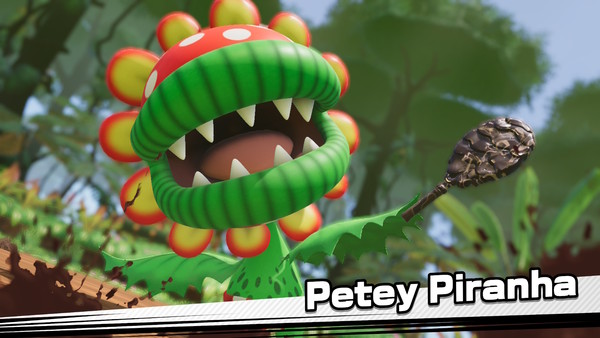 © Nintendo / CAMELOT I don't include these points to be glib, but instead to further highlight how misaligned Mario Tennis Fever feels. The narrative material within the story mode clashes with this game's overt family-friendly aesthetic, and it has a mechanical depth geared towards establishing a competitive audience while also trying to be a children's game. While these elements come together more cohesively in other Nintendo spin-off games, like the Super Smash Bros franchise, here they're discordant. There's definitely enough in Mario Tennis Fever for fans of this mini-franchise to appreciate, but it's a bit too incongruent to entice a casual like me. |
|
The views and opinions expressed in this article are solely those of the author(s) and do not necessarily represent the views of Anime News Network, its employees, owners, or sponsors.
|
| Grade: | |||
Overall : B-
Graphics : B
Sound/Music : C+
Gameplay : B
Presentation : C
+ Effectively expands on the sport of tennis using the affordances of video games. |
|||
|
discuss this in the forum |
bookmark/share with:

|
|||