

Journal with Witch
Episode 9
by Sylvia Jones,
How would you rate episode 9 of
Journal with Witch ?
Community score: 4.8
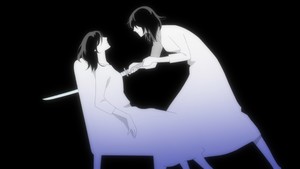
As instinctual as it would be for me to focus only on the characters, narrative, and themes of Journal with Witch, this week, I must first commend the brilliance of the adaptation's scaffolding. The second part of this episode gracefully weaves together three scenes from three distinct days by stitching them at their thematic seams. It's a deft structural trick that avoids feeling ostentatious by centering each character's emotional reality. Makio suffers from writer's block after the stress of helping with Asa's issues overwhelms her, which prompts the chronic introvert to again make herself vulnerable and reach out for help. Asa, meanwhile, starts to confront her grief, yet she feels no less adrift after that effort, as frustrations fester beneath her skin. Our mental state affects how we perceive time. A single day might stretch interminably, or multiple months might fly past in the blink of an eye. This is one of many nuances that Journal with Witch understands and captures through its smart adaptational choices.
After her brush with truancy, Asa leans on multiple outlets for her emotions. Emiri, as always, is there for her as her best friend, and it doesn't take much for Asa to ease back into their usual rapport. Left unspoken, however, are Emiri's thoughts, and she continues to avoid the subject of romance despite her bestie's teasing. That's not a status quo she can maintain forever. Asa begins counseling, but she resents it as soon as she figures out that the counselor isn't going to just hand her the answers she wants. I'll be honest: that also caught me off guard when I started therapy. My therapist helps me a lot, don't get me wrong, but before my first session, pop culture had me believing that I'd lie down on the couch and get whisked away to a magical place of psychological healing. The reality is that therapy is a skill you need to work on. And Asa isn't too confident in her skills when she returns to the music club, only to feel left behind by the other members. She tries to turn it around through the power of songwriting, but that similarly denies her a quick resolution to her problems. In fact, the creative exercise only seems to create new problems that widen the gap between Asa and her ideal finish line.
Asa is impatient. All teenagers are to some extent, and they have plenty of good reasons to be so. Adolescence is an agonizingly monumental and agonizingly slow period, and Asa's additional stresses provide her all the more reason to say, “screw this.” While she does not want to be defined by her parents' deaths, she believes that tragedy entitles her to some leeway. Maybe that's hypocritical of her, but I think one's teenage years are the best and earliest point to grapple with the fundamental hypocrisies of being human. As individuals and as a species, we constantly indulge in the irrational. We let fantasies seduce us, and then we act indignant when they inevitably never come to fruition. It's ridiculous. We are ridiculous, and the best response to that is to acknowledge it.
That's why I know exactly where Asa is coming from. If nothing else, Asa's grief is supposed to grant her unique insight into the human condition. Her lyrics are supposed to be good now. Her aunt is supposed to read them and overnight them to her publisher. That's the equivalent of the universe tearing her heart out. Indeed, we all want our pain to translate, transcend, and transform into art, but the truth is that art remains a craft. You cannot escape the work, nor can you escape failure. There are no shortcuts. Every epiphany is a struggle. The toil is where the art comes from.
Makio is an adult, so she knows that this is true, yet she nevertheless struggles to communicate it to her niece. Two decades of experience stretch interminably between the two. While Makio's critiques are sound, her words cannot travel that much distance unscathed by their journey. Asa doesn't know how to process her practical advice, and Makio's more abstract philosophizing flies over her head. As a viewer and a writer, I can appreciate Makio's phrasing, and “write with the intent to kill” sent a bolt of lightning up my spine. That's exactly it. It's not about fulfillment. It's not about satisfaction. Writing, for me, is a struggle. My brain burns through countless glucose molecules searching for the best way to phrase a thought, and when it's done, it finds more fuel and moves on to the next thought. It's absurd. It's Sisyphean. But I find hope within that struggle. I write so that I can write a little bit better the next time. The absence of satisfaction is my motivation. If I settle, I die, so I must write to kill.
Unfortunately, Makio's wisdom does not shield her from all the barbs of her trade. Asa's jejune poetry, lacking the polish of self-consciousness, attacks her aunt's heart directly. It's adorable. More severely, though, Makio's slump reveals that even fully grown adults are fallible. The corollary, of course, is that adults never stop growing. Makio's group of gal pals was still learning new things five years ago, and in the present, Makio seems at least a touch more comfortable leaning on other people instead of resenting them. As much as she might deny being Asa's parent, her conversations with Juno and Kasamachi probe the subject all the same. Makio seeks guidance, and while she concludes the episode with her work finished, her voiceover reveals her uncertainty, telling herself that “someday” she might figure things out. We all fill our caskets with the questions we could never answer, but until the day of our death arrives, we will have many of those "someday" to look forward to.
On a personal note, I love how increasingly and casually queer Journal with Witch has become. For instance, in the flashback, one of Makio's friends figures out she's aromantic, and she's excited to tell the rest of the group. In addition to her obvious contentment, the key component for me is the phrase “now everything in the past makes sense.” That's real. When I grew up thinking I had to be a boy, I felt constant frustration when I couldn't grasp what came naturally to my peers, and seeing no other alternative, I hollowed myself and disappeared into the background. I didn't know why I couldn't make anything work; I only knew something about me was wrong. Many years later, after I've started transitioning, I am constantly digging up memories and looking back on them with a new clarity. While this process wrings a lot of emotions out of me, joy is one of the most prominent ones. In knowing the “why,” I know I have a future ahead of me that will not be suffocated by the same question and the same loneliness. That's why Makio's friend can smile so freely.
I also love Juno. The manga makes it more obvious that they are nonbinary, although I think the anime's portrayal and Kujira's performance capture their vibe well. It's subtler than with Makio's other friend, but Juno imparts their own nuggets of queer wisdom throughout the episode. More than anybody else Makio talks to, Juno understands the feeling of futility that can come with writing, or more generally with existence. They sympathize and lament the life their mother never led, shouldering the additional guilt of a queer child who “stole” her opportunities without offering her the socially acceptable repayment of a "normal" child. I'm glad Makio immediately blames society, not Juno, for that. And when Asa is confused about who she wants to be, Juno knows all too well how loaded, complicated, and nuanced a subject that can be. Asa resents their breezy attitude and lilting response in the moment, but she later scribbles a smiling Juno in her journal. Their mirth meant something to her. In many ways, it can be the most difficult thing you'll ever do—a lifelong battle—but by the same token, living true to yourself is all that matters.
I will always be chuffed to see more good queer representation in stories that are as beautifully considered as Journal with Witch. Here, however, I appreciate that it doesn't end at representation. By including the struggles and successes of its queer characters, Journal with Witch enhances its core theme about fundamentally different people learning how best to understand, accept, and enrich each other.
Rating:
Journal with Witch is currently streaming on Crunchyroll.
Sylvia is on Bluesky for all of your posting needs. She is a witch-in-training. You can also catch her chatting about trash and treasure alike on This Week in Anime.
The views and opinions expressed in this article are solely those of the author(s) and do not necessarily represent the views of Anime News Network, its employees, owners, or sponsors.
discuss this in the forum (65 posts) |

back to Journal with Witch
Episode Review homepage / archives