

Mushrooms and Fairy Tales: An Interview with the Director and Producer of Champignon Witch
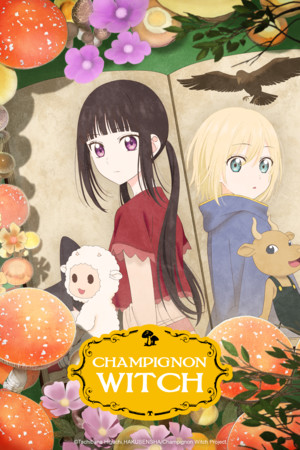
by Rebecca Silverman,Deep in the black forest lives an unusual witch—Luna the Champignon Witch. Luna is a black witch, and her body emits poison, which means that everyone in town fears her. But Luna is a kind, gentle soul trying to survive in a dark world that distrusts black witches despite the very necessary function they fulfill: purifying the miasmas that sicken humans and the land. Drawing from familiar fairy tales in both imagery and story, Champignon Witch reframes the idea of the evil witch through both its narrative and its narrator, Lize, a boy Luna takes in when no one else would. We sat down with the anime director, Yōsuke Kubo, and the producer, Shimomiya, to discuss bringing the story to life.
Champignon Witch is full of visual references to famous fairy tales – Lize is laid out like Snow White or Sleeping Beauty on the table, Luna wears a red hat, Luna and Henri dance with Cinderella and her prince. How did you decide to incorporate those fairy tale elements into the story? How important do you feel that fairy tales are to Luna's world? What do they tell viewers about it?
Yōsuke Kubo: In Japan as well, fairy tales like the ones mentioned are deeply rooted, to the point that they form the foundation of many stories and traditions. They function as very effective symbols, and I believe the original author [Tachibana Higuchi] intentionally embeds rich metaphors within them. In visual storytelling and in animation in particular, using these symbolic elements allows us to communicate a great deal within a limited runtime.
Champignon Witch also features many classic fantasy elements, such as magic, royal castles, poison, and persecution. By using this shared classical language, we can quickly communicate the story's world to viewers and guide them toward the original narrative that the series ultimately aims to tell.
Episode five is taken from a side story in the third manga volume. What made you decide to incorporate Dorothy's tale into the main plot? Do you see Dorothy as being particularly important to Luna's character arc? Do you plan to incorporate other side stories into the show?
KUBO: When I read the original work, the series composition writer and I found Dorothy's story extremely compelling. Dorothy herself is a very appealing character, and she was also the best character for deepening the relationships surrounding Luna, who is a persecuted character. Above all, her story succinctly expresses the cruelty of this world.
Because the series features gentle and heartwarming characters, there is a risk that the tension of the story could occasionally soften. However, Dorothy's powerful ending allows this single episode to strongly convey to viewers that this is not a conveniently kind or gentle world.
Luna's story opens on a tragedy – her doomed romance with Henri. What steps did you take to ensure viewers understood the ephemeral nature of her relationship with humans in general and with Henri specifically? How did you want to use it to set the tone of the series?
KUBO: In contrast to the classical fairy tale opening, Henri's episode subverts expectations from the very beginning. There is a lonely heroine who meets a kind prince, and even if it ends in tragic love, a fable would normally draw a line under the story there. In Champignon Witch, however, that is where the story begins. This is not simply a tragic romance, but an episode that powerfully emphasizes Luna's loneliness. The strength of that loneliness becomes a key element that later supports and motivates each of Luna's choices throughout the series.
Despite the protagonist of Champignon Witch being Luna, she doesn't speak very often, and the narrator is Lize. How do you work with that to ensure that Luna is still the star of her own story? What techniques do you use to center the plot around her, despite the fact that she rarely says anything?
KUBO: We portray Luna as the protagonist, and as someone who carries a wide range of emotions despite speaking very little, through moments such as her tragic romance with Henri and her farewell with Dorothy. By the time viewers reach Dorothy's episode, they can sense Luna's unspoken feelings even when they are not expressed in dialogue.
Meanwhile, Lize, who appears later as a central character, struggles to fully grasp Luna. The audience understands Luna, while Lize remains confused. This contrast, I believe, helps establish Luna as the true central figure of the story.
How did your approach to Champignon Witch differ from your other projects? Was there a particular theme or feel that you particularly wanted to evoke in viewers?
KUBO: Behind the scenes of the visual construction, another staff member and I generated the entire 3D layout for all twelve episodes—around 3,000 cuts—by ourselves. This was an attempt to reduce extreme inconsistencies in proportions, perspective errors, and other visual issues. It was a major departure from our usual production approach, but it proved effective.
The theme we wanted to evoke in viewers was the strength of the story itself. However, because the narrative contains a certain “poison” in its intensity—such as Dorothy's farewell—we aimed for a gentle and soft visual tone so that the imagery would feel calm and soothing despite the weight of the story.
How did you go about creating the different mushrooms around Luna? The manga seems to be in part inspired by real mushroom varieties; did you try to stick with that? Or did you want Luna's mushrooms to evoke the same air of the fantastic that the rest of the story does?
KUBO: The author has a strong commitment to mushrooms, so for those that grow naturally in the world, we limited them to real, existing mushroom species. By placing all of the specified mushrooms into the 3D layouts mentioned earlier, the art staff used them as references when creating the backgrounds. On the other hand, the mushrooms that Luna herself grows are entirely fantastical.
Apart from the original manga, did you have any inspirations behind this show? Some scenes look like illustrations from 19th-century fairy tale collections; is that deliberate? How did you settle on an aesthetic?
KUBO: For the shadow-play style, we referenced a variety of other shadow-theatre techniques. One of the main intentions was to avoid depicting certain scenes too directly, as doing so would have made them excessively cruel.
Producer SHIMOMIYA: The original work creates a story unique to Champignon Witch by combining a fantastical fantasy world with dark elements such as poison and persecution. However, when adapting it into a TV anime, it was difficult to portray those darker elements exactly as they are. From the scenario stage, we consulted closely with the director about how to express them.
Within those constraints, the director proposed the shadow-play approach. It preserved the atmosphere of the work while creating a clear stylistic contrast with other scenes, allowing the darkness to remain intact in a way unique to this adaptation. As a production team, we strongly felt that we should never remove the darker aspects of the story, even those that might be perceived as grotesque, and the director's expressive approach made that possible.
What is it that you hope viewers take from your version of Champignon Witch? What do you feel the dimensions of movement and sound can bring to the story?
KUBO: Regarding the music, I strongly wanted this particular composer (Takeshi Hama) to join the project. The beautiful sonic world created through the score and the atmosphere of this series allow both fans of the original work and those discovering it through the anime to experience the gentle, comforting world of Luna and her companions.
Do you have anything you'd like to say to Western fans of the show?
KUBO: I believe Luna's delicacy is very Japanese in nature, and I would be truly happy if that charm has resonated with many of the Western fans.
SHIMOMIYA: Luna is a rare kind of shojo heroine—someone who struggles both to love and to be loved. She is pure, sincere, and a wonderful girl, and I hope that through the anime, many people will come to know and love Luna, the beautiful world created by the author, and its charming characters.
Champignon Witch is currently streaming on Crunchyroll.
discuss this in the forum |
