

Absolute Borderline: The Early Days of Evangelion Fandom, Part One
by Brian Stremick ,
Shock waves were sent across Japan and the world at the close of the Neon Genesis Evangelion 30th anniversary celebrations on February 23, 2026. A brand new Evangelion TV is now in production, with Yokō Tarō (NieR:Automata) writing the story and Kazuya Tsurumaki, a protege of original Eva director Hideaki Anno, directing. In this age of social media, the announcement was disseminated within hours. In the case of the original TV show, it was still pretty much an analog society taking its first digital steps. Yet, as the show aired in late 1995 and early 1996, it was at a moment of great technological innovation in home computing, while at the same time paralleling preexisting and well-established infrastructure created by the fans themselves, and Evangelion found itself right in the middle.
This is a story that not only spans the Pacific, but also goes into the computers in people's homes, video shops tucked away in various corners of cities, conference rooms at anime conventions across North America, and everywhere in between. And you will see how Evangelion was at the border between the fandom of old and the fandom of today.
In Japan, anime fandom was in a unique place in 1995. It was expanding at a steady rate despite declining investment due to the contraction in the Japanese economy at the beginning of the decade. The biggest titles released at the time were Macross 7, Slayers, and various iterations of the Tenchi Muyo! franchise. At the same time, the shadow of the Tsutomu Miyazaki murders in 1988 and 1989 still hung over the community. In the regular society, it was considered suspicious at best if someone in their late teens or older was a huge fan of anime. The Tokyo Subway attacks in March of that year likely reinforced that negative view in the country, since cult members were fans of science fiction and manga.
In North America, the fan community was still small but thriving. Elements that fans take for granted today, such as conventions, easy access to anime and manga across several formats, and news services such as ANN, were limited or nonexistent. Publishers such as Viz were beginning to get manga on the shelves in comic book stores, but would have to adapt one or two chapters from a tankobon into their own issue, then reverse the image so it would read left to right like Western books. To get news from Japan, people would either importing Japanese magazines such as Newtype (and if some out there couldn't read Japanese, trying to make sense of it) or relying on early anime magazines such as Protoculture Addicts or Animerica as well as fanzines produced by local and college-based anime or sci-fi clubs.
Anime-focused conventions have been around since the early 1980s (before that, they were a small part of larger sci-fi or comic book conventions). It wasn't until the advent of AnimeCon91 that the major cons of today (more on that below) were established, though numbers were still a few thousand at the most.
Access to various official titles was difficult. Companies specifically dedicated to distributing anime, such as US Renditions, AnimEigo, and A.D. Vision, were only formed at the beginning of the decade, and their titles were few and far between. Otherwise, you were stuck buying heavily-priced Japanese releases.
William Chow, who founded one of the earliest fansubbing groups Arctic Animation, put it this way, “AnimEigo was out there, [and] they got a couple of titles such as Bubblegum Crisis and Vampire Princess Miyu, but not a lot [of] stores carried large amount of anime, because it was really expensive, we're still talking US$45-50 a tape. MADOX-01 was US$49.95 and it's only [48] minutes long. So if you go to Suncoast Video or Tower Records, they might have one or two copies, but no one is going to spend lots of money buying this when [Terminator 2] is US$19.95 on the clearance shelf, so you know beginning anime fans were finding the price point a little hard to swallow.”
This is where the fan community came into play. Fansubs have been around since the mid-1980s, with Macross: Do You Remember Love? being the first. The source for these fansubs was sometimes Japanese commercial releases that were imported, but many other works came from home recordings.
“People getting raw episodes from these Japanese video stores or people [in the military] stationed in Japan and sending them back here to North America to places like the International District in Seattle, Los Angeles, Vancouver,” remarked Chow. “We have Japanese video stores that you could get these episodes, and the small delay of a couple months for the latest episodes, so you could literally get [a] Japanese magazine [like Newtype], and you could literally watch the episodes that they mentioned in the magazine a couple of months away.”
Carl Horn, one of the foremost authorities on Studio Gainax in the West, wrote in his coda to volume 11 of the official Evangelion manga that he would rent videos from a store in the Japantown area of San Francisco. He elaborated further in an interview with me for this article.
“[T]here were three stores in Japantown that rented videos in Japanese...[one store] JBC, is where I would rent anime that was just then showing on Japanese TV...these were shows recorded off-air, complete with commercials and the occasional breaking news or weather caption in the bottom of the screen...the store was intended to serve the needs and tastes of the local community, which meant they had lots of different kinds of current Japanese TV programming, not only anime.”
Often, these tapes have four episodes per VHS tape, as that was the right balance between multiple episodes while maintaining video quality. Horn remarked that since it took only a few days to send it by air mail, someone could conceivably be caught up with the Japanese audience, or, as he described it, “a 25% simulcast.”
The important question was who had what particular title on hand. This is where tape trading lists come into play. Often, individual clubs and, eventually, online entities maintained lists of volunteers who would copy anime (usually, unsubbed) from their personal libraries. Eventually, fansubbing groups such as Chow's own Arctic Animation or Kodocha Anime fansub groups took center stage in distributing tapes across the fandom. Those who wanted those tapes would have to send letters, blank tapes, and often a small amount of money for shipping and handling. After a period of time, which could take months, your tapes would be returned with the anime you requested. While there were occasional bad actors on both sides of the exchange, this proved to be a good system in the fan community.
In 1995, home computing had made significant strides in both processing power and affordability. The introduction of the Windows 95 operating system in August made computing tasks that required some advanced knowledge possible with a few clicks. Finally, the advent of the internet enabled nearly instantaneous communication between people and the emergence of new forms of creativity. The elements allowed anime fandom to boom. Email allowed for messages to be sent all over the world almost instantaneously. The ability to create personal web pages dedicated to an anime series or a particular character was now within reach. It even allowed fan-produced creative works, such as fan art, either their own or others', and fanfiction.
And then there was Usenet, which began in 1980. It gave users the opportunity to engage in group conversations similar to later forum sites, or even sites like Reddit. It was the Usenet newsgroup rec.arts.anime (or RAA for short) created in 1987, where fans gathered to talk about new anime, hear news about upcoming releases, or even how to get VHS fansubs. Even so, it was, if not impossible, then very difficult to download anime off the internet, so it wasn't a real option. Back then, if you were willing to wait all day to complete the download and tie up your landline in the meantime, you might get the first 10 minutes or so of an episode. It was easier to get audio and music files at the time. The mix of analog systems and early digital infrastructure created a unique circumstance in which a fan in the West could conceivably keep up with a TV anime airing in Japan, or at least make it much easier.
However, there is another factor to consider when discussing conventions and perhaps early anime fandom itself: the role of the studio that created Evangelion, Gainax. According to Carl Horn, they played a major role in shaping American fandom, not just through their works before Eva, but in the fan culture at the time. The Daicon opening films were being played at American cons. Toren Smith shared a house with studio members at one point, American fans met the staff at the premiere of Royal Space Force (when it was titled Star Quest) in LA in 1987, all their major works were cover stories in early magazines such as Animag. Their merchandise division, General Products, attempted to set up operations in the U.S. Their crowning achievement was, along with the people who ran the San Francisco-based BayCon convention, co-presenting the first great anime convention in the U.S., AnimeCon91.
This convention would lead the way to cons such as Anime Expo and Otakon. That latter convention was named after the 1991 Gainax OVA Otaku no Video, which premiered at AnimeCon91. To this day, the first half of the OVA is the first anime played in the video rooms, and the second part is the last played as the con winds down. This gave fans a strong impression of the studio compared to other production companies, which gave Gainax a built-in audience eager to see their next work. As Horn put it, “[T]o many fans in 1995, both here and in Japan, this new series called Evangelion wasn't the arrival of Gainax as a creative force – it was their comeback.”
The first mentions of Evangelion to the Japanese public were in Gainax's own newsletter G.Press and in the beginning of the official manga version of the show by character designer Yoshiyuki Sadamoto. The manga started in the February 1995 issue of Shōnen Ace, which came out in December 1994 (the manga, taking its own unique path in its story, would continue in Shōnen Ace and eventually Young Ace magazine until its conclusion in 2013).
One of the most surprising details of its announcement was that there was no mention in a Japanese anime publication such as Newtype or Animage, but a Western one. The February 1995 issue of Animerica magazine covered the announcement in its Dateline Japan section “Gainax Returns to Anime with Shinseki Evangelion” (according to Carl Horn, he was able to get the scoop from a conversation at an end of the year party Gainax held in December 1994, describing the process as a game of telephone). Originally slated for the Spring 1995 season, the article described the series, noting that both director Hideaki Anno and Sadamoto would be working on it. However, its description of the plot is the most interesting part of it:
“In this future age, biotechnology, rather than atomics, is the final scientific frontier as man attempts to artificially induce his own evolution through genetic engineering. Without warning, alien beings appear and demand the human race stop this direction of research...or else!
"In a bizarre twist, the aliens refer to themselves as the 'Disciples,' claiming to be the messengers of the divine. These so-called Disciples grant humanity a grace period of several years before they return once more, and the panicked governments of Earth embark on a crash program of building fortress-like cities and giant robot weaponry, in preparation for the Disciples' return…”
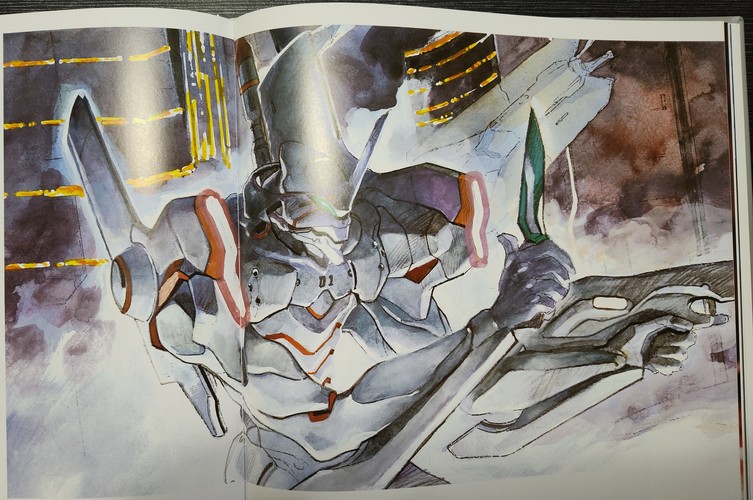
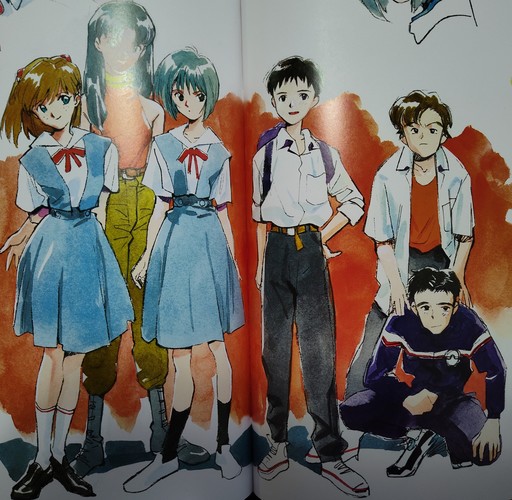
Now, it is understandable that many of you would be confused by that description (and not in the normal way Eva has confused people). In some ways, there are familiar elements, such as mentions of artificial evolution and the use of religious imagery. But in others, it sounds nothing like the show we all saw, more like a generic sci-fi story (Anno stated in the article that the show will ask some questions common in the genre, such as “what is the nature of evolution” and “what is humanity's relation to his or her god?”). This description isn't completely out of left field. Elements of it appear in proposal documents from late 1993 as the series was getting approval for production, including several preliminary images drawn by both Sadamoto and mecha designer Ikuto Yamashita (some of these drawings can be found in Sadamoto's art book Der Mond).
 |  |
The next time we hear of the show in the West is in the June 1995 issue of Animerica. That article, which heavily borrows from an article printed in the April 1995 issue of Newtype, gave more details on the show, though it does make a few errors, such as mislabeling an illustration of Asuka as Rei. The article does give some foreshadowing of what kind of story would unfold, stating that the show would be “no ordinary robot anime” along with some quotes from Anno such as “Don't you think that robot animation is behind the times? The genre is over twenty years old. It's not a refreshing or new genre,” and “If a person likes robot or cutesy girl animation, can that person get past the age of twenty and still be really happy?” He also stated that the first two episodes, even though not complete, did reflect his personal feelings. The article ends with speculation that the show will have a more cult-like following than Gainax's previous TV show Nadia - The Secret of Blue Water or Royal Space Force, but there is a feeling fans will see something they haven't seen before.
On July 22 and 23, the Gainax festival was held in Itako, Ibaraki prefecture, where they showed Episodes 1 and 2 without the opening or closing (they would be finished by the end of September). On September 27, a week before the premiere, the final episode of Teenage Mutant Ninja Turtles (the 1987 version) aired, followed by a commercial for Evangelion that would air at that time slot.
Stay tuned for parts two and three!
discuss this in the forum (1 post) |
