

Game Review
by Rebecca Silverman,Temirana: The Lucky Princess and the Tragic Knights
Visual Novel Review
Nintendo Switch
| Description: |  |
||
Cecilia is the third princess of her kingdom, damned by the superstitious nation as the “cursed princess” for a stigma on her forehead. Despite this, she looks forward to coming of age and being able to create her own order of knights to help the country. But with her reputation, she has to resort to unconventional recruits, like a farmer, the prince of another nation, an amnesiac, a sickly nobleman, and a blacksmith. Can Cecilia successfully form her knightly order and help defend the kingdom from threats from within? |
|||
| Review: | |||
How much time do you have to sink into an otome game? If the answer is “not tons,” consider picking up Temirana: The Lucky Princess and the Tragic Knights. It's not a short game by any means, but chapters are digestible, especially once you get through the common route, and it's easy to play in hour-long chunks in between doing other things. It's a great game for those without a lot of time or without a long attention span, and that's not something you can say about every otome game or visual novel out there. 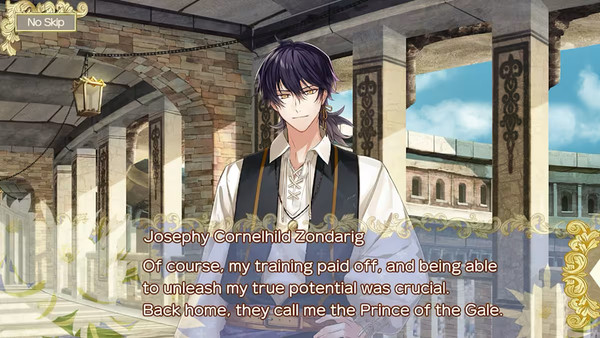 © 2024 IDEA FACTORY/ichicolumn inc. It also helps that the story is good and offers a fair amount of variety between its routes. The basic story is that Cecilia, the third princess of her kingdom, Temirana, has been shunned since her birth due to a strange mark on her forehead and the death of her grandmother shortly after she was born. These things don't seem related at first glance, but as the plot gets deeper into the superstitions and religious beliefs governing the world, it does begin to look like Cecilia's birth may have inadvertently caused her grandmother's death – although there's also an implication that this was her grandmother's choice. But whatever the cause, Cecilia has spent her entire life living away from her family (her parents and two older sisters), something she feels very keenly. She looks forward to the day she'll be able to assemble her own knight order as a legal adult, not just because it's something she wants to do as a princess, but also because she craves human interaction. 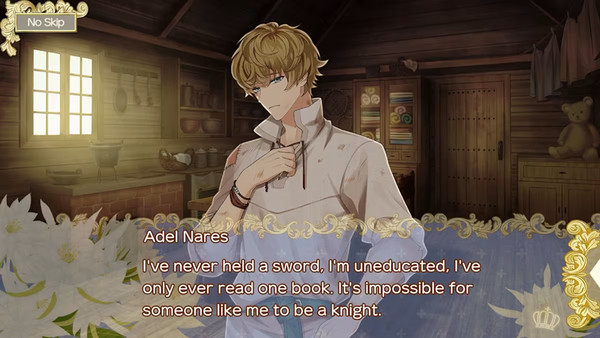 © 2024 IDEA FACTORY/ichicolumn inc. As might be expected, the five young men Cecilia picks to be her knights are both unconventional and romantic interests. Only two of them are nobles – Josephy, the prince of a fallen kingdom, and Tobias, a sickly young man with big dreams. Milan is a commoner who works as an ornamental blacksmith (he crafts ornamental works rather than weapons), Kiya is an orphan working as Tobias' servant, and Adel is a peasant farmer. Only Josephy has any formal training, and most of the others either aren't interested in becoming a knight or don't feel like they're worthy of the job. While this is all dealt with in the common route, their personal circumstances help to build the plots of each of their routes. Each route is different and explores a different area of the greater issues facing Temirana. That's a major plus, because it means that you truly get five different sides to the story with very little plot overlap. You do have to replay the common route each time to make the appropriate choices to get on a given route, but with the skip function, it's not a drag. Each of the routes differs in length as well as plot, with Kiya's being the shortest and Josephy's the longest, although this is a difference of a chapter or two rather than anything greater. Gameplay is typical of a visual novel in that you mostly read onscreen text with occasional choices. Life-or-death choices come with a fancier interface, and “correct” decisions are marked by a string of sparkles after you click. That makes it easy to avoid bad ends and to woo the knight of your choice, although I could see it feeling too simple for some. 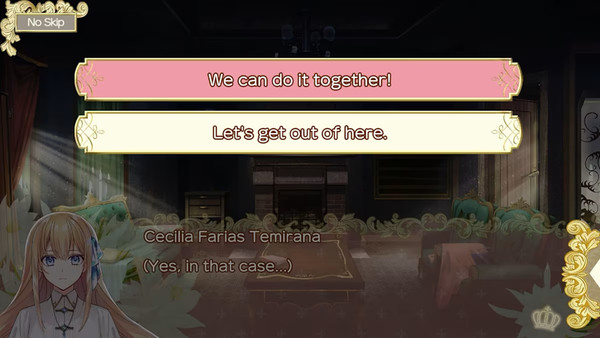 © 2024 IDEA FACTORY/ichicolumn inc. 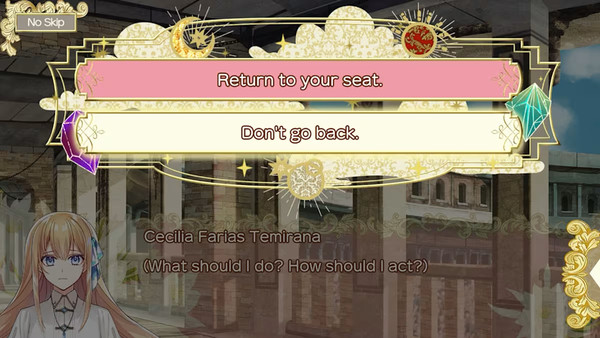 © 2024 IDEA FACTORY/ichicolumn inc. While each of the love interests does fit a basic character type, they don't feel quite as tropey as some other otome games I've played. Milan is clearly “the stoic one,” and Josephy “the tsundere one,” but neither of them feels stereotypical to the point where it's just a new name and face on an old character. I particularly enjoyed Adel as a character because he felt the most unique, but all of them feel like fairly rounded options rather than color-coded game pieces. Villains are somewhat less nuanced, although a few supporting characters offer some decent narrative surprises. Most of the characters are voiced (Cecilia being the exception), and for the most part, I enjoyed the performances, particularly Shō Karino as Adel. Each voice can be adjusted separately in the settings menu, which is a good thing because I had to turn Benetti's voice off; the little mascot character's utterances were intensely annoying. 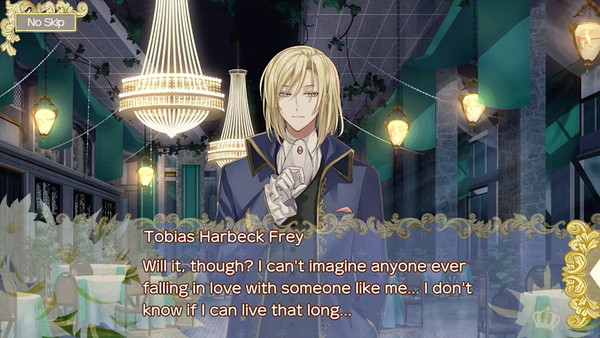 © 2024 IDEA FACTORY/ichicolumn inc. The art is beautiful, and there are a lot of CGs to collect. Interestingly enough, bad endings don't have a dedicated CG, but they're also pretty mild; just some blood spatter on the screen. Care has been taken to give even the side characters unique designs, and if not everyone who speaks has a sprite, well, there's enough detail in the rest of the artwork to make that feel like a necessary shortcut rather than cheaping out. Music is also very nice, although a bit chirpy at times. Both a gallery and a music box are included in the extras menu, along with mini audio dramas (translated on-screen) and exhaustive route maps. Each chapter also has a mini-map you can call up from the menu alongside an affection meter and a dictionary. 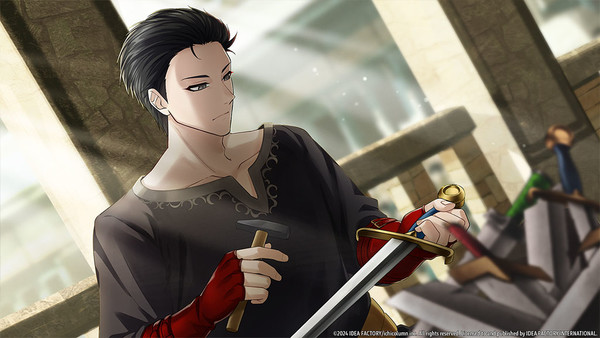 © 2024 IDEA FACTORY/ichicolumn inc. The dictionary is exhaustive, but it's symbolic of one of my criticisms of the game. While a lot of care obviously went into building a complete world, there are times when it feels like they went too far in trying to make Temirana and environs unique. It's one thing to have an intricate system of gods whose corresponding months determine people's jobs in life; it's another to make up unnecessary words for ordinary things. Would the game have felt less like a fantasy if they'd just used the word “cake” instead of creating “kelk”? I have my doubts. 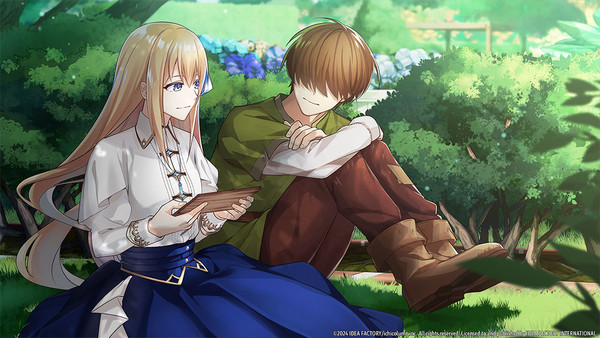 © 2024 IDEA FACTORY/ichicolumn inc. Despite this, I very much enjoyed Temirana: The Lucky Princess and the Cursed Knights. It's a light, sweet game that's easy to pick up, put down, and play when you have the time and it's long enough to feel worthwhile while also being short enough to feel like you can play to completion. It may not be the absolute best otome I've played recently, but it's good enough to make it worth the wait to see it localized in English. |
|
The views and opinions expressed in this article are solely those of the author(s) and do not necessarily represent the views of Anime News Network, its employees, owners, or sponsors.
|
| Grade: | |||
Overall : B+
Graphics : A-
Sound/Music : B+
Gameplay : B
Presentation : A
+ Lovely art, unique storylines for each route. Easy to play a full chapter in between doing other things. |
|||
|
discuss this in the forum (1 post) |
bookmark/share with:

|
|||