

The Long Career of Romeo's Blue Sky Character Designer Yoshiharu Satō
by Lynzee Loveridge,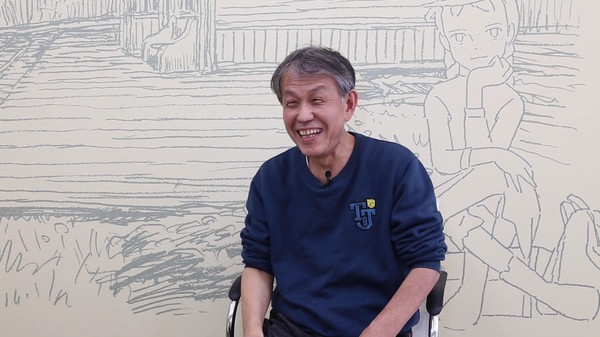
At 67 years old, character designer Yoshiharu Satō has spent over four decades in the animation business. Currently residing at Nippon Animation, the Kanagawa prefecture native has worked his way through era-defining projects before discovering an ad in Animage magazine. The publication was fresh on the scene, having launched in 1978. While reading it, Satō discovered a job offer would bring him into the same workspace as Studio Ghibli's Isao Takahata and Yoshifumi Kondō and the massively influential animator and character designer Yasuji Mori.
It was 1979, and Nippon Animation was in the midst of producing Anne of Green Gables. Satō made a phone call to the studio to apply. But first, he'd need to take a test.
"They told me I could take an entrance test. That's how I ended up coming here, to take the test. Yasuji Mori was in charge at the time. One of the tests was drawing a character turn from facing forward to facing sideways. Another part was animating a ball, like, drawing the ball following a parabolic arc. You only had to draw the ball itself, and they told me to mark the positions of the ball along that arc. I also remember a drawing test, like a still life. I think I had to draw a kettle or something like that," Satō shared. Then, like the titular Columbo, he added, "Oh, and one more thing I remember. Instead of taking the test at the studio, they actually let me take it home. They were just like, 'Here you go, take it home, draw it, and bring it back.' It was such a laid-back era. There was no way to know who really drew it, right?"
Satō had a jovial demeanor, animated and eager to share his industry stories with me. Throughout the interview, he recalled everything from his early years cleaning leftover cigarettes off of Takahata and Kondo's desks to learning the importance of emotive animation from Mori. Director Kōzō Kusuba pushed how to connect audiences and characters through good cry sessions, and Satō would take that lesson to heart during a pivotal scene in Romeo's Blue Skies. Please note: This interview contains spoilers for Romeo's Blue Skies!
Learning from Animation's Biggest Talents
During your career, you worked with acclaimed animators Yoshifumi Kondō and Yasuji Mori. Can you share your memories of working with them? How did they help you develop your own artistic approach?
Yoshiharu SATŌ: Of course, since they were both incredible animators, they influenced me completely. Like, I absorbed everything just by being around them. What really stuck with me was their attitude toward work, their way of thinking. How seriously and sincerely they approached each project. When you're involved in a project, you set your private life aside.
For example, with the World Masterpiece Theater shows, you'd be on one project for an entire year. I learned from Yoshifumi Kondō that, during that year, you dedicate yourself fully to that one work. You pour everything into it, putting your personal life on hold. Yasuji Mori also had a deep devotion to the work, but his focus was more on the idea of what kind of story you wanted to bring to life. He came from Toei Animation, and he was all about seikatsu shibai, bringing real-life, everyday acting into animation. I was really influenced by that approach, too. In Anne of Green Gables, for instance, the way girls move, their facial expressions...I got to see Kondo-san draw that kind of thing up close, and it had a huge impact on me.
Is there any particular project you closely associate with either person?
Yoshiharu SATŌ: So, when I think of Kondo-san, I think of Anne of Green Gables. As for Mori-san, when it comes to this studio's work, I think of things like Bannertail: The Story of Gray Squirrel or Monarch: The Big Bear of Tallac. But when you talk about his earlier stuff, it's definitely Toei Animation. One standout is The Wonderful World of Puss 'n Boots.
Oh, that's still the mascot for Toei Animation to this day.
Yoshiharu SATŌ: Right, so it turns out that Yoshifumi Kondō himself watched Puss 'n Boots, and that inspired him to knock on the door of Toei Animation. But Toei wasn't hiring at the time, so Yasuo Ōtsuka introduced him to A Production*, and that's how Kondo ended up becoming an animator, he said. So, when I joined Nippon Animation, Mori-san still really loved Pero, the cat character from Puss 'n Boots. Whenever visitors came by and asked for a drawing, especially younger ones, Mori-san would always draw Pero for them.
*A Production (now SHIN-EI ANIMATION Co., Ltd.) was founded in December 1965 after a financial shuffle stemming from Tokyo Movie and the mid-sixties anime series Big X. The studio was first run by Daikichirō Kusube, a former Toei animator, out of an apartment in Yoyogi with animators Osamu Kobayashi and Eiichi Nakamura in tow. As Toei Animation shifted focus from feature films to television animation, many veteran members of its staff exited to join A Pro. This would include Isao Takahata, Hayao Miyazaki, Yōichi Kotabe, and Yasuo Ōtsuka. Takahata, Miyazaki, and Kotabe would all later work on Heidi - A Girl of the Alps and A Dog of Flanders.
You worked with famed director Isao Takahata on the production of Anne of Green Gables. What was it like working with Takahata-san? Do you have any memorable moments or experiences that left a strong impression?
Yoshiharu SATŌ: Takahata-san was irritable all the time. And he'd smoke as he'd draw like this, and I'd watch his back as he took a puff as he worked. He'd be in the studio all day. I'd often wonder if he ever went home. It was the same with Kondo-san. They were both heavy smokers, so their desks would be covered with cigarette butts. I was a new recruit, so I'd come in the morning and clean their desks because I was the new guy. Nobody told me to do it. We'd pick up what our elders left off, so I have memories of the mornings when I'd clean Kondo-san and Takahata-san's desks.
I heard that there was also a spirited discussion about Anne's design between Miyazaki-san and Takahata-san.
By the time I joined, Miyazaki-san had already left and gone to Telecom Animation Film*. I heard a joke, or a half-joke, that “Miyazaki-san left because he didn't like girls like Anne.” And then Miyazaki-san had the heroine for his Lupin III: The Castle of Cagliostro film, Clarisse. I remember thinking, “Oh, that's the kind of girl that Miya-san likes.”
*Telecom Animation Film, like A Production, was born from Tokyo Movie. In this case, it was the later-founded Tokyo Movie Shinsha. The studio was Tokyo Movie's successor with the intent of entering the American film market. Founder Yutaka Fujioka established the studio in 1976 while simultaneously cutting business ties with A Pro (which then went on to change its name to SHIN-EI ANIMATION Co., Ltd.). Much like he recommended Kondo to A Pro, Yasuo Ōtsuka invited Miyazaki and Takahata to join the studio. There, they produced Cagliostro and Chie the Brat.
What do you think about Anne of Green Gables and World Masterpiece Theater that makes them “classic” or “timeless” animation works?
Yoshiharu SATŌ: I think the reason people love them so much is because of the creators. When the projects are decided, they really take their time to consider how they want to convey the stories to the viewers with the World Masterpiece stories. I was a fan of Heidi - A Girl of the Alps. That's why I became an animator. But even among Takahata-san's works, the way he portrayed Heidi and the way he portrayed Anne was completely different. Heidi was more relatable, like the more ideal happy little girl, whereas with Anne of Green Gables, Anne was more, how do I say it… I didn't really understand Anne when I watched it. I think I found the portrayal of characters like Marilla or Matthew more understandable. There's something there that you only understand after you grow older. That's how much depth there is in both works. Working under Takahata-san… I'm not a director, but watching him work, I naturally absorbed a lot of that from him.
Putting His Heart into Romeo's Blue Skies
One work I'd like to hear more about is Romeo's Blue Skies; the author Lisa Tezner's works aren't as well-known in the English-speaking world compared to others adapted by Nippon Animation. Do you recall how this work was chosen to become an anime? What was it about the story that made it an appealing work?
Yoshiharu SATŌ: When I came back from Studio Ghibli, there was already a project proposal for Romeo's Blue Skies, originally titled The Black Brothers. I'm not exactly sure what year that proposal first came up, but Yasuji Mori had already drawn the concept illustrations for it. However, with a title like The Black Brothers, it was tough to get the TV networks to approve the project. Then Shōji Satō, the producer who used to work here, came to me and said, "I really want to make this happen. Would you be willing to work on it?" That was after I had returned to the company and done a few other projects, so the timing lined up.
The connection to the project was partly that Mori-san had drawn the original concept art. Also, the director had already been chosen, Kōzō Kusuba. I had worked with Kusuba-san a few times before, and we had a good rapport, so after hearing the details, I felt like, "Yeah, I want to give this a try." As I listened to the outline of the story, I thought it could be a project where I could apply everything I'd learned during my time at Ghibli and elsewhere, all my skills and techniques. Kusuba-san had also worked under Isao Takahata back during Anne of Green Gables, so his directing style sort of aligned with Takahata's. Well, of course, every director has their own approach, but they both had the same mentor. That shared background helped us connect and work well together.
As far as the story of Romeo's Blue Skies, what do you think is appealing about the story itself?
Yoshiharu SATŌ: As for Romeo specifically? While working on it, I was already at a point in my career where I had some experience under my belt. The story itself deals with kids born into poverty who are sold off and go through a lot of hardships. It's about how they push forward through those challenges. I kind of felt, on my own, really, that there was something in that story that could speak to mothers and children watching the World Masterpiece Theater series. And in that sense, Romeo really became something of a return to my roots. Even though I could never quite reach the level of Heidi or Anne…The expressions, the gestures, the movements, I poured all of that into Romeo in my own way.
I was talking to a friend who watched the series, and they told me one of the series' appeals was the relationship specifically between the two boys and whether it was romantic or not. I was wondering if there was any comment on that.
Yoshiharu SATŌ: And how did it turn out? (laughs) Honestly, it was purely about friendship. I never imagined it would become something like that or that it would attract fans. All I wanted was to create an anime that a mother and child could watch together and feel comforted by. But somehow, young girls ended up becoming fans.
Do you have any memories you can share about working with Kōzō Kusuba-san at the time? What was his directorial approach like?
Yoshiharu SATŌ: Kusuba-san was often called "The Crymaster Kusuba," because he loved scenes where the main character would cry. He really liked animating crying scenes. There were times I'd think, "Again, with the crying?" But since I was in a position where I could actually say, "Isn't this a bit much?" I think that helped balance things out a bit. Kusuba-san had his own sense of direction. There were moments where I agreed, like, "Yeah, this is a good place to cry." But there were other times when I felt he went overboard. Also, he loved close-ups.
He'd say, "This is how it should be." He wouldn't change his mind. That's part of why Romeo ended up feeling so impactful, I think.
World Masterpiece Theater is known for its human-focused drama. Is there a scene from one of the series that had a strong emotional impact on you?
Yoshiharu SATŌ: As I mentioned earlier, I had left this studio to go to Ghibli, and there I worked on Totoro, and later on Porco Rosso. I think I absorbed a lot from working with Miyazaki-san during that time, and those influences showed up in my work. So when Kusuba-san approached me again and said, "Let's do Romeo," something just welled up inside me. I felt like, "I'm going to put everything I've got into this." That's why Romeo became such a personally significant project for me.
Is there an episode or scene from Romeo that really you still think about to this day?
Yoshiharu SATŌ: A specific scene? There are a few, but one that really stands out is the moment when Alfredo dies in the church when Romeo lifts him up. I remember struggling a lot over how to draw Alfredo's expression in that scene. What helped me figure it out was actually a memory from Heidi. There's that part where Heidi becomes a bit sleepwalk-y, and her eyes get kind of hazy, like there's no light in them, or like we call in animation, the "eye highlight." So I thought, "What if I do something similar for Alfredo's death scene?" So I drew his eyes with the highlights removed, making them look like the light had gone out. I really put a lot of feeling into it. I remember showing to the director, asking "How does this look?" and getting the okay.
That's so impressive, actually. That technique, removing the eye highlights to denote a character who has passed away or is experiencing a mental break, is still used in anime.
Yoshiharu SATŌ: Once I actually animated it, it felt like Alfredo's gaze; it wasn't looking at anything in this world anymore. It really seemed like his soul had moved on. I know that sounds like I'm patting myself on the back, but still, it wasn't just about removing the highlight. On top of that, I had really studied the scene, read the story deeply, and poured all of that into his gestures, his expression, and his whole body.
Changes in Anime Production and The Importance of Dedication
Workplace culture has changed overall over the last two decades. How has Nippon Animation's workplace changed since you started here and after returning in 2009?
Yoshiharu SATŌ: In terms of the work environment, things have definitely gotten easier. Working hours and that sort of thing, they're much more manageable now. When I first joined the studio, the top priority was meeting the broadcast deadlines. When I started during Anne of Green Gables, we had at least one all-nighter every single week. That pace continued for a whole year just to make it in time. And it wasn't just for Anne. That was pretty much the standard during the World Masterpiece Theater era. Even during Romeo, although we didn't have all-nighters anymore, we still couldn't take weekends off. It was basically a full year of working without holidays. But now, things like that never happen.*
So, in that sense, the work environment has definitely improved. Still, when it comes to how people approach the job, I sometimes feel like, I don't know. I just wish people would try a little harder. And by "try harder," I don't mean working longer hours. I mean, once you've been assigned to a project, I'd like to see people really study it, really read into it, fall in love with it. I just feel like there's not enough love for the work these days.
*Staff at Nippon Animation assured us that this work ethic was voluntary and that no one working on these projects was forced to pull all-nighters, sleep at the studio, or go a year without breaks.
What is it about children's programming that appeals to you as a storyteller?
Yoshiharu SATŌ: For me, animation was always… You could do things you can't do with live-action, including emotional expression, joy, and sadness in an exaggerated way, and create a world that's easy for children to understand. Animation these days has gotten so broad and a little bit bloody. I know that sort of thing has its fans, and not to denigrate that or anything, but I try to keep away from that side. But, going too far in the other direction isn't necessary… It all feels extreme. You either have that or things like Chibi Maruko-chan or Crayon Shin-chan or Doraemon… There's this dichotomy. But the World Masterpiece Theater works are in the middle, where you have proper acting and are still relatable to children. I kind of wish there were more shows like that.
Going back to your earlier statement, how do you know when love and care are present in an anime project?
Yoshiharu SATŌ: It's really all about how much depth they put into their work. The quality of the work. Take movies, for example. The movement is really fluid, along with the acting. Looking at TV, it doesn't feel like there's a lot of movement. The characters are not moving and are just there. Making the characters pretty is fine, but for me, animation is all about the acting and the movement. It feels like there's a lot less of that these days.
When someone really loves what they're working on, they feel, “This character would move like this and want to do this.” And they'd try to improve the animation to meet those ideals. Working with that mindset… Not to downplay the work people are doing, but it feels like there are fewer people who have that mindset. We're constantly struggling with the limited time and budget that we have. And it feels like there are fewer people who really take that struggle seriously in what they do. In my opinion, there are a lot of works out there that just feel like they were done by people who are satisfied with just drawing pictures and getting paid.
What I feel, and to go back to what I said before, I watched Takahata-san and Kondo-san work on Anne of Green Gables, and I felt their love for it. As I mentioned before, they'd give up a year of their personal lives. Kondo-san, for example, he'd get sick and be at work throwing up. He'd draw for a while and then feel ill and disappear, and I'd wonder where he went, and he'd be in the bathroom throwing up and then come back and work some more. You wouldn't take a break. You couldn't. We watched Kondo-san work like that.
Then there was Takahata-san. The script would get written, and since multiple people are writing, there needed to be consistency. He made sure Anne's character remained consistent for the whole year. And the way he'd work was so impressive. You couldn't do that if you don't love what you're working on.
What I wanted to say was you have to question if there are people out there willing to go the distance. I'm not saying that there aren't, but you have all those shows out there in a single week. Seeing all of those, it makes me realize just how lucky I was to watch Takahata-san or Kondo-san or Miyazaki-san at work. I wonder just how many people will really understand me when I talk about this.
I hope you don't mind me saying this, but Kondo-san passed away very young. If he had taken it a bit easier, is it possible he might still be here to create new works?
Yoshiharu SATŌ: I really don't know. It's true that he passed away early, and he made a movie at Ghibli, I think it was Whisper of the Heart… I met him back then, but he wasn't ill at all or anything then. You can't really tell, but I didn't get a chance to work with Kondo-san on Whisper of the Heart, but I was hoping to work with him on his next directorial project. So, the fact that he passed young… The art director, [Masahiro] Ioka-san, also passed away young. You really don't know what to say, I mean, there's obviously a lot of sadness. But I think looking after yourself and your health is part of the job. Kondo-san was the one who told me that. So to have the person who said it pass so young…
As an industry professional with over 40 years of experience, do you have advice for new animators looking to work in the anime industry?
For advice, I'd say be interested in lots of things. Miyazaki-san said, “There's lots of interesting things happening around you, so be the sort of person who can sense them.” I really agree with that. Not just as an animator, but just being curious about things will help in whatever you do. That's why when I talk to young people, I tell them to focus on that and that technical skills will come later.
Thank you to Nippon Animation Studio for hosting us and to Yoshiharu Satō for his thoughtful and enlightening answers.
discuss this in the forum |
