

The Dark History of the Reincarnated Villainess
Episode 8
by Caitlin Moore,
How would you rate episode 8 of
The Dark History of the Reincarnated Villainess ?
Community score: 3.9
I wonder how many people are skipping this series because they think it's a generic villainess series. The other day, I was out with a friend who is the same age as me, has been an anime fan for the same amount of time, and has many of the same touchstone series that I do. I asked if she'd been watching The Dark History of the Reincarnated Villainess, and she said no. She'd seen the title and assumed it was an edgy isekai series. When I told her it was a loving satire of the exact kinds of series we'd both watched as 12-year-olds and imagined ourselves in, describing the story to her, she said, “Well, I'm watching that as soon as I get home.”
It's not her fault – there's a considerable amount lost in translation with the title. “Dark History” is a newer Japanese idiom that refers not to villainy or skeletons in the closet, but one's embarrassing chuunibyou years. While the Japanese audience knows exactly what it refers to, English speakers imagine more, say, committing crimes or, at the very least, an uncomfortable era of yelling slurs because they think it's funny. It's just one of those cases where even if something is translated one-to-one, there's not really a good way to capture the nuance in the same way.
Guess we'll all have to evangelize the series as much as possible!
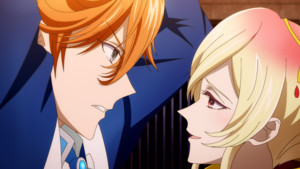
This episode plays the action more straight than usual: Iana tries to escape Cheneau's interrogation, but he catches her. The two team up, she with the intent to prove Duchess Amaryllis' guilt and he to exonerate her. The solution to the mystery won't shock anyone: the entrance to the supposedly nonexistent basement is under the greenhouse that only the Duchess has access to, revealed when Iana accidentally turns the head of a statue, and the fountain slides out of the way.
I cannot be mad about the contrived nature of the twist; this is a world created by a teenager. Even if she didn't design the secret passage, the entire world runs on that mindset.
That's what I tell myself when Duchess Amaryllis reveals herself as the most stereotypical predatory bisexual villain imaginable. In addition to the prisoners she has locked up in chains in her dungeon, she has two skimpily-clad minions who are introduced licking an ice cream cone, lapping at it together like they're trying to give it an orgasm. She gloats to Cheneau about raping his little sister. It's tacky, tacky, tacky in a way that would have made me turn off the TV if I didn't know it was engaging with these tropes intentionally.
It's less explicitly stated than usual, but we can use our knowledge of how Konoha Satou operated to deduce what kind of psychosexual impulse was driving her to create this kind of character. We know that she had some internalized misogyny, having surrounded the character Konoha solely with a male supporting cast. We may also suspect that she had some latent bicuriosity, given that she plays GL games alongside otome and BL. Finally, she has made it absolutely clear that she has a rape fetish. Given all this, though Amaryllis may be a deeply problematic stereotype, she was also another case of Satou exploring desires she's not quite ready to fully confront through fantasy.
The episode's most pointed bit of satire, however, comes in one of its only gags. When Amaryllis has Iana and Cheneau chained in her dungeon, she threatens to strip and assault Cheneau as well. Iana counters that if she wants to do that, she'll have to figure out how to undress him, because as a teenager she loved the kind of overdesigned “Original Character Do Not Steal ™ ™ ™” nonsense that you used to see all over DeviantArt and now populate gacha games. She decked her characters out in ornamentation without regard for form or function, so their costumes are impossible to casually put on or take off.
Iana, meanwhile, dredges up some memories of Bloody Rosa to attempt to resolve the issue without violence. Lady Amaryllis is, like so many others, motivated by her younger sister. She died young, begging Amaryllis to stay the way she was forever. Amaryllis took this to mean remaining physically beautiful; when she traps Konoha in the book world, Konoha tells her that she must have meant her beautiful heart. It's the same tactic that worked on Sol, even if Iana is convinced he still wants to kill her. But someone like Lady Amaryllis, obsessed with physical appearances, doesn't respond well to hearing it from someone like Iana, with her reputation for envying beautiful girls. It's nice that the narrative doesn't take a one-size-fits-all approach to settling conflicts; Iana must continue to be creative about how she uses her foreknowledge, because it turns out that some people don't respond well to borderline-strangers acting like they know something about you!
Would you believe we're not even all the way through volume three of the manga? One of my criticisms of the early volumes was how crowded and busy every page was, so I'm enjoying the anime's pace with its time to let jokes land.
Rating:
The Dark History of the Reincarnated Villainess is currently streaming on Crunchyroll.
The views and opinions expressed in this article are solely those of the author(s) and do not necessarily represent the views of Anime News Network, its employees, owners, or sponsors.
discuss this in the forum (7 posts) |

back to The Dark History of the Reincarnated Villainess
Episode Review homepage / archives