

The Winter 2026 Manga Guide
Mechanical Buddy Universe 1.0
What's It About?
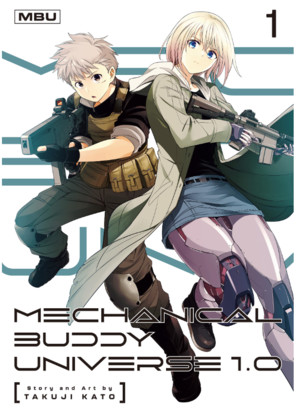
In a society of cyborgs, humans, mercenaries, and snipers, Rainy is a young man raised by MC-227, also known as Blau. They live in a post-war world full of monsters of many kinds. Rainy knows he isn't strong enough, but getting strong entails risky behaviors that he may never survive.
Mechanical Buddy Universe has story and art by Takuji Katō. It is translated by David Evelyn and lettered by Richmond Torrefranca. Published by Square Enix. (January 13, 2026)
Is It Worth Reading?
Erica Friedman
Rating:
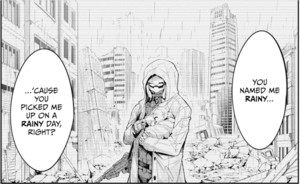
I just absolutely loved this book. Kato throws everything at the wall, and it all sticks. There are snipers, and mecha of many sizes, mercenaries, monsters, criminals, and a rich young lady who sees everyone as tools. In the center of it all is a former combat android known as Blau and her adopted son, Rainy. They move through this landscape, sometimes as hunters, often as hunted, and there's no real reason, per se. Everyone is out for everyone, and multiple parties may be hunting at the same time.
The volume is loosely arranged as a series of shorts that interlock in this shared world. We learn a bit about Blau and Rainy's origins, and fight snipers with one of Rainy's acquaintances. Blau will be manipulated into a one-on-one fight for Rainy's life that does not end the way any of them expect. Rainy will run off to try to gain experience and crawl home, stronger in ways he doesn't understand.
It was really nice to see the portrayal of an older woman, a combat veteran and squad leader, who ends up teaching Rainy a valuable lesson in the middle of an unwinnable fight.
Everything about this series is appealing, even the gross bits. The art is pretty clean, the violence—of which there is quite a bit, the world is brutal—is coherent. Characters are likable, even the annoying ones, and some of them are still annoyingly relatable.
What I liked best is that the tactics are clever and in-world specific, so you know the creator has thought their world through in great detail. Kato confirms this in the author's note, where they say they have spent a lot of time with this world, since its origins as an online comic.
We can clearly see how this series is going to play out. There will be full-on crazy action and fighting, and heartstrings will be tugged. Characters will open up and be vulnerable, then will crack a joke and ruin the moment. Then they will fight, again and again. I like it. I hope that it gets an anime someday, because that will be a great watch.
Rebecca Silverman
Rating:

Regardless of whether or not you read the previously released short story collection of Mechanical Buddy Universe, this is a knockout. Yes, there are some things you'll understand better if you've read the collection – how Blau and Rainy came to be parent and child, where the freaks come from, who the Banshee Squad was. And yes, knowing some of that backstory does make the follow-up feel more meaningful. But Takuji Katō's world is so alive that those bits and pieces are like the icing on the cake. It's nice to know them, but not necessary, and if nothing else this first officially serialized volume shows the truth in the old writing saw about authors needing to know 80% more about their worlds than readers do.
That said, the original collection is excellent and you should still find it and read it.
When the book opens, all of the players are already on the stage. Android Blau and her adopted human son Rainy are working as mercenaries, with Blau doing her best to protect the boy, Dahlia is still out doing her duty as the leader of the lost Banshee Squad from the Great War, and Rika is secretly acting as the mysterious sniper Hawkeyes. The way all of these characters meet and part is what makes the book work so well. Despite fully half the cast being mechanical in some way, this is a remarkably human series. Both Blau and Hawk (Rika's android partner) have become more and more human the longer they interact with people, as the flashback to Blau's early days shows. Humans and mechanical beings coexist in a world where no one is guaranteed survival, and everyone is still living with the aftermath of the Great War, which didn't end that long ago. This is ably shown by Rainy's meeting with Dahlia: Dahlia is an old woman now, and she mentions that the war ended before Rainy, a young teen, was born. She's both a relic of the past, unable to put it behind her, and a woman steadily working towards a future where the war is truly over – a future she doesn't necessarily believe she'll ever see. History is still alive in the actions of those living in the ruined world.
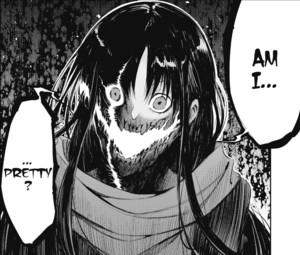
Despite that, this isn't really a war story. Dahlia's flashbacks are, and several of the characters are working as mercenaries, but this reads more like a sci-fi Western in a lot of ways. That's particularly true of the so-called “freaks,” a group of monster-modded people who each correspond to a Japanese yokai – the Slit-Mouth Woman, No Face, and Teke Teke. The Slit-Mouth Woman adheres to her folklore very closely, and it's impressive how well that works, both in the story and visually. I would not want to meet her on the street, night or day.
Mechanical Buddy Universe is an excellent story. It has pathos, silliness, and a keen understanding of what makes us human – no matter what we're made of.
Kevin Cormack
Rating:
I really enjoyed the preceding volume in this series (simply titled Mechanical Buddy Universe) when I reviewed it for the Fall 2025 Manga Guide. Now it's been upgraded to a 1.0 version. Has anything of import changed? Not really, it's the same anthology of loosely-related stories featuring human-robot duos in a ramshackle post-apocalyptic society. The closest characters to protagonists are the android mother/human son family, who now have names: Blau and Rainy, respectively. They appear in some capacity in most of the chapters here, interacting with the other duos. Rainy's desperate to grow up to prove himself as a mercenary, but Blau warns him he's not yet mature enough to go off on his own. They have a sweet dynamic.
Of the other pairs, I like the android noblewoman and her human maid a lot. There's a bizarre love triangle where the noblewoman wants to marry her maid off to Rainy, but Rainy only has eyes for the noblewoman, and not the maid, while the maid also loves her employer. The chapter where the noblewoman and Blau duel over the “possession” of Rainy is funny, especially its eventual outcome.
Human/android sniper duo Hawkeye has a super-cool design; the girl's bird-themed cloak reminds me a lot of Science Ninja Team Gatchaman (localized in the West – twice – as Battle of the Planets, and G-Force, both of which I watched as a kid). Stoic old soldier Banshee returns, too, and she's as badass as ever, fighting a monstrous “dragon” with her mech suit. The creepy slit-mouth monster lady re-appears, and makes a new friend by slicing off his face and replacing it with artificial parts… These chapters are much more gory and horror-themed, a little at odds with the rest of the book.
Once again, there's not much of an overarching narrative; it's pretty much a post-apocalyptic slice of life that examines the relationships between humans and artificial people. It's about on par with the preceding volume, so I'd recommend reading both, in publication order, as there are some important character details from before that aren't reiterated here. I'll almost certainly seek out the next volume when it's published later this year.
discuss this in the forum (14 posts) |

back to The Winter 2026 Manga Guide
Seasonal homepage / archives