

The Winter 2026 Manga Guide
Scenes from Awajima
What's It About?
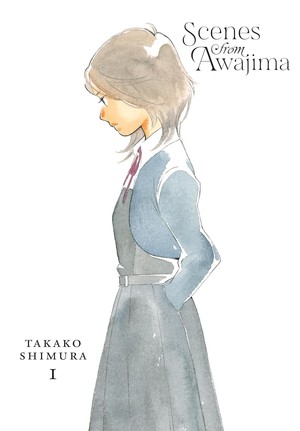
Awajima Opera School―where countless girls from across the country flock in hopes of one day standing on the big stage. As they work toward achieving their dreams of stardom, their time at Awajima is filled with as much friendship and admiration as competition and jealousy. The precious feelings of girls who are at once both classmates and rivals, tenderly captured in the portraits of an ensemble cast!
Scenes From Awajima has a story and art by Takako Shimura. English translation is done by Andria McKnight, and lettering by Rebecca Sze. Published by Yen Press (January 20, 2026). Rated 13+.
Is It Worth Reading?
Rebecca Silverman
Rating:
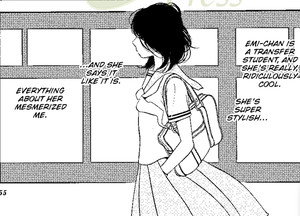
According to the afterword, Takako Shimura began working on Scenes From Awajima while also working on Wandering Son and Sweet Blue Flowers. That makes a lot of sense with the content of this book – although not overtly yuri, there's one story that has the lightest of lily scents, and although not about gender identity, there's one story that touches on the idea of gender norms. That's not to say that anything here is watered down, but rather that Scenes From Awajima is a gentle distillation of the themes from those other two series, a hint of sweetness in a volume that's all its own.
Each chapter largely stands on its own here, although there are links between them that enhance each story. The book covers two time periods: the present day (or at least, the present as of 2015, when this was first serialized) and two generations back. In the present, Wakaba is arguably the main character; she's the one we meet first, and she plays a central role in two other stories. The past doesn't have any one protagonist; instead, introducing us to four girls, only three of whom attended Awajima Revue. Two of those girls have since passed, leaving the one who didn't go and one who later became a teacher.
Both of these women make for interesting stories that add depth to Wakaba's time. The latter, who became a teacher at Awajima, is first introduced as a bully when she was a student, a role that shaped her far more than any she acted on stage. Her cruelty as a teen haunts her, especially since the two girls most affected by her words and actions have died, and there's a sense that she's trying to make amends by teaching at the same school where her actions caused such anguish. She has a reputation as the meanest teacher in school, but Wakaba can see past that, and as she forges a friendship with the teacher, you can almost see the invisible wounds healing. This story, as well as the only one to star a boy, suggests that the greatest role anyone can play is not one on stage, but their authentic self. That goes for the girls aspiring to be actors as much as it does for the boy who admires them and things deemed as “feminine.” He doesn't want to be a girl, he asserts to himself, but he does want to like what he likes, something validated by the older man he befriends, who is also a fan of Awajima Revue.
With soft, gentle art and stories that have more depth than at first appears, Scenes From Awajima is a beautiful book. The peace is mildly deceptive, but the characters are worth meeting.
Erica Friedman
Rating:
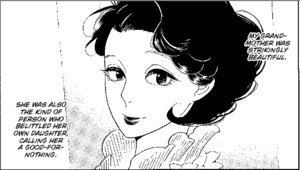
In 2011, while also working on several other series, including hits Wandering Son and Sweet Blue Flowers, Takako Shimura embarked on a series of vignettes about a musical revue school. Awajima was clearly based upon the famous (also, sometimes, infamous) Takarazuka school, but of course, no, it isn't, because the first rule of Takarazuka is you do not talk about Takarazuka.
Shimura's art and story-telling was still in an intermediate stage in this series. There can be rough moments in both that will make some of the more complicated relationships even more complicated to parse. There are small plot tie-ins to two other Shimura stories, Sweet Blue Flowers and Wagamama Chie-chan, which can be wonderful easter eggs for folks who are familiar with them, but distracting to those who are not—to be fair though, the latter only comes in an extra chapter at the end.
This story is presented almost as a tableau that touches on the experiences of specific students, but also flashes back and forth through the girls' recent pasts and the less recent pasts of the adults around them. These all tie together, but not tidily, which requires a little patience from the reader. We enter a story from the past in the middle, then move back and forth in time until, at the end, we understand that this was a story of generational trauma, love, hope, loss, life, and death.
If you do enjoy this kind of asynchronous storytelling, or are willing to wait until it all makes sense—which I promise it will—this is an interesting story, centered on character, rather than plot, from a creator who has become a master of that style.
Scenes From Awajima has an anime adaptation coming out in spring 2026, I expect that to iron out many of the wrinkles in the narrative, to make it make more sense for viewers, but I'd recommend reading the manga first to see how the story was laid out originally.
discuss this in the forum (14 posts) |

this article has been modified since it was originally posted; see change history
back to The Winter 2026 Manga Guide
Seasonal homepage / archives