

The Winter 2026 Manga Guide
The Magnificent Bastard
What's It About?
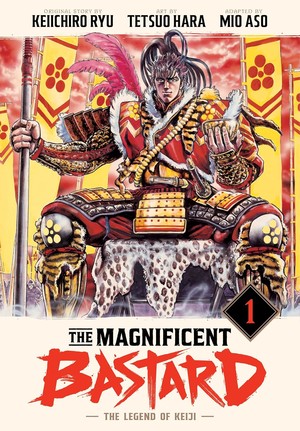
Tall, handsome, and deadly, Keiji revels in his own taste of beauty, whether it be slaying men on the battlefield or carousing with courtesans in the pleasure district. But in an era when might and ruthless politics reign, staying true to oneself—while staying alive—is no easy feat.
As feudal lords vie for supremacy, Keiji's House prepares for a clash with the powerful Hojo Clan. When a team of scouts is dispatched to procure wild horses for the House's army, they are attacked by a creature unlike any they have ever seen. Tasked with slaying this beast, Keiji sets out to tame it instead. Once the Hojo and their ninja master catch wind of this expedition, however, Keiji will have more than a wild beast to break…
The Magnificent Bastard has a story by Keiichirō Ryū, adapted by Mio Asō, and art by Tetsuo Hara. English translation is done by Andrew Love, and lettering by Dietrich Premier. Published by Kodansha USA (December 9, 2025). Rated 16+.
Is It Worth Reading?
Erica Friedman
Rating:
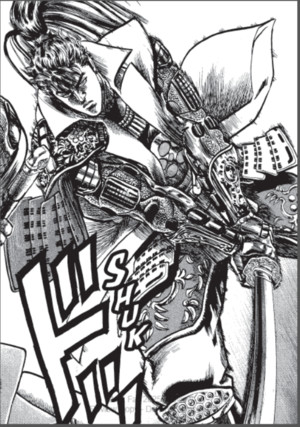
A Devil Horse attacks the army of Takigawa Kazumasu, whose objective is the destruction of the Hojo Clan. Maeda Keiji is the adopted son of the Takigawa family. Dressed strangely (the definition of “kabukimono”) Keiji is notorious for his fits and his ferocity as a warrior.
Frankly, this story had me at historically accurate, excessively overdressed young men. I love counter cultures, no matter where I find them, in any age or location. Then the story throws in a demon horse? They had me line, hook, and sinker. Add Hara's iconic art style and Keiji's chiseled jawline, and seriously, who would not love this book?
I know next to nothing about Fist of the North Star (and I'm sure readers will educate me in the comments) beyond overused memes and recognizable character designs, but that is not at all needed to love this manga volume. Everything about this volume is over-the-top in the most ahistorical way to tell a historical tale. I loved every single page of this volume and am absolutely going to re-read this. It was a hilarious and wonderfully epic way that completely captivated me. Even the ending in which Keiji confesses attraction to a woman as he has her naked in his still-armored arms was the perfect finale to a story that is three parts utterly absurd to one part some real-life things that are similar might have happened kind of that way, but probably not.
Honestly, this book is gift-worthy to just about any fan of action, adventure, history, FotNS, or chiseled, masculine, manly, but kind of pretty(?) men in flamboyant armor beating the crap out of other men and still looking chiseled and purse-lipped. Seriously, this is a must-read manga. I'm absolutely delighted this exists in English and hope you will be, too.
Kevin Cormack
Rating:
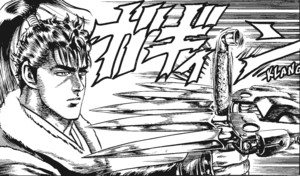
So this is a type of manga we don't see much of in the modern era. Artist Tetsuo Hara was world-famous in decades past for his work with writer Buronson on the seminal post-apocalyptic epic Fist of the North Star, published between 1983 and 1988. Keiji was published in 18 volumes between 1990 and 1993, and adapts the work of historical novelist Keiichirō Ryū, who sadly passed away in 1989. Hara visited an ailing Ryu in the hospital, before the publication of his manga adaptation, to receive his blessing.
The titular Magnificent Bastard Keiji is a formidable man-mountain, in appearance essentially Fist of the North Star's Kenshiro transplanted into Sengoku Era Japan, though he's overall much more cheerful. He's legendary amongst his allies, in whom he inspires admiration, and amongst his enemies, in whom he engenders hatred and fear. Although the story name-drops and even features a great many famous warlords and retainers from real-life history, Keiji himself is a cartoonish, exaggerated figure who swaggers through the battlefield, pursuing his own goals without fear for his life.
He's the kind of hero we know will never suffer any lasting defeat, nor any shameful indignity. As a descendant of a clan of kunoichi (ninjas), while also the (displaced) heir to a prominent samurai family, he's adept in both deception and swordplay. The reader's enjoyment of the story will hinge entirely on whether they can identify with this cocky asshole with a heart of gold.
Like any other example of this testosterone-fuelled genre, the bad guys are evil to the point of ludicrousness, their features often twisted into obscene ugliness. None of their schemes to end Keiji's life ever succeeds, and Keiji takes great pleasure in taunting them. During one scene, a prolonged siege battle, Keiji and his friend stand atop the castle battlements, gleefully whipping out their genitals and unleashing a torrent of urine upon their enemies as they attempt to scale the walls. That's pretty much the level of humor throughout.
Hara's art is, as usual, exceptional. Incredibly detailed and improbably macho, it hails back to an era of action-oriented male-targeted manga long since past. In a way, it seems quaint now. While I don't think, as a whole, it has a great deal of cultural merit other than the multitudes of cool-looking battles, beautiful women, and manly men doing manly things, it's something of a guilty pleasure. It's not really my kind of thing anymore, but as a teenager, I probably would have liked it as something I was “supposed” to enjoy at that age.
discuss this in the forum |

back to The Winter 2026 Manga Guide
Seasonal homepage / archives