

Journal with Witch
Episode 5
by Sylvia Jones,
How would you rate episode 5 of
Journal with Witch ?
Community score: 4.8
The premiere's nonlinear timeline made it obvious that Journal with Witch does not believe the past and the present are discrete. This week, the anime flips back and forth between decades without any transition, as if these scenes are entangled on a quantum level. Whether consciously or subconsciously, we act on our past experiences every day—comparing, contrasting, iterating, revising, forgetting, inventing, and so on. We author our interiorities through a constant stream of self-editorialization. Makio does it with the learned hand of a professional writer. Asa does it with the clumsiness of adolescence. In both cases, though, these women cannot ignore their pasts any more than one can ignore the air they breathe.
The visage of Minori, Makio's sister and Asa's mom, looms largest in their memories. Having gone incommunicado in adulthood, Makio long ago resigned herself to living unburdened by her sister's presence. When memories of Minori arise, they are almost always bad ones, painting a portrait of a woman who was curt, judgmental, and condescending. Makio comments this week that she does not enjoy reliving these moments. It is, of course, ironic that Makio is now interfacing more with her sister than she did when Minori was alive. Perhaps these specters are her subconscious, Dickensian means of grappling with her grief. While she is firm when telling her mother that she does not feel sad, I wonder if she feels regret. Clearly, she can't shake Minori from her mind, nor can she reach out to her for closure.
Asa, meanwhile, confronts a more complicated mental image of her late mother. Through her daughter's eyes, we've glimpsed Minori's kinder side before, but in this episode, we see the most complete portrait to date. And, if I may speak as a writer, I envy the economy with which the anime portrays the textures of a dynamic relationship. We glean years of psychological cause-and-effect from short montages with sparse narration. Young Asa's indecisiveness causes her to grow up relying on her mom's opinion. Her mom, happy to help, still recognizes that her daughter needs to be her own person. Asa, in turn, makes a choice, and her mom disapproves. It's hypocrisy I recognize from my own experiences, feeling like utter betrayal when you're at that age. Worse still, Minori specifically criticizes her for looking too "boyish" in her short hair. It's a hurtful critique that cuts to the core of her identity, already tenderized by early adolescence. It's the kind of offhand cruelty that instills a mistrust of adults when you're that age. And Asa places this memory proximal to her memory of the accident—two traumatic experiences dueling between the scratches and smudges on the pages of her journal.
Minori's overbearing personality, as we've seen from Makio's perspective, might have caused Asa's indecisiveness in the first place. The irony, as Makio points out, is that their mom used to criticize Minori for being similarly dependent on her. It's very possible that Minori, cognizant and committed to avoiding her mother's mistakes, recognized the same tendency in her own daughter and tried to couch her comments in maternal kindness. However, no parent is perfect, children are perceptive, and Asa, in particular, is a sensitive kid. Moreover, Journal with Witch shows us how deeply entrenched her distrust of adults remains. Asa goes behind Makio's back to purchase a laptop, yet she only does so to avoid asking her about joining the band club. I can't tell you how many times I've done something ridiculous and convoluted to avoid asking a single question—all because I felt paralyzed by the fear, the certainty that the answer would be no. It's a terrible way to live.
I appreciate, too, that Journal with Witch shows how these behaviors, resentments, and coping mechanisms can stem from innocuous situations and relationships. Nobody in this family was or is an evil person. Makio recounts how she and her sister used to get along with their mother. Asa has plenty of fond memories of her family. Makio and Asa are currently getting along. But people are complicated, unique, and never wholly compatible with each other. Even miniature conflicts can accumulate and paralyze the delicate balance of a relationship, like how motes of dust might wear down the clockwork of a pocket watch. We can't always predict or stop these problems. They are the cost of living around others.
There's no loophole around this, either. Journal with Witch warns us about the dangers of isolation. Makio comments that her mother turned “dull and snide” when her husband died, and her daughters left the nest. Does Makio realize the irony of her saying that? Asa, echoing her adjectives, likely realizes that the same words might someday be used to describe her reclusive aunt. Makio's strained relationship with her immediate family enabled her to rescue Asa, but it now strains their current living situation. We saw that last week, and this week, Makio reiterates that she will not tell Asa her true thoughts about Minori. While she justifies it by not wanting to taint Asa's memories—which we already know are not all sunshine and roses—her refusal to communicate widens the chasm between them. It's an insidious pattern. At the same time, mere physical proximity can be enough to foster change. Makio and Minori both picked up habits from their mother. Makio's mom still knows how her daughter's brain works. Kasamachi passes his comforting technique down to his ex. Makio recognizes the song Asa has been singing. No person is ever completely alone.
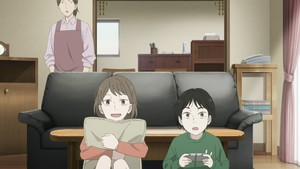
Mercifully, the series also explores these themes in lighter situations. The lawyer scene is a refreshing comedy of errors, as Makio's off-kilter nervousness rams into Tono's highly manicured projection of unflappability. These are two fundamentally awkward individuals who could both stand to soften a tad, but it takes some time for that truth to reveal itself. Once they realize that, their conversation proceeds much more smoothly. Likewise, the humorous hallway misunderstanding leads to a very sweet, familial tableau, with Makio, Kasamachi, and Asa all smooshed together on the couch. While all three characters may be walled off from each other in some manner or another, and while they are not a traditional family, they forge that moment and exist within it.
Rating:
Journal with Witch is currently streaming on Crunchyroll.
Sylvia is on Bluesky for all of your posting needs. She is a witch-in-training. You can also catch her chatting about trash and treasure alike on This Week in Anime.
The views and opinions expressed in this article are solely those of the author(s) and do not necessarily represent the views of Anime News Network, its employees, owners, or sponsors.
discuss this in the forum (25 posts) |

back to Journal with Witch
Episode Review homepage / archives