

The Extraordinary Magic of Ichi the Witch
by Jairus Taylor,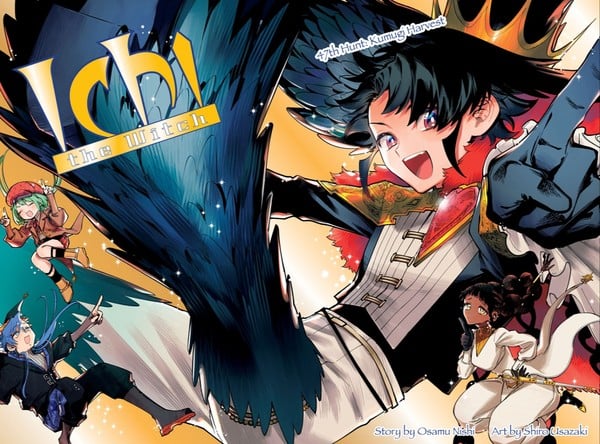
For better or worse, Shonen Jump reigns supreme in the world of anime and manga and has consistently churned out some of the biggest franchises on the market. As such, in the wake of juggernauts like My Hero Academia and Jujutsu Kaisen having recently ended, and other established hits like Sakamoto Days and Witch Watch inching towards their own conclusions, there's been the ever-looming question of what will eventually replace them. Fortunately, there seem to be a couple of very clear answers. One of them is the urban sword battle series, Kagurabachi, and despite gaining a lot of its early buzz through internet memes, it's managed to establish itself as a genuine hit, as well as being a solid story in its own right. The other is Ichi the Witch, which, despite not hitting quite the same level of viral popularity, has also done really well for itself ever since its debut. It's also a manga whose very existence feels somewhat bizarre, as despite it being the product of two well-established creatives, the circumstances of its creation are about as miraculous as its protagonist.

However, Usazaki's time on the series was cut short when the writer of act-age, Tatsuya Matsuki, was arrested for molesting middle school students, and although there were discussions of Usazaki continuing working on the series without Matsuki's involvement, she chose to let the series be cancelled and taken off shelves out of respect for his victims. It's not too hard to imagine a scenario where this might have permanently stunted her career, and for a few years, it was somewhat in the air, as her output was limited to assisting on one-shots or judging art contests run by Jump's parent company, Shueisha. Thankfully, her editors valued her talents as an artist, keeping her employed until they could find the right writer for her to work with, and that person would be Osamu Nishi.
Osamu Nishi has also been working within the manga industry for quite a while, with her biggest claim to fame being the fantasy comedy, Welcome to Demon School! Iruma-kun, which centers around a kind boy named Iruma who gets adopted by a demon after being sold by his terrible parents, and must now navigate school life in the demon world to avoid getting eaten by his classmates. Iruma-kun has served as one of the flagship titles for Weekly Shōnen Champion ever since its debut in 2017, and has managed to spawn a couple of successful manga spin-offs as well as three anime seasons, with a fourth set for the near future. With such a successful series under her belt, the last thing anyone would have expected was for Nishi to pitch an idea for a second weekly manga serialization (especially since an author juggling more than one series at a time is already pretty rare in the manga industry), and especially not for Weekly Shōnen Champion's biggest competitor.
Needless to say, this move was met with some apprehension from her editors at Champion, and its chief editor, Hideo Matsuyama, would later joke in an interview about the series that he hoped the deal would fall through when it was first suggested. However, since Nishi's position within the magazine was seen as valuable, and she was continuing to work on Iruma-kun, she was eventually given the go-ahead to work on it, and Ichi the Witch debuted in September 2024 with Usazaki filling in as the artist. Given the rather extraordinary circumstances behind its creation, it wouldn't be too much of a stretch to say that the fact this manga exists at all feels like a fluke, but the results of this unlikely collaboration have been pretty fantastic.
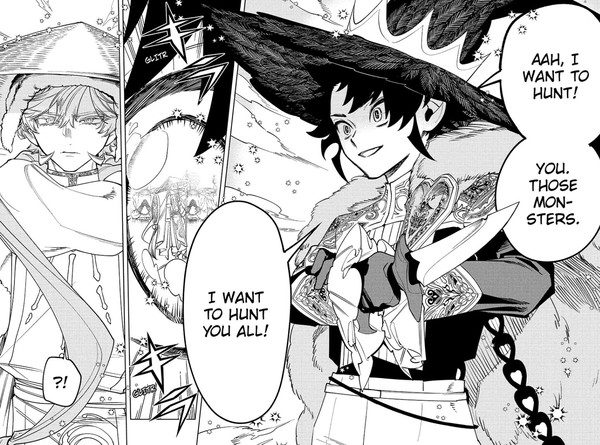 © 2024 by Osamu Nishi, Shiro Usazaki/SHUEISHA Inc. | 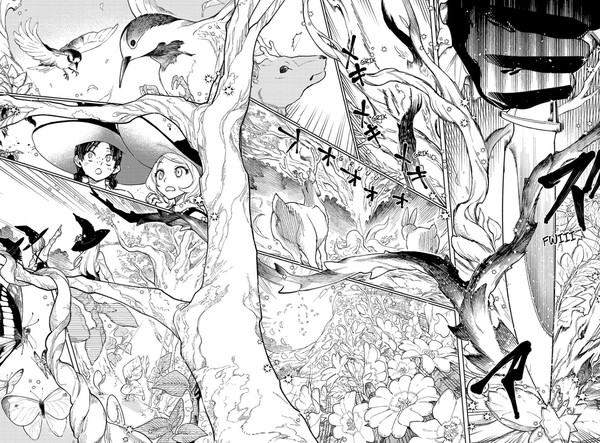 © 2024 by Osamu Nishi, Shiro Usazaki/SHUEISHA Inc. |
The series is set in a world inhabited by beings called Majiks, who can grant humans magic in exchange for completing specific trials. One day, a mountain boy named Ichi encounters the great witch, Desscaras, while she's in the middle of hunting a Majik called Uroro, and decides to hunt Uroro himself. While it's believed that only women are capable of acquiring magic from Majiks, Ichi manages to successfully catch Uroro in one of his traps and, in the process, becomes the first and only male witch to ever exist. With Ichi being such an anomaly, Desscarass is left with little choice but to take him under her wing and teach him more about Majiks while Ichi dedicates himself to hunting as many of them as he can.
It's a simple, somewhat loaded premise, but one that Nishi and Usazaki have managed to capitalize on with an impeccable sense of charm. The manga juggles fantasy, action, and comedy, as the various trials Ichi goes through to acquire new Majiks range from vicious life-or-death battles to fashion contests, and the story shifts between high stakes and great humor pretty effortlessly. That range is also captured really well through Usazaki's art, with some intense action spreads for large-scale fights, hilarious character expressions for big comedic punchlines, and panel layouts that help to create a sense of wonder for some of the magic features throughout the series.
The manga also benefits from occupying a somewhat unique space within the pages of Shonen Jump, as it is being sold as a fantasy manga rather than a battle manga. While that might not seem like too big of a distinction on the surface, it has granted the series a pretty high degree of flexibility. Rather than structuring a lot of its plot around flashy battles, it plays a lot more fast and loose with its narrative, as Nishi tends to zero in on whatever the most immediate needs of the story are, whether it be action or gags, and there are even points where the manga outright glosses over portions of fights to sell the intended effect of whatever it's currently up to. Although the result of this means that the series doesn't have the same degree of action as series like Jujutsu Kaisen or Sakamoto Days, it does make for a manga that feels unpredictable as it is fun, with a tone that feels more in line with pre-Saiyan Saga Dragon Ball and One Piece than Jump's more recent offerings, in many ways feels like their spiritual successor.
Now it might seem like a stretch to compare a fairly new manga to such titans of the industry, but this makes more sense when you look at Nishi's work on Iruma-kun. If One Piece has managed to run for as long as it has through Eiichiro Oda's skill at structuring its story arcs around its expanding world and populating new locations with interesting characters, then Iruma-kun has survived by Nishi's ability to center its story arcs entirely around new or pre-existing characters, and using that spotlight to continually build the world of the series around them. While this approach seems less structured on paper, it's one that's allowed the series to run for over 45 volumes (which, for contrast, is an even longer run than My Hero Academia) without any signs of slowing down, and much of that same approach to storytelling has carried over to Ichi the Witch. This is best seen in the Bakugami arc, where Ichi confronts a Majik that has positioned itself as the deity of a nation through magic that causes people to experience perpetual joy. However, this also robs citizens of the ability to feel any sadness, and the arc's central character, Gokuraku, is motivated to free the nation from the Majik's grip so his sister can properly mourn their mother's loss. This ultimately culminates in both an action-packed climax and a heartfelt exploration of the importance of grief, and makes for an excellent showcase of everything Nishi is capable of as a writer.
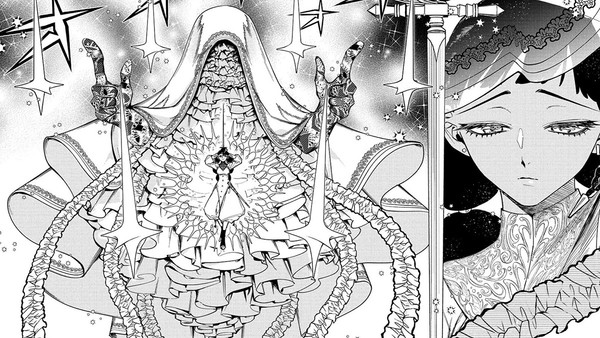 © 2024 by Osamu Nishi, Shiro Usazaki/SHUEISHA Inc. | 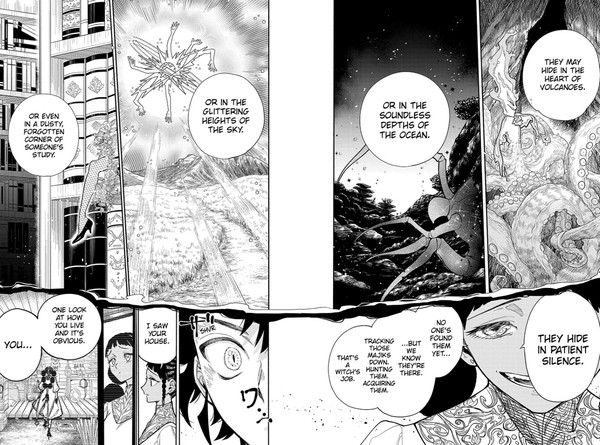 © 2024 by Osamu Nishi, Shiro Usazaki/SHUEISHA Inc. |
Of course, this approach wouldn't succeed if Nishi weren't great at creating characters, but this is one of her greatest talents. Even within the fairly limited span of the manga's run thus far, she has already managed to put together an ensemble of strong personalities, from Kumugi who serves as the straight man to Ichi and Desscarass, while being in over her head trying to keep up with them, to Uroro, who resents being bound to Ichi and constantly plots to get rid of him, but keeps getting in his own way because of his giant ego. Nearly all of them do a good job of immediately getting across what they're about, while also having more going on beneath the surface that becomes more apparent the more you learn about them, and this can be seen through the main duo of Ichi and Desscarass.
Having lived in the mountains all his life, Ichi is something of a wild child who knows nothing of the world around him, which makes for both a consistent source of comedy and a key part of his development as he gains a stronger sense of self through the other characters he interacts with. At the same time, that lifestyle has also made him a seasoned hunter and instilled in him an instinctive desire to hunt any unknown creature he comes across. Although he still tends to do good more often than not, those hunting instincts give him a somewhat loose sense of morality that can make him unsettling to watch as well as entertaining, with that duality a large part of what makes him a compelling protagonist. Desscarass on other hand, sits somewhere between Satoru Gojo from Jujutsu Kaisen and Bulma from Dragon Ball, serving as Ichi's mentor figure, and existing as one of the most powerful characters in the setting, with her planet sized levels of vanity only being matched by her constant exasperation at cleaning up after the strange mountain boy she's adopted (a combination that has already helped to make her into a clear fan favorite).
Although this relationship is largely played for laughs, it also gradually becomes important to both of them. Since she's taken Ichi away from the only life he's ever known, Desscarass takes it upon herself to look after Ichi as though he were family, and having never known the concept of family himself, this bond eventually becomes one of the first things Ichi values outside of his desire to fuel his hunting instincts. This dynamic serves as another strong example of the manga's ability to shift between whimsical and heartfelt at a moment's notice, and its ability to nail both consistently has been one of the biggest factors in what makes it such a delightful read.
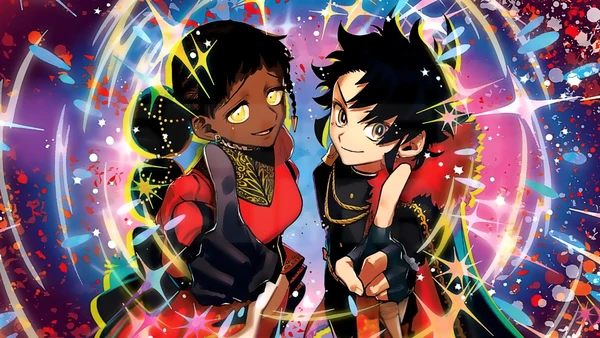
Success is never a guarantee within Shonen Jump, and even some of the most established veterans have seen new works meet a swift demise (the short-lived run of Masashi Kishimoto's Samurai 8 is certainly proof of that), so it's great to see that Nishi and Usazaki's new venture has been met with a largely positive reception. Between its colorful array of characters and how well it can shift between tones with its storytelling, there's a lot to like about this series, and it's made for one of the most consistently charming weekly reads that Shonen Jump has had on offer in quite a while. Time will tell if this manga reaches the same heights of popularity as some of the magazine's heaviest hitters, but with how well it's managed to handle itself so far, I have little doubt it'll manage to get there.
discuss this in the forum |
