

Game Review
by Richard Eisenbeis,Code Vein II Game Review
PlayStation 5 (Played), Xbox Series X/S, Microsoft Windows
| Description: |  |
||
Many years ago, the vampire hero Idris sealed away the phenomenon known as The Resurgence and saved the world. 70 years ago, several more vampire heroes stepped up to reinforce the seal. They failed, creating the ominous Luna Rapacis which hangs in the sky in the process. Now, those heroes, trapped in cocoons and twisted by a century of the Luna Rapacis' corrupting powers and their own inner demons, are exploding in flashes of light that threaten to bring a final end to this already post-apocolyptic world. There is only one remaining hope: to awaken the now monstrous heroes and kill them before they go critical. But as each cocoon is seemingly unbreakable, doing so is no easy task. It will take the unlikely pair of a resurrected vampire hunter and a vampire born with the power to travel through time to go into the past and befriend each hero, searching for the key to unlock their cocoons and defeat them in the present. But with the power to alter time at their fingertips, can this strange duo fight the temptation to tamper with the timeline beyond what is necessary—resist the urge to help those who are clearly suffering—when not doing so may leave their own world wholly unrecognizable at best and even closer to annihilation at worst? |
|||
| Review: | |||
2019's Code Vein is very much a game built on the Dark Souls foundation. It plays similarly in most ways, but two things set it apart from that series: its anime-inspired art style and its focus on plot and characters (more than on environmental storytelling and collecting brief snippets of lore from item descriptions). This has earned it a nickname: “Anime Dark Souls.” And let me tell you, if the original Code Vein is “Anime Dark Souls,” Code Vein II is “Anime Elden Ring.” 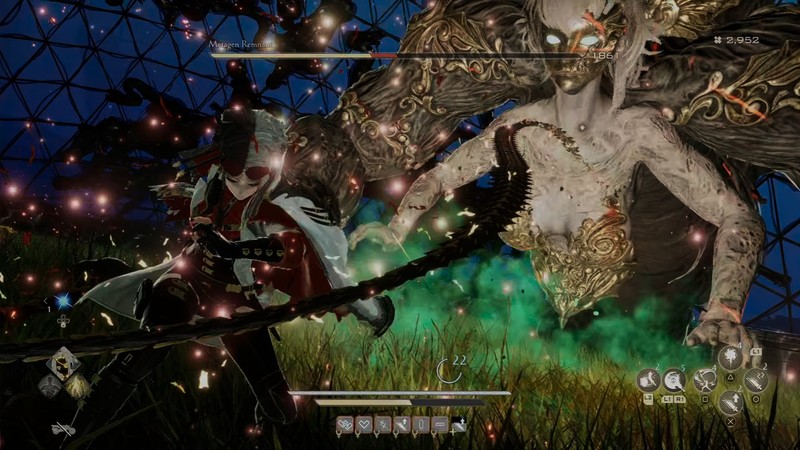 ©Bandai Namco Entertainment Inc. The general gameplay is exactly as this implies. When your character dies, they come back to life at the last save point minus their “Haze”—the currency used to both level up and purchase items—which you have one chance of recovering from the spot where you died. In battle, you utilize weak and strong attacks that differ depending not only on the type of weapon you are using but also on that weapon specifically. There are dozens upon dozens of weapons—and each can be upgraded by collecting stones from across the map (or purchasing them from merchants). You can also change their element. Like the above, a lot of the changes between Elden Ring and Code Vein II are skin deep—little more than a change in proper nouns. Instead of “Ashes of War” and “Spells,” they are called “Forma.” Meanwhile, “FP” is called “Lichor,” and “Sites of Grace” are called “Mistle.” As for the world itself, there is a huge map broken into different, open-world zones. Each zone contains a large and complex central dungeon and several smaller dungeons, along with tons of items to find monsters to kill across the map in general. Each area has a different biome—from a half-sunken city and a prison island to a ghost-infested forest and massive strip mining operation—which can be traversed both on foot and via motorcycle. When an area is completed, you can then challenge the main boss of the area and progress the main plot. 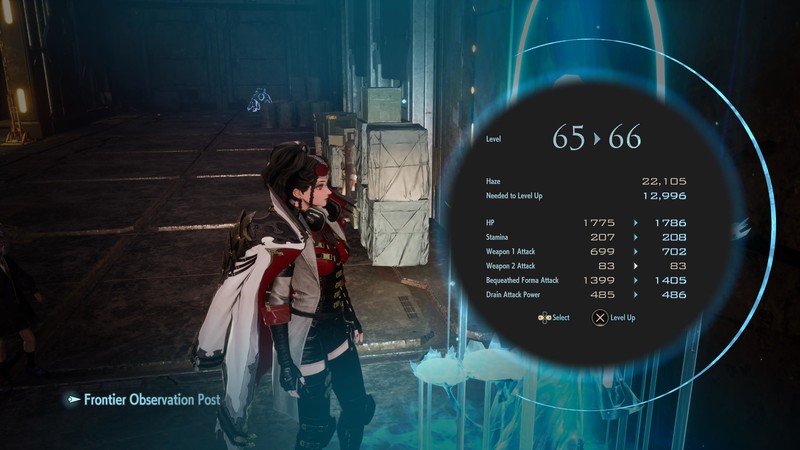 ©Bandai Namco Entertainment Inc. However, all this doesn't mean that the gameplay is a 1:1 copy. There are quite a few differences. To start with, each weapon you have can be equipped with a total of four skills or spells that you have collected—and comes already equipped with at least two that are locked to that weapon (until you find the same skill or spell out in the wild). These skills and spells each have a cost to equip, and each weapon has a different maximum load it can equip, so it becomes a bit of a puzzle to make your preferred weapon build. Yet, the biggest change to the back-end system is how leveling up works. While you can use your Haze to level up at any save point, you don't get to choose where your stats are allocated. In fact, leveling up mostly just affects your survivability—i.e., your HP —as your attack power only recieves the most token of increases. Your attack power comes largely from an entirely different source: Blood Codes. You can equip one Blood Code at a time. Each one provides a different allocation of stats to your character. This is important because each weapon requires a different set of attributes to use at 100% (though they can still be equipped at a penalty if your stats fall short). 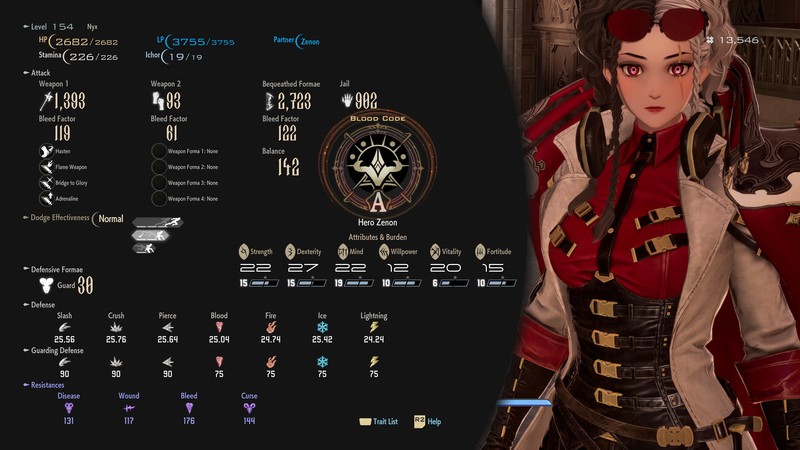 ©Bandai Namco Entertainment Inc. New Blood Codes are gained in three ways: 1) Befriending the various Revenants (vampires) you come across in the main story, 2) defeating bosses, and 3) mastering a Blood Code (equipping it and defeating enough enemies) and then returning to the source character to receive a stronger version. Moreover, mastering a Blood Code grants you a “Booster" (basically a talisman or accessory in similar games). These strengthen things like individual attributes, status resistances, weapon proficiency, and magic power. One such Booster (coming from mastering Lavina's Blood Codes), even speeds up how fast you master Blood Codes in general. The Blood Code system also acts as a soft level-cap of sorts for each area. Each Blood Code has a letter grade. The higher the grade the Blood Code has, the higher level of the enemy you need to face to get XP to master it. As each major zone has enemies of a similar level throughout, this effectively means that you'll never be too overpowered when exploring each for the first time (assuming, of course, you do them in the intended order). Of course, if you need a bit more of an edge, mastering Blood Codes isn't the only way to get stronger. Exploration rewards you not only in finding new gear/skills and gaining base levels, but also in finding shrines, which offer stat and resistance buffs that persist as long as you remain within the major zone you are currently in. Also, the merchants scattered across the world are vital since they sell weapons, skills, and, most importantly, special passes which allow you to purchase upgrade stones back at the hub. 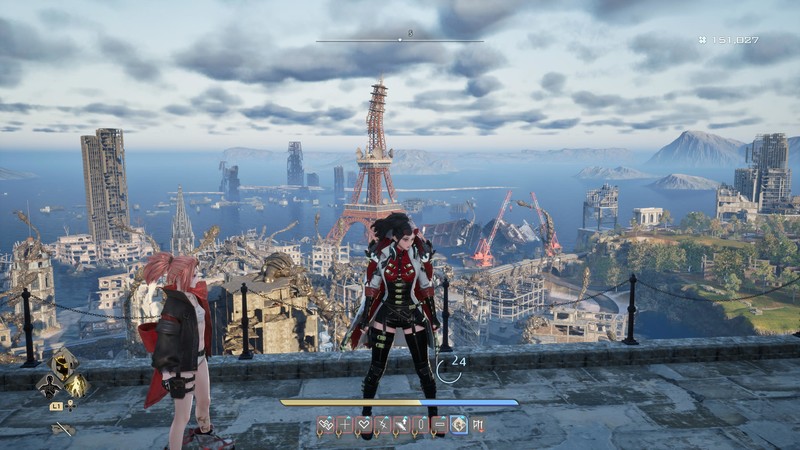 ©Bandai Namco Entertainment Inc. You also have a variety of NPC partners to adventure with (who level up in power according to your base level). They can either fight alongside you or merge with you, increasing your stats. They act as an extra life when you die, bringing you back at low health in exchange for their own lives, as well. (Don't worry. They're vampires. They get better.) Interestingly, some of the NPC partners will refuse to leave your body and aid you in actual combat, which can result in a major difficulty spike late in the game if you've become too dependent on always having an advantage in numbers. When it comes to the general gameplay flow for Code Vein II, you first enter a new area and find the hero's cocoon. Then you time-travel to the past, do two or three missions with the associated hero, and return to the future and kill them. Of course, this is just the bare minimum, as each area map is huge and there are tons of additional places to explore—but even that is just the start of it. In this time travel adventure, you encounter two full versions of the world map. 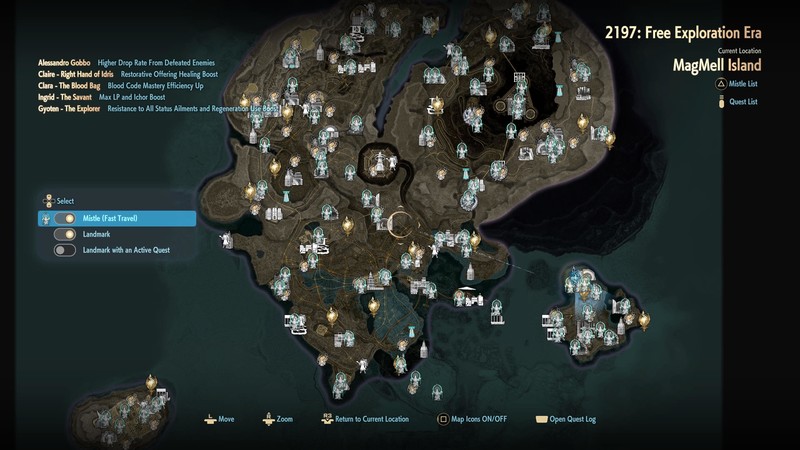 ©Bandai Namco Entertainment Inc. The first is the present. In this world on the edge of ending, many areas are closed off to start (and stay that way until you finish the corresponding area in the past). The other map is that of the past. Initially, you are locked into a specific zone per character, but once their main story is completed, you can return to the past (though to a slightly different time period) and do anything you might have missed. Not only are there more than a few changes between the two maps in terms of where you can access, but the enemies (outside of dungeons) are also largely different as well. Speaking of the landscape design, overall, it does a great job with how it handles verticality. Both in dungeons and across the world map in general, height is used to tease you—to show you a location far above or below and challenge you to figure out how to get there. Likewise, the interactive map is a good one. It contains topographical lines that do a great job of showing the elevation (even if, in one particular zone, its lack of layers makes an entire part of a zone hidden from view on the map). It also has several solid quality-of-life additions. Dungeons, their entrances, and other important locations are marked in bright yellow. Likewise, the items that increase your amount of healing charges appear on the map as blue dots, and the area buff altars get their own special icon to help you find them as well. 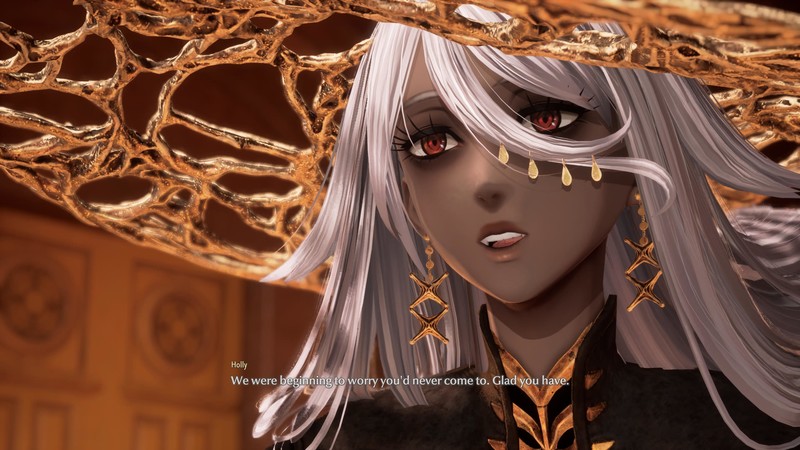 ©Bandai Namco Entertainment Inc. Of course, as alluded to at the start of this review, the biggest difference between this game and its Soulsborne inspirations is the story and how it is told. Rather than simply killing the big bosses, you time-travel into the past and befriend them. You help them overcome their struggles, both professional and personal—and gain a symbol of emotional connection between you and them in the process. This is the key to unlocking their cocoons; you don't break them open, you entice the heroes to emerge on their own. This process adds a major emotional element to the game. You spend several hours at the very least with each main boss. As you help them and create a lasting connection, you also learn about what would cause them to be willing to step up and become self-sacrificing heroes—and spend 70 years in pain transforming into monsters due to that choice. Then, you return to the future to kill them—even if it's basically a mercy at this point. 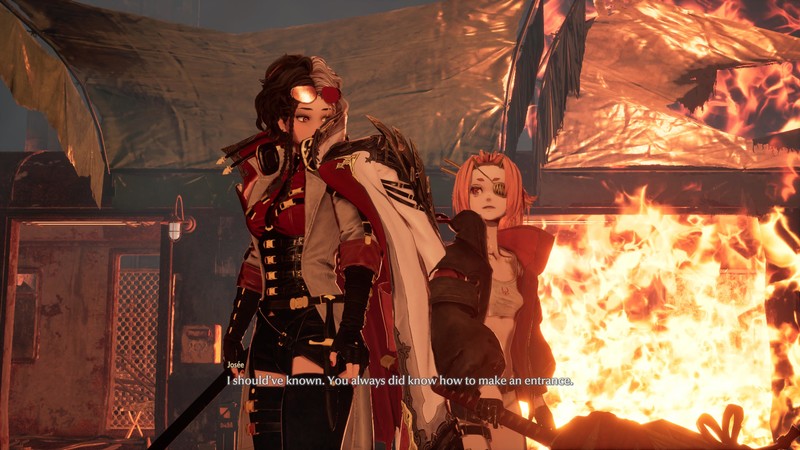 ©Bandai Namco Entertainment Inc.©Bandai Namco Entertainment Inc. As each hero kill leaves you with a bad taste in your mouth, the game taunts you with the possibility of traveling back once again to help each hero at their lowest point—even though the more you change the past beyond what is necessary, the more uncertain saving the world becomes in the present. This is the big, ethical time travel dilemma at the core of the story. Pragmatically, for the sake of the world, you should only do the bare minimum and stick to the plan. Emotionally, you want to help the suffering of those you have come to care about on a personal level—even if it might actually bring about the end of the world. It's up to you to make your choice. While Code Vein II has a lot of positives going for it, there are some notable, if small issues. For the size of the game, the enemy variety is lacking. You will fight the same basic enemies from start to finish. Or sure, sometimes their design is different, or it's a spooky ghost version, but the attacks are nothing hard to deal with as they are linked to which type of weapon is equiped. Moreover, most, if not all, of the normal enemies will appear as a boss in one dungeon or another (with extra HP and damage). On the other side of the enemy spectrum, some of the bosses and late-game enemies (which you will also fight enough times to get tired of them) have combos that either seem to go on forever or they fire off spells in a machine gun-like fashion. These attacks feel nearly impossible to dodge without specific dodge boosting skills active. This gets even more frustrating when these enemies are encountered in groups alongside other enemies. I also found some of the boss arenas to be annoying at times—either getting pushed into odd corners or caught on some ankle-high piece of floor geometry. My NPC partners also had issues traversing the general environment from time to time—especially in enclosed locations. Usually, if they were obstructed, they would teleport to me automatically. However, sometimes they would fall to a lower level or simply not follow me through a narrow hallway—forcing me to manually merge with them (often while in combat) to get them unstuck. 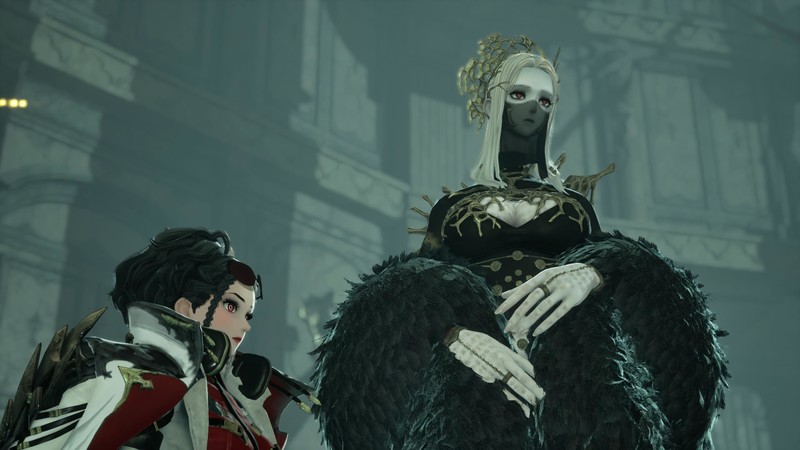 ©Bandai Namco Entertainment Inc. However, the most aggravating problem I had was a glitch with the controller mapping. (Note: I played on a pre-release version of the game, so any glitches I mention in this review may be fixed by the time of actual release.) The first thing I did upon booting up the game was remap the controls to be similar to Elden Ring. This put the item pick-up/interact button on the triangle. It was several hours into the game (when I was long used to playing this way) that I encountered the issue. When diving into the various characters' memories, the triangle button becomes mapped to the “skip” command—i.e., holding it ends the memory immediately and skips that part of the story. At the end of most memories, you can talk with the person whose memory you are in, which is also the triangle button. Tapping the triangle at this point does nothing. Then, when I tried to remap the button, I couldn't because the “apply” button for remapping is, you guessed it, triangle. The only choice I had was to reset the controller to default and then remap the whole controller to my liking once again when the memory was over. From then on, whenever I saw a memory trigger, I remapped my interact button—but more than once, there was no way to know one was coming. I must have had to remap my controller a good five or six times total. 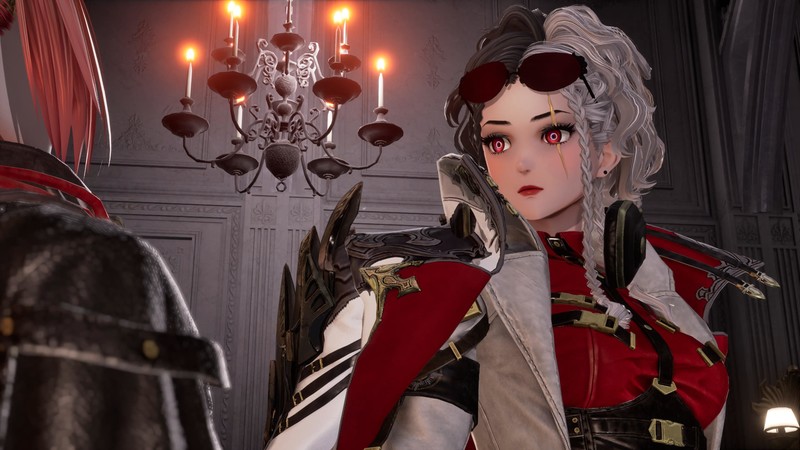 ©Bandai Namco Entertainment Inc. When it comes to the game's graphics, it ranges from good to great 95% of the time. The environments are visually distinct and creatively laid out. The character creator is downright amazing. I spent a good three hours designing and redesigning my character—and could have spent far more if I really got into the real nitty-gritty of character customization. The only real issue with it is one of clipping. Hair and accessories clip through clothing rather than interact with them, which can make your character look really bad at times, especially compared to the NPCs who suffer no such issues. The only other graphical issue I encountered was one of draw distance. There is noticeable pop in (at least on a standard PS5). You'll be running through an empty field when, suddenly, a giant monster that should have easily been visible appears a couple of hundred feet off. With items, it was even stranger as I would see one twinkling while turning the camera, only for it to disappear when I focused directly on it—and then it would pop back into existence a second later. The music is fantastic with an orchestral score that fits the fantasy feel of a vampire post-apocalypse. The main boss themes and in-memory themes are particularly memorable—as is the musical spectacle of a certain scene late in the game. The only audio glitch I encountered in the game involved the standard boss battle song continuing long after the boss battle ended. Even starting conversations, teleporting to new zones, and traveling through time didn't stop it. (Luckily, rebooting the game did.) 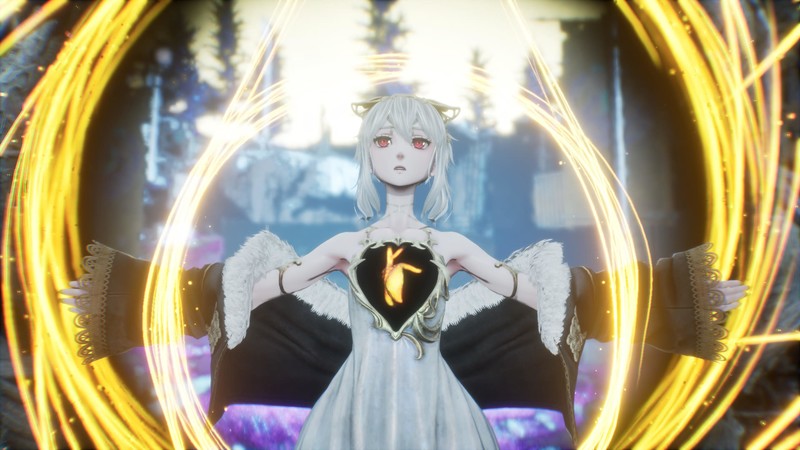 ©Bandai Namco Entertainment Inc. All in all, as a person who loved Elden Ring so much he's spent the last few years playing through every Soulsborne and Soulslike game he could get his hands on (including the first Code Vein), this game scratches that itch perfectly. While the gameplay at times lacked a bit of polish, the front-and-center plot with its tragic characters and time-travel-based ethical dilemma more than made up for any technical issues. If you like Soulsborne games and think a game about time-traveling post-apocalyptic vampires sounds like fun, then don't hold back—this is the game for you. (And don't worry if you haven't played the first game. They're basically unrelated beyond how vampires work and being set in a post-apocalypic world.) |
|
The views and opinions expressed in this article are solely those of the author(s) and do not necessarily represent the views of Anime News Network, its employees, owners, or sponsors.
|
| Grade: | |||
Overall : B+
Graphics : B+
Sound/Music : B
Gameplay : A-
Presentation : B+
+ Post-apocalyptic time traveling vampires. (Also an ethical dilemma built around altering the past and the fact the the main bosses and your party members are one in the same.) |
|||
|
discuss this in the forum |
bookmark/share with:

|
|||