

Spring 2026 Manga Guide
Akira Failing in Love
What's It About?

Akira returns to the countryside for high school with a foolproof scheme to win the heart of her childhood crush, Hajime. Too bad they're both fools in love!
Highlights of Akira's carefully orchestrated strategy to court Hajime include covering his eyes with her hands, tricking him into saying her name, and making his heart race. But she might have better luck impressing him with her academic and athletic prowess. Or not. Because he's too dense to figure out she likes him. And she's too dense to figure out he likes her back!
Akira Failing in Love has story and art by Shinta Harekawa. English translation is done by John Werry and lettering by Evan Waldinger. Published by Viz Media (March 10, 2026). Rated T.
Is It Worth Reading?
Erica Friedman
Rating:
Akira Momose and Hajime Kugayama went to school together when they were children. Now, Hajime is back in town and he'd like to tell Akira that he likes her. When she tackles him to find out what food he like, he is overwhelmed and barely able to answer. He immediately thinks Akira hates him, while she is telling her friends how successful her plan was. These two, with their completely different incoherent communication styles, are unable to recognize the simple fact that they actually both like one another.
This is pure sit-com, where the “sit” is that Akira is overly aggressive and Hajime a raging dork. When he speaks, it is some random uninteresting factoid. When they finally do talk, it turns out that Hajime was wrong about Akira all along. And there are wild pigs.
You know from the opening that this manga is meant to be wacky, with a verrrry light sprinkling of actually opening up to one another, then more wacky. The series will undoubtedly continue as long as the author can think of gags. Luckily, all the usual school life scenarios present themselves for maximum comedic misunderstandings and shenanigans.
The art favors beautifying Akira with flowery pages and making Hajime looks like an overacting dork, even when he's doing something athletic or heroic. This is meant as a straightforward romantic comedy where “not being able to communicate” is both the comedy and the romance. As such, it's not for me, but I could see other people enjoying it for the gags, which are refreshingly light-hearted and also unrealistically ridiculous.
Presumably, Alira and Hajime will get closer little by little in future volumes; when locked in the storage closet or from a fake kiss during the school festival. There are so many adorable ways for them to just misread each other, for volumes to come.
Bolts
Rating:
If a story or series is only about one joke or one idea, it must commit. I don't even need to find the joke funny, but I need to respect or have some kind of reverence for how far a series is willing to go with whatever idea it's willing to push. I've read a lot of comedies and slice-of-life stories that revolve around one joke or one repetitive idea. If a writer or artist can learn to get creative with the idea or push the boundaries, then I can, at the very least, respect what I'm reading, even if it's not intended for me. That being said, I love comedies based around misunderstandings because that scenario is primed for exaggerated comedic potential. Akira Falling In Love is the type of series that does that.
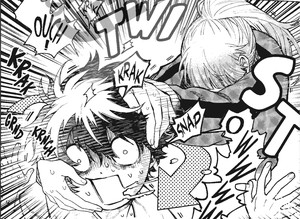
I was impressed with how I found myself laughing while reading this, even though almost every chapter was structured the same way. There's an overly excited boy who ends up misreading a situation brought about by his incredibly stoic, socially awkward crush? Yeah, that checks out. Throw in some incredibly exaggerated slapstick with snappy panel framing, and there I was on the floor laughing. The great thing about setups like this is that even though there is clearly a formula in place, the comedy and appeal come in the gap between what a character wants to do and ends up doing. The wider the gap between those two things, the greater the comedic potential is. If a socially awkward girl wants to approach her crush by sneaking up behind him and whispering in his ear, but grabs him in a surprisingly threatening way instead, that's hilarious.
The art really carries a lot of this exaggeration and these misunderstandings because of how they recontextualize a lot of the characters' actions. Almost every chapter pretty much frames the characters in both a really cute light and a really twisted one. There's a rough sketchy style to it, which matches the more countryside setting that the characters reside in. If the art wasn't as detailed and impactful, then the comedy wouldn't work as strongly, but with the way that it is, it's a perfect compliment. I hope the series is able to maintain this quality beyond the first volume, but only time will tell. If you don't like this kind of humor, this Manga is not going to win you over since it pretty much does exactly what it says it's going to do. But I appreciate the fact that it at least accomplishes that goal well.
Kevin Cormack
Rating:
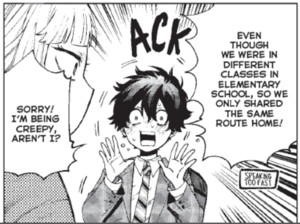
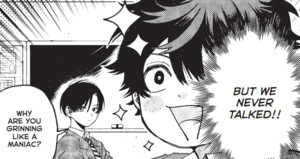
Let's get the nice things out of the way first. Shinta Harekawa's art is really beautiful, especially the way he draws Akira, the main female love interest of the male protagonist Hajime. Akira is properly adorable, with huge eyes all the wider due to her crippling anxiety. Her bizarre behavior drives much of this romcom's plot, and at least at the beginning, it's quite funny. Akira and Hajime are childhood “friends” reunited in high school after years apart. As elementary school kids, Hajime used to talk her ears off every day on the way home from class, yet Akira never replied, and Hajime was so dumb to realise they went to different schools and only happened to share a walking route. We eventually learn that Akira's totally unable to have a functional conversation with Hajime without detailed, written plans to coach her on appropriate topics. It sounds exhausting, and after a few chapters, it is.
Considering the evidence provided by its first volume, Akira Falling in Love is one of those romcoms with a repetitive central joke, iterated on to increasingly absurd extremes, with a minimum of actual plot or relationship development achieved over any number of chapters. I was tired of this schtick decades ago. Perhaps something happens in later volumes, but I'm unlikely to stick around. No matter how beautiful and detailed the artwork is, if the humor is as repetitive and uninspired as this, I don't care. Repeated episodes of Akira getting flustered over completely innocuous events, resulting in her physically assaulting the object of her affections, were barely funny the first time, but the sixth or seventh? Unbelievably tiresome. This kind of manga makes me feel I'm too old for this high school romcom nonsense. I just have to remember there are many better entries in this genre, like Horimiya and Aharen-san, that transcend these limitations. You'd be much better off checking those examples out instead.
The views and opinions expressed in this article are solely those of the author(s) and do not necessarily represent the views of Anime News Network, its employees, owners, or sponsors.
discuss this in the forum (3 posts) |

this article has been modified since it was originally posted; see change history
back to Spring 2026 Manga Guide
Seasonal homepage / archives